
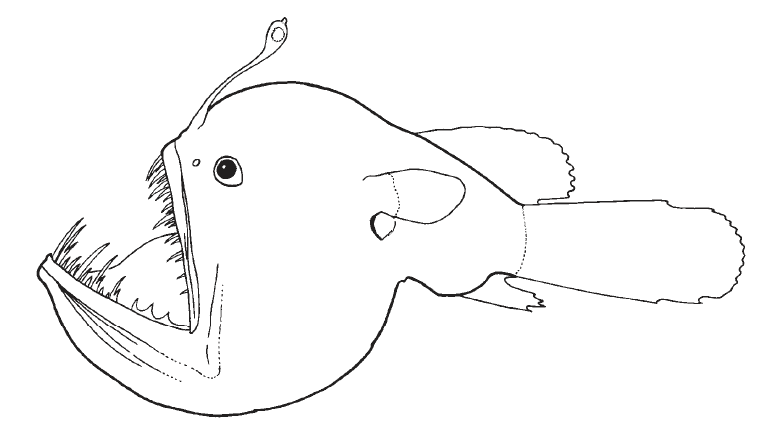
Source: FAO 2002.
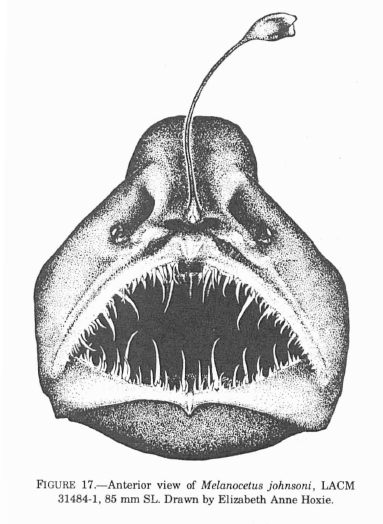
Source: Pietsch and Van Duzer 1980.
| Family | Scientific Name | Author | Year | Common Name |
| Melanocetidae | Melanocetus johnsonii | Gunther | 1864 | Humpback Blackdevil |
Melanocetus johnsonii
Unique Characteristics: Extreme sexual dimorphism in which males are dwarfed and reach only a fraction of the size of females. Females attaining a length of 12 cm, males 2.8 cm. Soft dorsal fin with 12-17 rays; anal fin with 4 soft rays (very rarely 3 or 5); pelvic fins absent.
Females with body short, deep, globose; first dorsal-fin spine (illicium) short, less than 70% length of head and body, bearing a conspicuous terminal bioluminescent bait (esca); bait without filaments or appendages. Snout and chin smooth, without papillae. Sphenotic spines absent; skin smooth, appearing naked.
Males free-living, not becoming parasitic on females, with eyes large, elliptical, directed laterally. Olfactory organs large. Skin spinulose; a median series and 2 or 3 transverse series of denticular teeth on snout, all fused at base. Lower denticular teeth in a median and 2 lateral groups fused at base.
Color: dark brown to black over entire surface of head and body (except for distal portion of bait); fins colorless in adolescent females.
Similar Species: None
Reference
Pietsch, T.W. and J.P. Van Duzer. 1980. Systematics and distribution of ceratioid anglerfishes of the family Melanocetidae with the description of a new species from the eastern north Pacific Ocean. Fishery Bulletin 78 (1):59-87.