
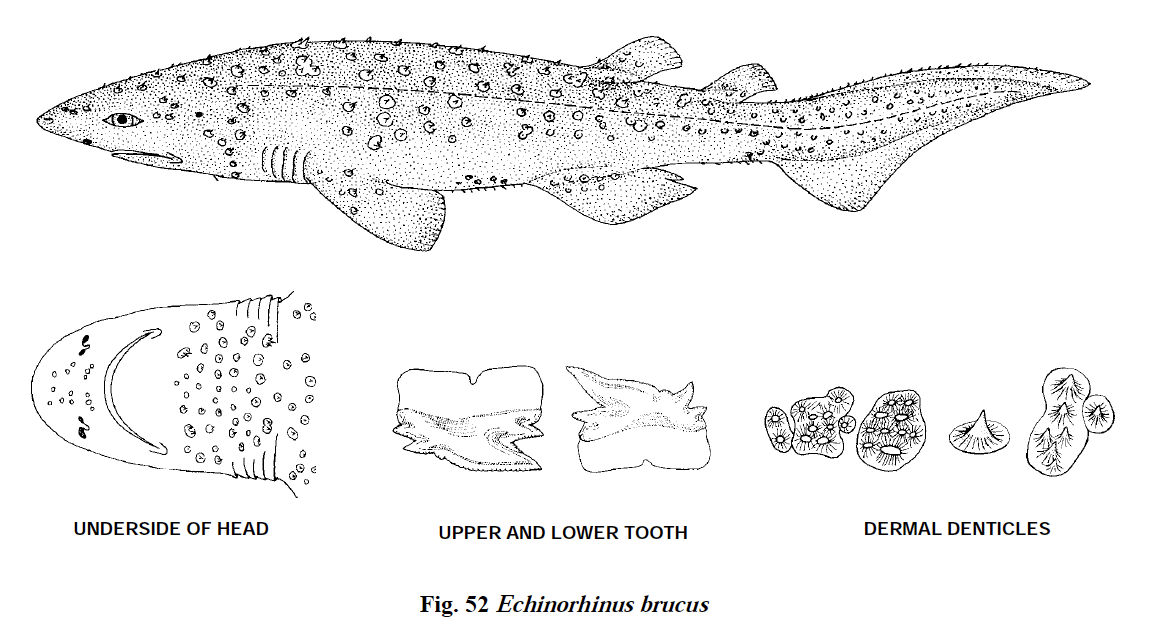
Source: FAO 2013
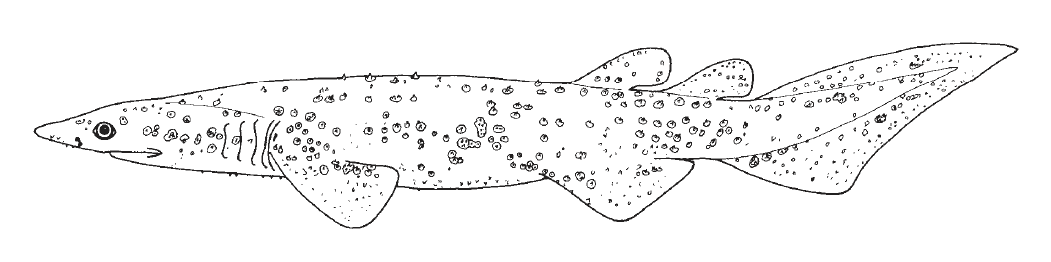
Source: FAO 2002.
| Family | Scientific Name | Author | Year | Common Name |
| Echinorhinidae | Echinorhinus brucus | (Bonnaterre) | 1788 | Bramble Shark |
Unique Characteristics: Large sharks with stout cylindrical bodies and no abdominal ridges. Head moderately depressed; last (fifth) gill slits abruptly expanded in width; spiracles present, very small, well behind eyes; nostrils far apart from each other. Snout short; mouth broadly arched, with very short labial furrows that do not encircle mouth, lips not papillose. Teeth alike in both jaws, strongly compressed and blade-like, with a cusp and up to three side cusplets in adults. Two small spineless posterior dorsal fins, both smaller than the pelvic fins, situated close together, the origin of the first dorsal fin behind the pelvic-fin origins; anal fin absent; caudal fin without a subterminal notch. Dermal denticles very large and thorn-like (FAO 2002).
Field Marks: Short–nosed and flat–headed with a cylindrical, heavy–body. Short–tailed with no anal fin. Two very small, spineless, posterior dorsal fins, the first behind the pelvic origins, and covered with coarse spiky denticles or enlarged tack–like thorns (FAO 2013).
Similar Species: None
Reference:
(FAO 2013) Ebert, D.A. and M.F.W. Stehmann. 2013. Sharks, batoids, and chimaeras of the North Atlantic. FAO Species Catalogue for Fishery Purposes. No. 7. Rome, FAO. 523 pp.