
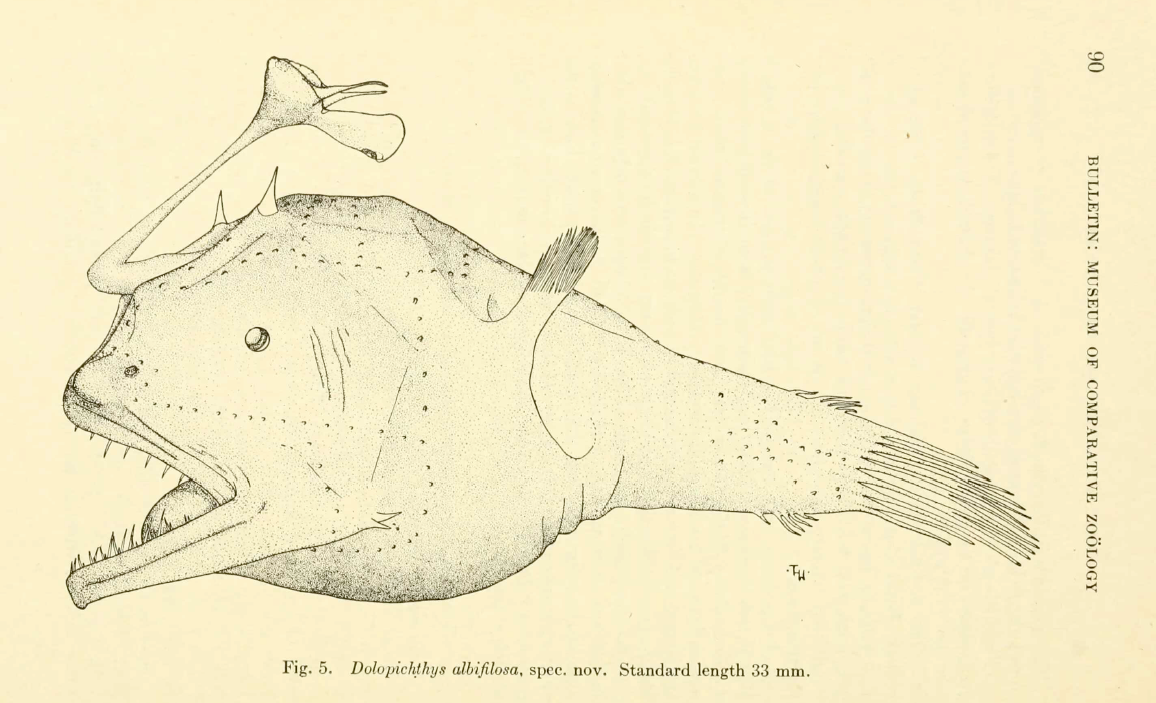
Note: Dolopichthys albifilosa Waterman 1939 was synonymized with Danaphryne nigrifilis – https://researcharchive.calacademy.org/research/ichthyology/catalog/fishcatmain.asp, accessed July 13, 2026).
| Family | Scientific Name | Author | Year | Common Name |
| Oneirodidae | Danaphryne nigrifilis | (Regan & Trewavas) | 1932 | Dana Dreamer |
Danaphryne nigrifilis
Unique Characteristics:
Holotype, Catalogue No, 35067, Harvard Museum of Comparative Zoology
Total length 45 mm., standard length 33 mm. Illicium suprafrontal, length from articulation with basal bone to distal end of escal bulb 14 mm. (41% S. L. or 2.4 times as long as the exserted part of the basal bone in the present condition of the specimen). Bulb of esca about 20% of length of illicium from basal bone articulation. Length of lower jaw 14 mm. (41% S. L.); lower jaw with symphysial spine. Large sharp sphenotic spines present; also 2 articular spines on each side, less than half the size of the sphenotics. Fin rays. D.5, A.5, P.17. Branchiostegal rays 6 (2+4); pectoral radials (pterygials) 3 (1+2).
Dentition. Teeth slender and acicular, depressable inwards. Lower jaw: 24 teeth on each side arranged in three series of different sizes. Upper jaw: 24 in a single series on each premaxillary (only 7-8 of these evident without partial dissection); maxillary toothless. Upper and lower pharyngeals and palatines toothless. Two teeth on each side of vomer.
The esca consists of a laterally compressed terminal expansion of the illicium enclosing within it an ovoid bulb. On the median anterior aspect of the latter is a low papilla projecting anterodorsally. Just posterior to this and running laterally are two slightly raised areas; between these and in the median line is a ridge which runs posteriorly and bifurcates over the posterior portion of the bulb. Each limb of this bifurcation gives rise to a stout, rapidly tapering filament one-fourth as long as the illicium from basal bone articulation to distal end of bulb. A loose transparent layer of tissue covers the distal part of the bulb and terminates posteriorly in a little upstanding ruffle on the antero-median surface of each of the escal filaments. Posterior to the latter and in the median sagittal plane the escal bulb bears a large vane-like, laterally compressed appendage three-tenths as long as the illicium. Distally on the ventral margin of this appendage there is a subspherical heavily pigmented body with a ventrally directed white spot (light organ?). The remaining pigmentation of the whole structure is as follows: the inner bulb of the esca, the proximal part of the latter where it expands from the illicial stem, and the median ridge running posteriorly from the papilla, are all heavily pigmented. The two raised areas just behind and lateral to the papilla, the ventral part of the compressed appendage and the anteromedian aspect of the escal filaments are lightly pigmented by a few scattered granules. The remaining parts of the esca including the rest of the two filaments are whitish.
The nostrils are short and tubular with two openings distally ; lateral line organs on tags or flaps of pigmented skin with terminal white spots are present on the head and body. An unusual aggregation of these organs occurs caudally between the opposed soft dorsal and anal fins. The skin is smooth and jet black (Waterman 1939).
Reference:
Waterman, T.H. 1939. Studies on deep-sea angler-fishes (Ceratioidea). Bulletin of the Museum of Comparative Zoology, 85 (3): 65-94.