
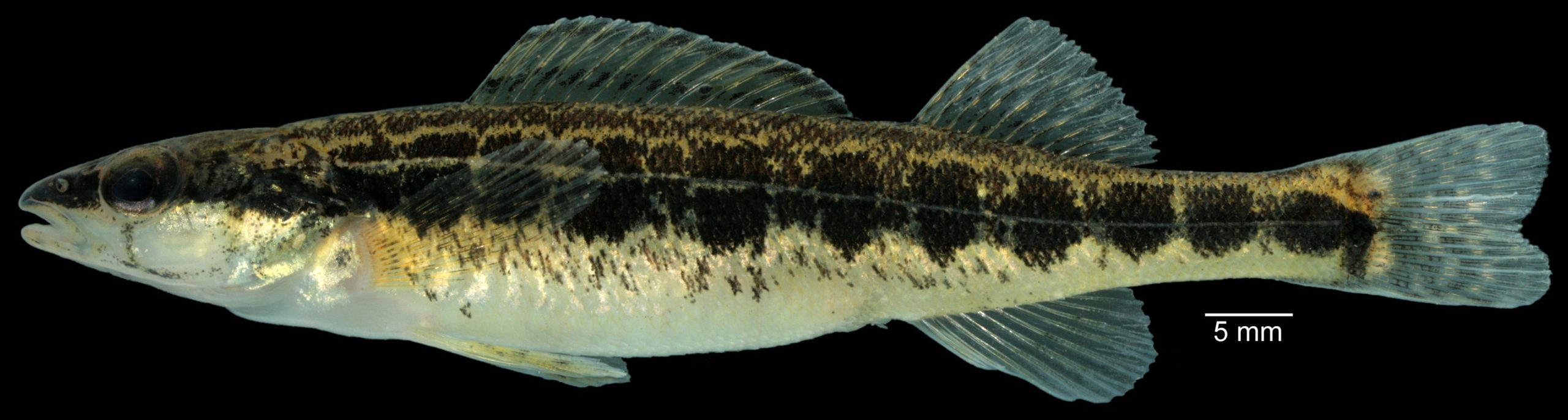
Photo Credit: Dave Neely
| Family | Scientific Name | Author | Year | Common Name |
| Percidae | Percina williamsi | Page and Near | 2007 | Sickle Darter |
Percina williamsi
Unique Characteristics: Belly and interpelvic area with 1 or more highly modified (enlarged, often strong-spined) modified scales. Gill membranes narrowly joined, 40-50°. Snout pointed, narrow. Dorsum uniformly pigmented, without distinct saddles. Sickle-shaped subocular bar curving posteriorly. Black bar subtending a medial black spot on the caudal-fin base. Spinous dorsal fin 14-16. Cheek and breast usually scaled. Small black spot at base of caudal fin.
Distribution in North Carolina: Sickle Darter is known only from a single specimen collected by Drs. E. C. Raney and E. A. Lachner (Cornell University) on April 04, 1940 from the French Broad River (French Broad River basin) near Skyland in Buncombe County (Tracy et al. 2020). It is considered extirpated in North Carolina.
Similar Species: None
References:
Page, L. M., and T. J. Near. 2007. A new darter from the upper Tennessee River drainage related to Percina macrocephala (Percidae: Etheostomatinae). Copeia 2007:605-613.
Tracy, B. H., F. C. Rohde, and G. M. Hogue. 2020. An annotated atlas of the freshwater fishes of North Carolina. Southeastern Fishes Council Proceeding. No. 60. Volume 1. 198pp. 10.7290/sfcp60gca7.