
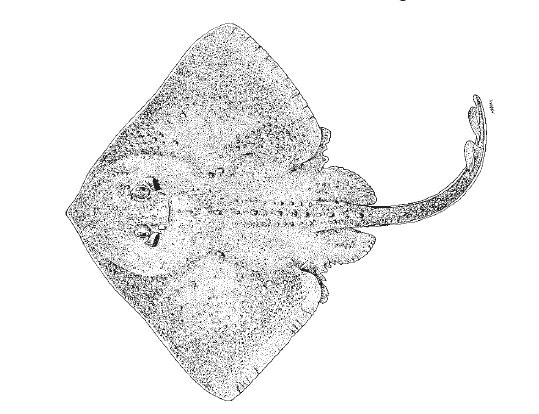
Source: FAO 2002.
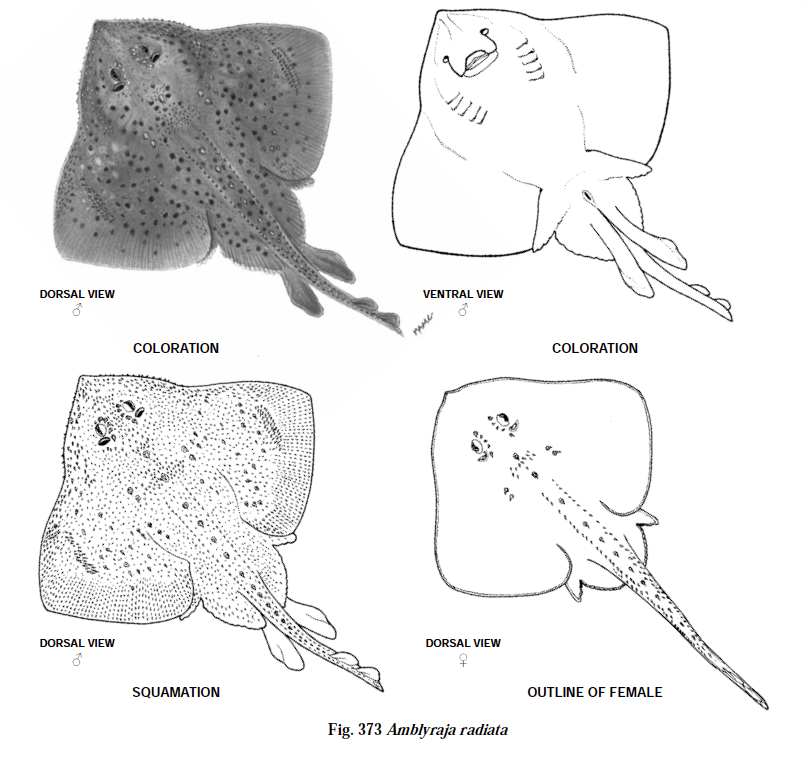
Source: FAO 2013.
| Family | Scientific Name | Author | Year | Common Name |
| Rajidae | Amblyraja radiata | (Donovan) | 1808 | Thorny Skate |
All Amblyraja Species:
Snout moderately long to short, anterior disc margins somewhat convex, slightly concave or undulated; a theoretical line from snout tip to pectoral wing tip touching or cutting front margin of disc; internasal width usually more than 70% of the distance from one nostril to snout tip; thorns always present on disc, at least on head.
Upper side of disc and tail totally or partly covered with coarse, less densely set dermal denticles; underside of tail usually smooth. Median row thorns on tail may show somewhat reduced size rearward, but are always set continuously to origin of first dorsal fin.
Disc shape subquadrate to subrhombic, outer corners angular. Tail length shorter than body. Thorns on head set individually at orbits, on nape and shoulders; median row of distinct thorns from nape to first dorsal fin always present, may only be incomplete, or interrupted on back of trunk in large specimens, particularly in mature males. Thorns conspicuously large, with high basal cones distinctly ribbed and on radiated basal plate. Claspers of mature males massive, with club-shaped, widened glans.
Amblyraja radiata
Unique Characters: Less than 50 tooth rows. Medium greyish-brown above, clouded with darker and few pale white blotches, also often with blackish dots arranged as rosettes; underside white, occasionally with small dark blotches and greyish disc margins.
Similar Species:
Amblyraja jenseni, Shortail Skate
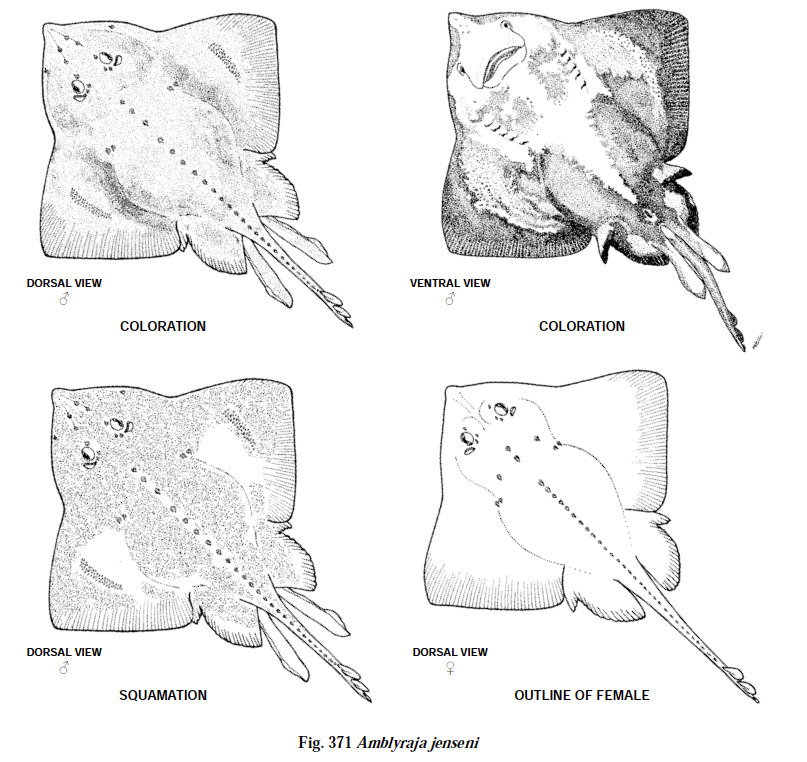
Source: FAO 2013.
Shortail Skate, Amblyraja jenseni. Jaw teeth set in 52-66 largely parallel rows. Upper side dark grey to brown, but specimens of all sizes also found plain whitish; underside white with large dark markings only in young, larger specimens increasingly dark blotched to become nearly totally dark in adults with only few white markings left at mouth and along midbelly.
Reference
(FAO 2013) Ebert, D.A. and M.F.W. Stehmann. 2013. Sharks, batoids, and chimaeras of the North Atlantic. FAO Species Catalogue for Fishery Purposes. No. 7. Rome, FAO. 523 pp.