
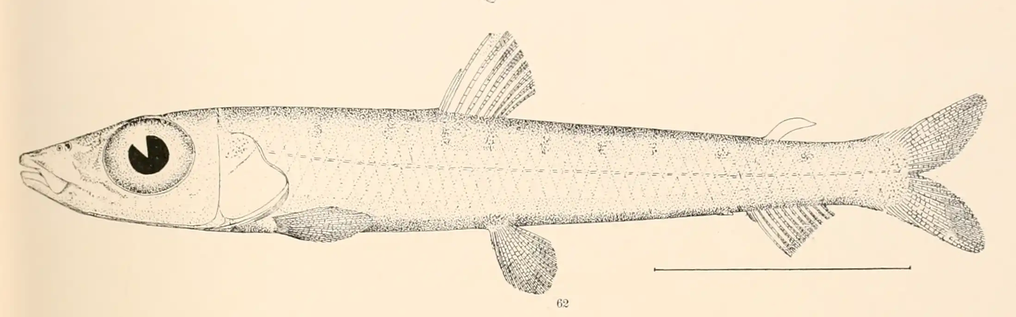
| Family | Scientific Name | Author | Year | Common Name |
| Argentinidae | Argentina striata | Goode & Bean | 1896 | Striated Argentine |
Family Argentinidae — Small-sized (10 to 70 cm) with elongated, robust body, usually convex head profile. Small terminal mouth, ending in front of eye; teeth absent on premaxillary and maxillary. A single dorsal fin with soft rays near the midpoint of body, followed by an adipose dorsal fin on the posterior 1/4 of the body above anal fin. Pectoral fin placed low, on the ventrolateral contours of body. Pelvic fins beneath or behind dorsal fin. No spines in fins. Dorsal fin with 10-14 rays, anal fin with 10-17 rays, pectoral fins with 11-25 rays, and pelvic fins with 10-15 rays.
Argentina striata
Unique Characters: Dorsal fin begins above a point behind tip of pectoral fin. Scales lack tiny spines. Gill rakers on upper arch 7 or fewer; rakers quite robust and conical. Lower gill rakers 7 or fewer.
Similar Species:
Pygmy Argentine
Glossanodon pygmaeus
Atlantic Argentine
Argentina silus
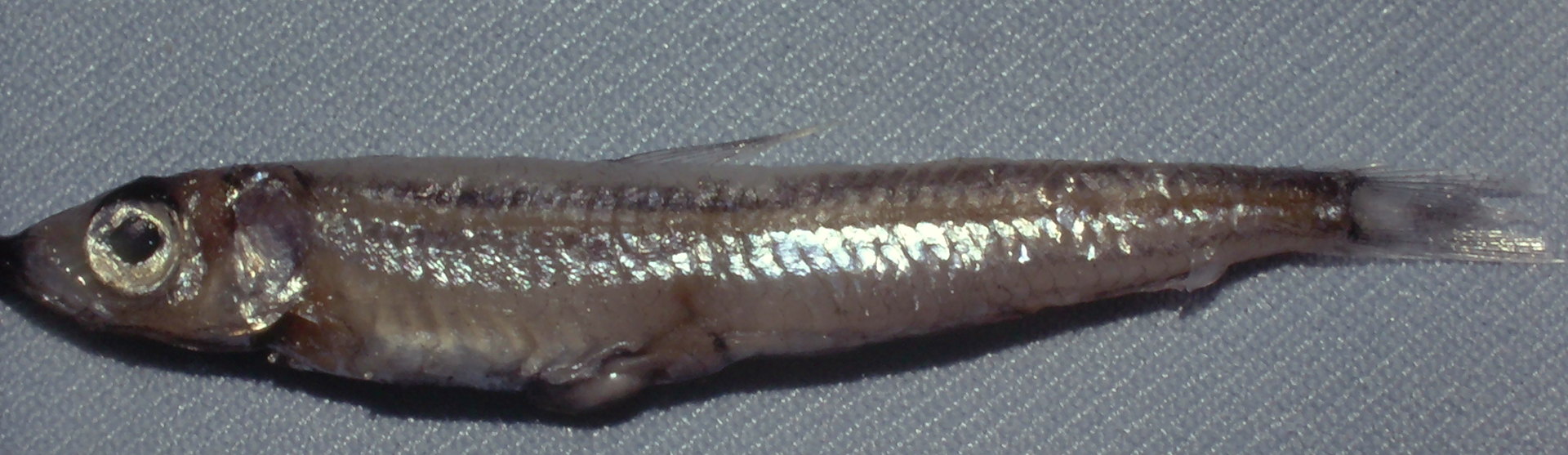

Pygmy Argentine, Glossanodon pygmaeus. Gill rakers on upper arch 10 or more; rakers thin and long.
Atlantic Argentine, Argentina silus. Dorsal fin begins above or nearly above tip of pectoral fin. Scales with tiny spines on exposed parts. Gill rakers on upper arch 7 or fewer; rakers quite robust and conical. Lower gill rakers 13 (11-15).
Reference:
Goode, G.B. and T.H. Bean. 1896. Oceanic ichthyology, a treatise on the deep-sea and pelagic fishes of the world, based chiefly upon the collections made by the steamers Blake, Albatross, and Fish Hawk in the northwestern Atlantic, with an atlas containing 417 figures. Special Bulletin U. S. National Museum No. 2: Text: i-xxxv + 1-26 + 1-553, Atlas: i-xxiii, 1-26, 123 pls.