
| Family | Scientific Name | Author | Year | Common Name |
| Stomiidae | Astronesthes niger | Richardson | 1845 | Black Snaggletooth |
Family Astronesthidae (genera Astronesthes and Borostomias) – Chin barbel present. Dorsal fin usually near middle of body, its origin about over pelvic fins; dorsal adipose fin present. Anterior portion of lower photophore row curving upward at pelvic-fin base and appearing disjunct from posterior portion of row; postorbital photophore prominent, located posteroventrally to eye. Patches of luminous tissue on body in many species (FAO 2002).
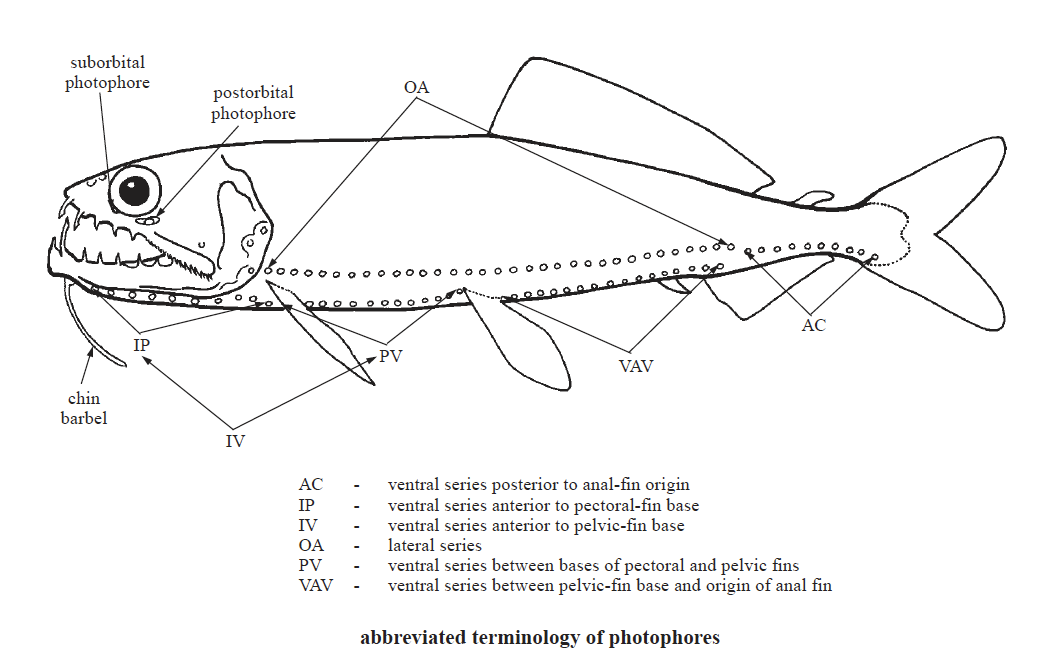
All Astronesthes Species: Body without scales or hexagonal scale pockets. Dorsal fin distinctly anterior to anal fin; adipose fin present. Anal-fin rays 20 or fewer; snout not upturned; gill rakers as 1-4 short teeth set in groups far apart. PV and VAV in a regular, continuous row; total PV photophores 26 or less. Teeth on maxillary comb-like, closely spaced, slanting rearward.
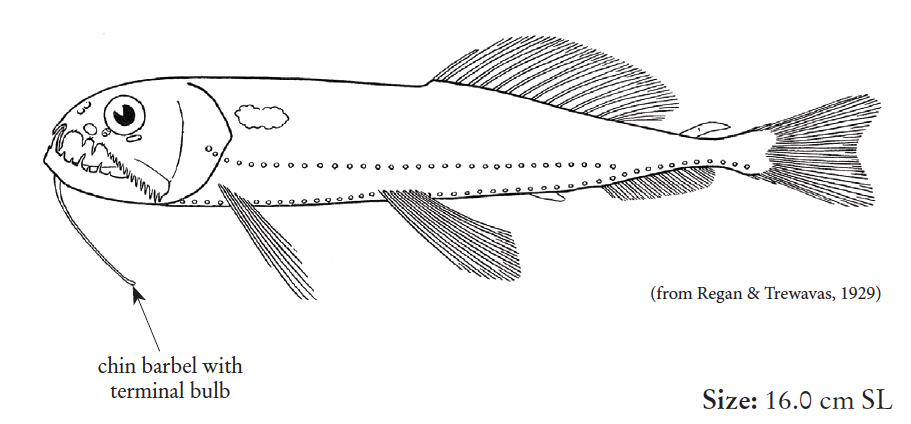
Astronesthes niger
Unique Characteristics: IC photophores 52-56; OA 34-36. Dense aggregations of luminous tissue on head and body. Chin barbel with terminal bulb. Body black (FAO 2020).
Similar Species:
Astronesthes richardsoni, Nobulb Snaggletooth
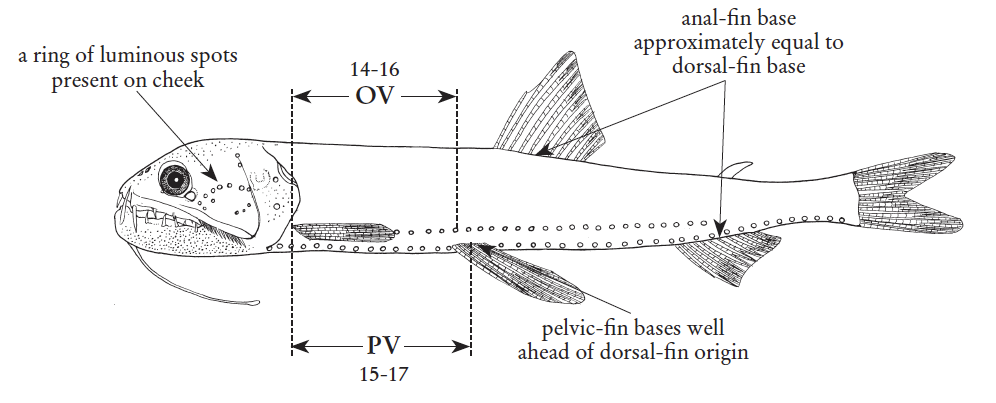
Nobulb Snaggletooth, Astronesthes richardsoni. IC photophores more than 56; no dense aggregations of luminous tissue on head and body. Terminal bulb not pigmented in its posteroventral part. Anal-fin base length approximately equal to dorsal-fin base length; pelvic-fin bases well ahead of dorsal-fin origin. OV photophores 14-16, PV 15-17; a ring of luminous spots present on cheek (FAO 2020).
Astronesthes similus, Similar Snaggletooth
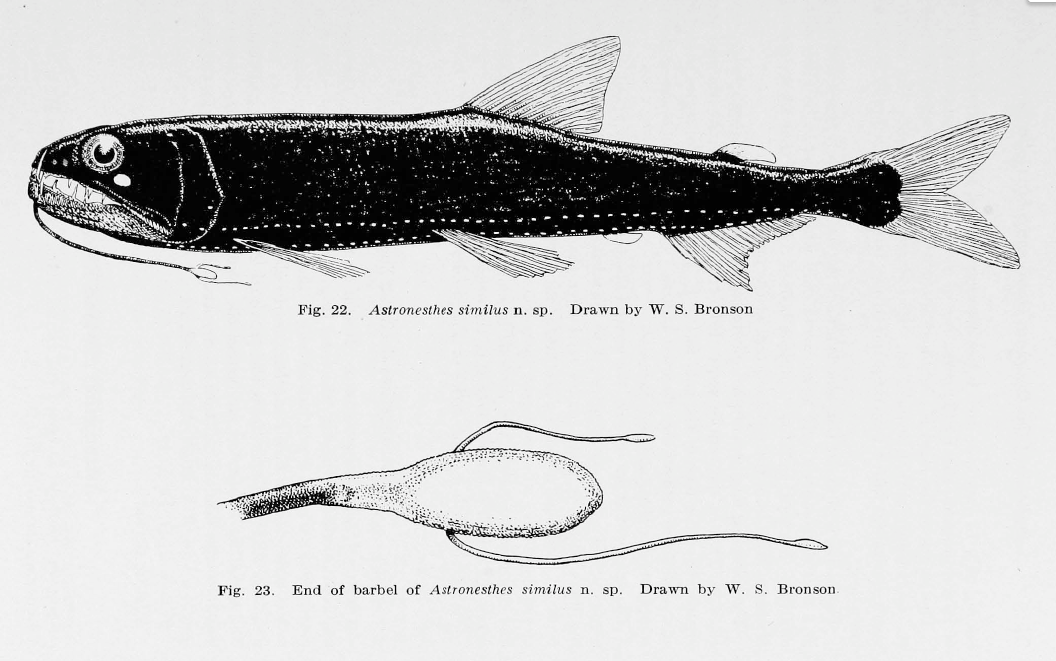
Similar Snaggletooth, Astronesthes similus. Babel about the same length as head; entirely black and ending in a whitish, comparatively large, ovoid bulb which seems to be filled with a multitude of small, globular, luminous bodies. A pair of white, posterior filaments arise from the proximal part of the bulb. Lateral series of photophores: O-V 15, V-A 24; ventral series: I-P 11, P-V 15, V-A 23 (the last three organs above the base of the anal fin) A-C 11. Caudal series straight and continuous without any elevated organs. Suborbital organ globular, comparatively large and conspicuous. Adipose fins narrow, ventral one occupying about one single segment. Adipose ventral fin inserted about four segments behind termination of dorsal fin; adipose dorsal above base of 7th anal ray. Maxillaries with a dense series of oblique denticles (Parr 1927).
References:
FAO. 2002. The living marine resources of the Western Central Atlantic. Volumes 1-3. K.E. Carpenter (ed.). Food and Agriculture Organization of the United Nations, Rome, Italy. 4099 pp. http://www.fao.org/3/y4160e/y4160e00.htm.
(FAO 2020) Sutton, T.T., P.A. Hulley, R. Wienerroither, D. Zaera-Perez, and J.R. Paxton. 2020. Identification guide to the mesopelagic fishes of the central and south east Atlantic Ocean. FAO Species Identification Guide for Fishery Purposes. Rome, FAO. 327 pp. https://doi.org/10.4060/cb0365en.
Parr, A.E. 1927. The Stomiatoid fishes of the suborder Gymnophotodermi (Astronesthidae, Melanostomiatidae, Idiacanthidae) with a complete review of the species. (Scientific Results of the Third Oceanographic Expedition of the “Pawnee” 1927). Bulletin of the Bingham Oceanographic Collection Yale University 3 (2): 1-123.