
| Family | Scientific Name | Author | Year | Common Name |
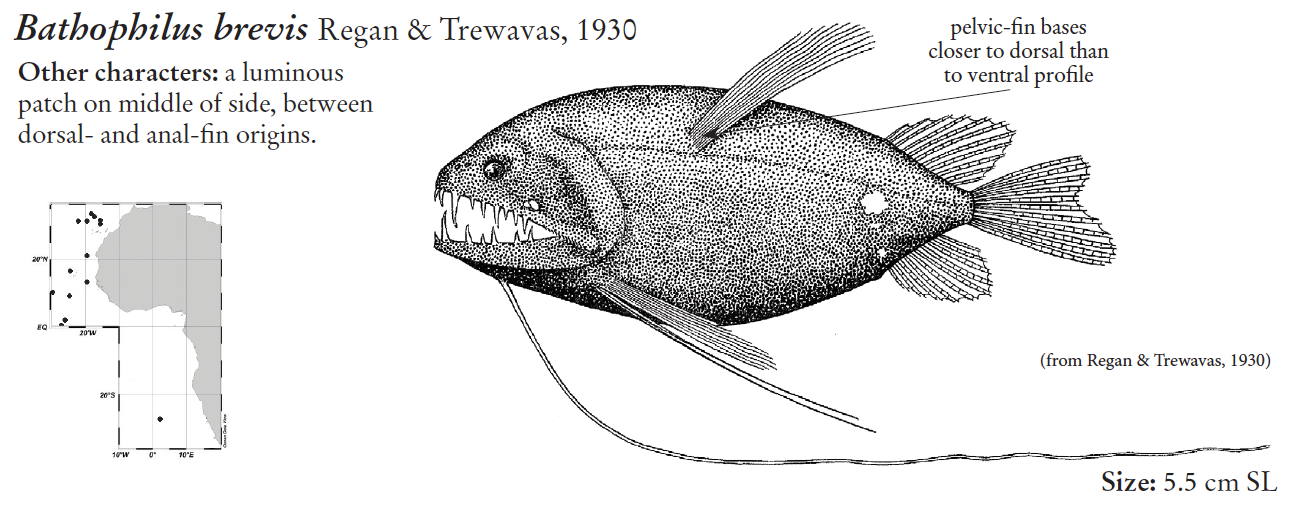
| Stomiidae | Bathophilus brevis | Regan & Trewavas | 1930 | Deepbody Dragonfish |
Family Melanostomiidae (genera Bathophilus, Chirostomias, Echiostoma, Eustomias, Flagellostomias, Gramatostomias, Leptostomias, Melantostomias, Pachystomias, and Photonectes) – Small, oblique denticles posteriorly on maxilla. Chin barbel present; ranging widely in length, with or without branches or terminal elaborations. Dorsal fin located well posteriorly, directly above anal fin; dorsal adipose fin absent (except in Chirostomias). Suborbital photophore absent; postorbital photophore usually present, located posteroventrally to eye, sometimes reduced or absent in females (FAO 2002).
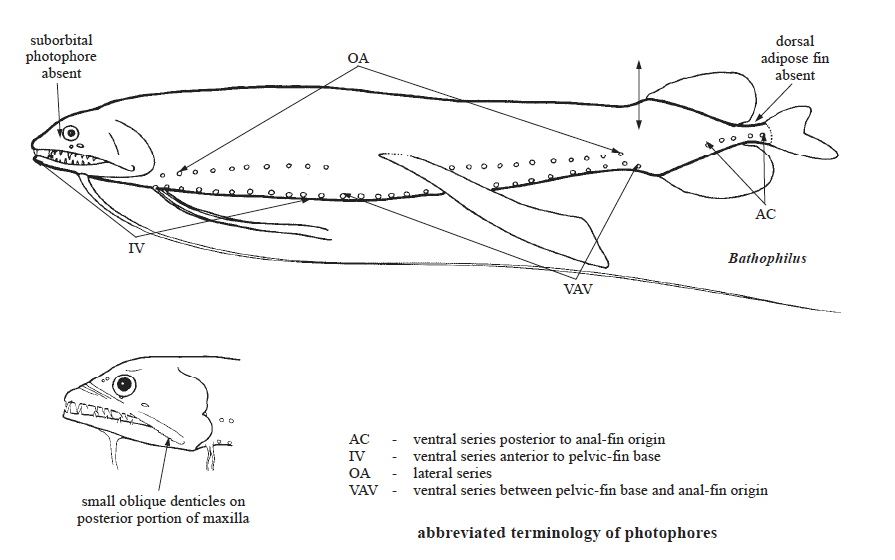
All Bathophilus Species: Ventrals [pelvic fins] inserted far apart, high on the sides of the body. Barbel and rays of the paired fins long and filiform. Suborbital organ and lateral photophores minute (Parr 1927). Body without scales or hexagonal scale pockets. Dorsal and anal fins located near caudal fin; dorsal adipose fin absent. Anal-fin base about equal to dorsal-fin base, its origin opposite to dorsal-fin origin. Mouth with floor, lower jaws connected by membrane. Anal-fin base about equal to dorsal-fin base, its origin opposite to dorsal-fin origin. First mandibular tooth not piercing premaxillary. Pelvic-fin insertion near middle of flank (FAO 2020).
Bathophilus brevis
Unique Characteristics: Pelvic-fin bases nearer to dorsal than ventral profile; body depth around 40% standard length. Pelvic-fin bases closer to dorsal than to ventral profile. Luminous patch on middle of side, between dorsal- and anal-fin origins (FAO 2020).
Similar Species:
Bathophilus altipinnis, Sidefin Dragonfish
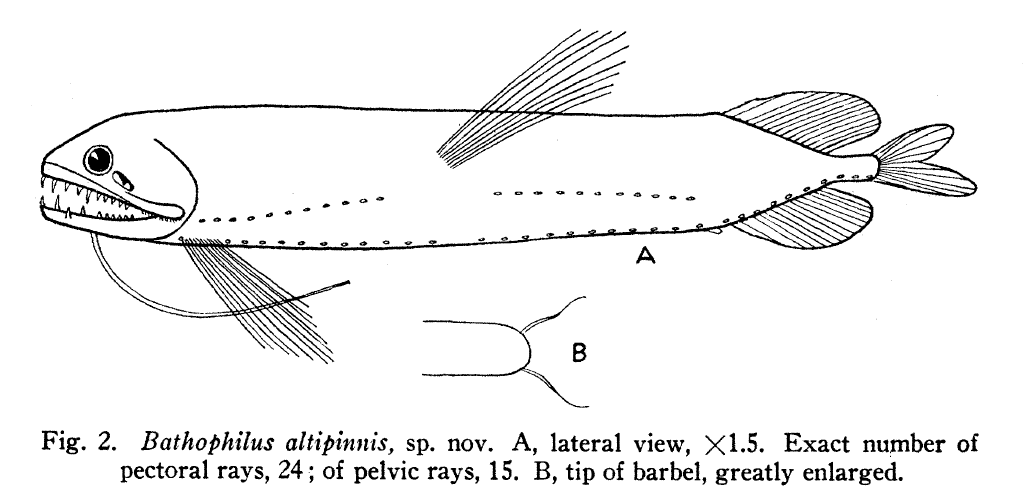
Sidefin Dragonfish, Bathophilus altipinnis. Barbel slender and pure white, tapering very gradually and ending in two short, slender filaments. Serial photophores: lateral series, O-V 13, V-A 11; ventral series, I-P 5, P-V 13, V-A 11, A-C 10. Suborbital photophore is of a flattened, oval shape, and when fully rolled up into view exposes two luminous areas, a small, inferoposterior triangle and a large anterior area, the extreme upper front of which shows in the preserved specimen a white surface, which in the fresh specimen is deep red (Beebe 1933).
Bathophilus digitatus, Twofin Dragonfish
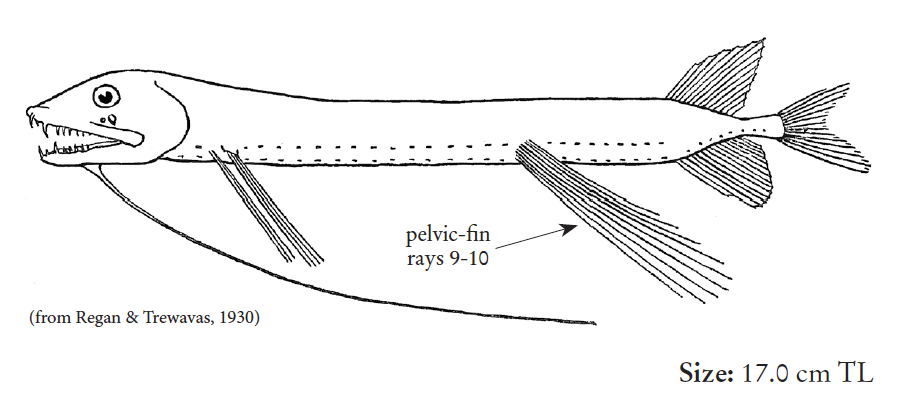
Twofin Dragonfish, Bathophilus digitatus. Pelvic-fin bases equidistant between dorsal and ventral profiles or nearer ventral profile; body depth less than 25% standard length. Pectoral-fin rays 10-13. Pelvic-fin rays 9-10; photophore rows straight (FAO 2020).
Bathophilus longipinnis, Atlantic Longfin Dargonfish
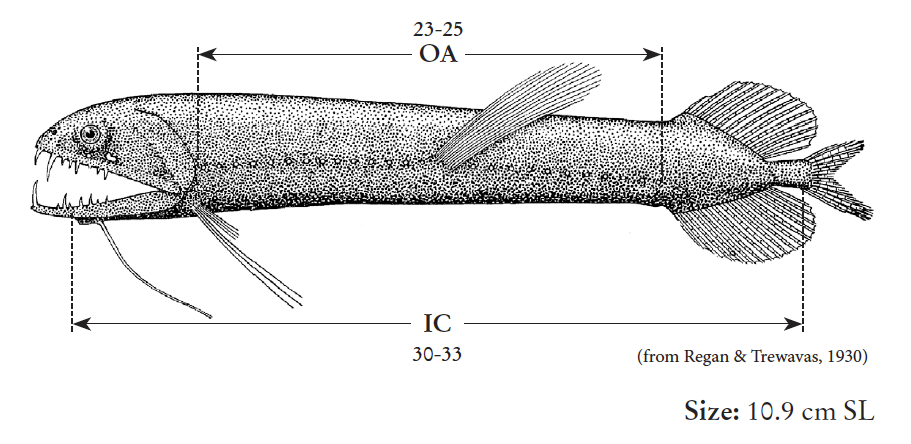
Atlantic Longfin Dragonfish, Bathophilus longipinnis. Pelvic-fin bases equidistant between dorsal and ventral profiles or nearer ventral profile; body depth less than 25% standard length. Pectoral-fin rays 5-9 (rarely 4). Pelvic-fin rays 13 or less. IC photophores 30-33; OA 23-25; pectoral-fin rays 6-8. Deep black, fins white and barbel yellowish white (FAO 2020).
Bathophilus metallicus, Fewray Dragonfish
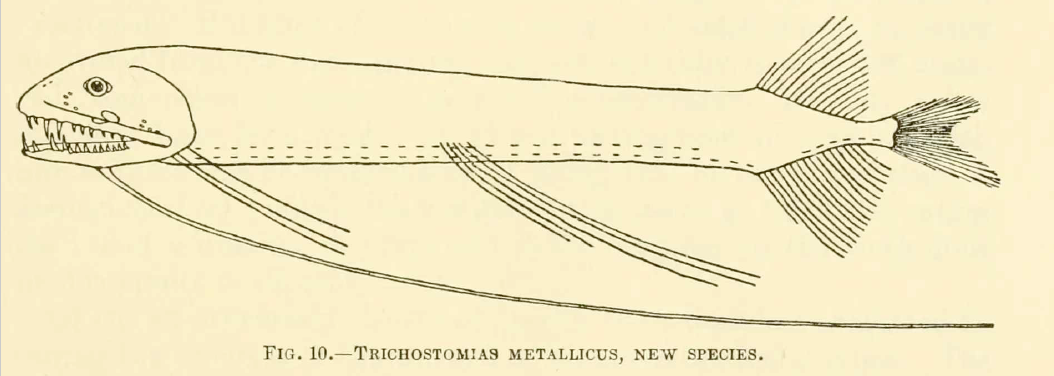
Fewray Dragonfish, Bathophilus metallicus. Barbel very long, filamentous, its base directly under eye (apparently incomplete in all the examples, in one of which it is 14 times length of body without caudal); teeth in both jaws in a single row, canine, of unequal length, the longer teeth in upper jaw projecting when mouth is closed. An ovoid light organ close to maxillary behind vertical from posterior margin of eye, contiguous with which is an oblong organ on upper edge of maxillary; a row of indistinct glandular organs on sides of snout and cheeks; two rows of small, elongated photophores on sides ventrally, about 30 in each from gill opening to anal; a single row of somewhat larger photophores above anal, extending to end of caudal peduncle. Dorsal origin three rays in advance of that of anal. Head and body dark greenish bronze with bright metallic reflections, thickly strewn with minute white dots bordered with black pigment; top of head, margin of opercular flap, and photophores, black; all fins unpigmented, barbel white, speckled with minute black chromatophores (Welsh 1923).
Bathophilus pawneei, Pawnee Dragonfish
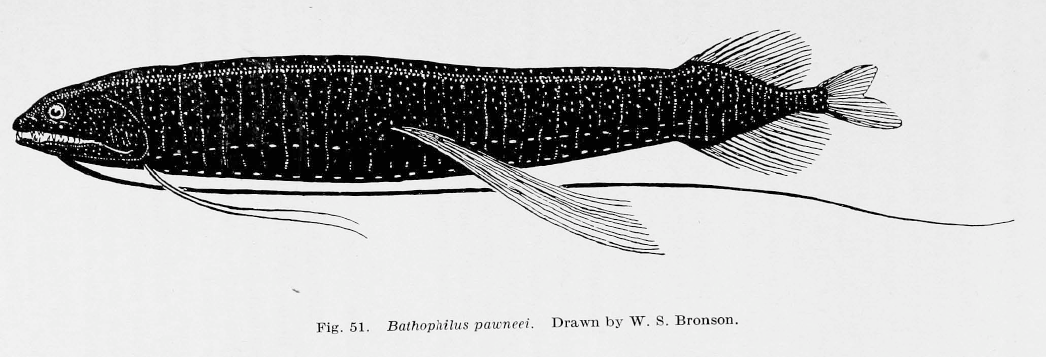
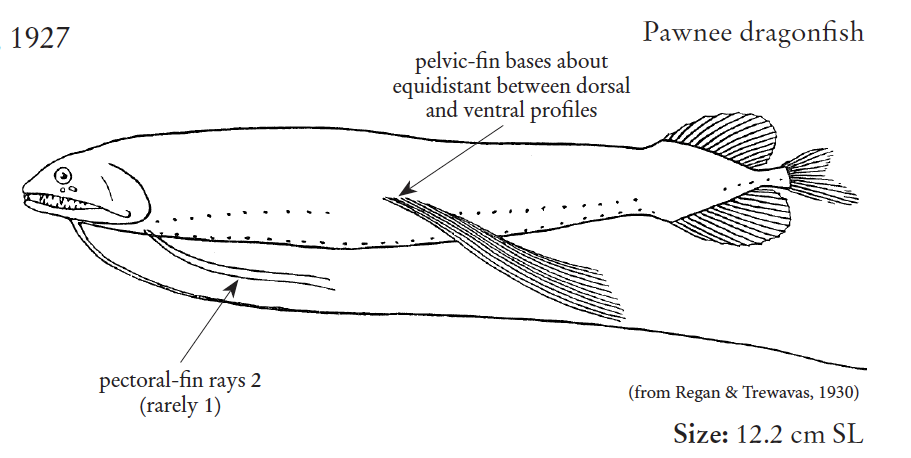
Pawnee Dragonfish, Bathophilus pawneei. Pectorals with two entirely separate rays originating close together; only two pectoral rays. Barbel longer than total length. Ventral series of photophores: P-V 14, V-A 14-15, A-c 11; lateral series P-V 14, V-A 14. Suborbital organ about same size as eyes. Well developed small roseous luminous organ on each side just behind and slightly above the bases of the ventrals (Parr 1927). Pelvic-fin bases about equidistant between dorsal and ventral profiles. Small luminous spot behind pelvic fin and sometimes one on shoulder (FAO 2020).
References:
Beebe, W. 1933. Deep-sea stomiatoid fishes. One new genus and eight new species. Copeia, 1933 (4): 160-175.
FAO. 2002. The living marine resources of the Western Central Atlantic. Volumes 1-3. K.E. Carpenter (ed.). Food and Agriculture Organization of the United Nations, Rome, Italy. 4099 pp. http://www.fao.org/3/y4160e/y4160e00.htm.
(FAO 2020) Sutton, T.T., P.A. Hulley, R. Wienerroither, D. Zaera-Perez, and J.R. Paxton. 2020. Identification guide to the mesopelagic fishes of the central and south east Atlantic Ocean. FAO Species Identification Guide for Fishery Purposes. Rome, FAO. 327 pp. https://doi.org/10.4060/cb0365en.
Parr, A.E. 1927. The Stomiatoid fishes of the suborder Gymnophotodermi (Astronesthidae, Melanostomiatidae, Idiacanthidae) with a complete review of the species. (Scientific Results of the Third Oceanographic Expedition of the “Pawnee” 1927). Bulletin of the Bingham Oceanographic Collection Yale University 3 (2): 1-123.
Welsh, W.W. 1923. Seven new species of fish of the order Malacopterygii. Proceedings of the United States National Museum, 62 (2449): 1-11.