
| Family | Scientific Name | Author | Year | Common Name |
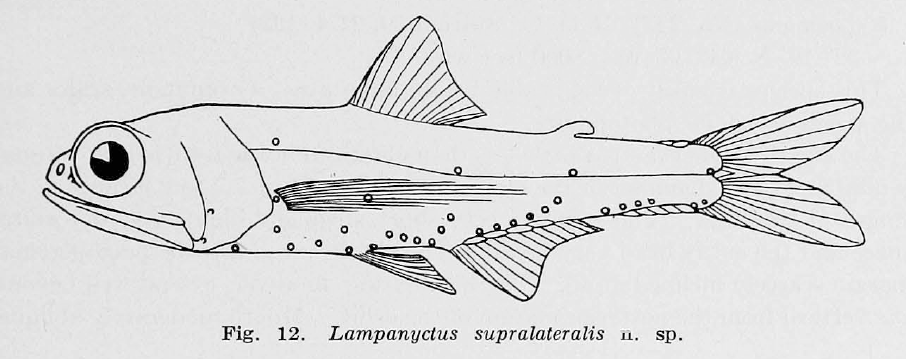
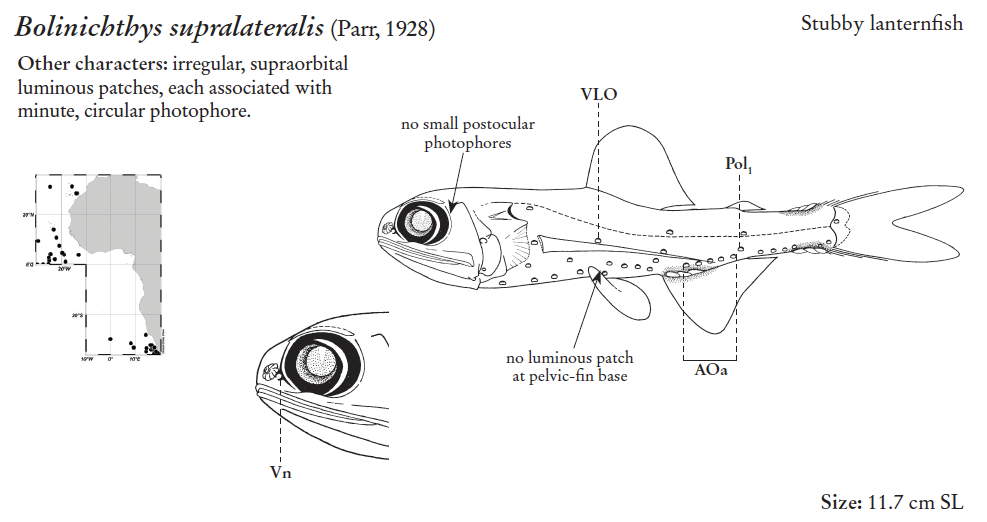
| Myctophidae | Bolinichthys supralateralis | (Parr) | 1928 | Stubby Lanternfish |
All Bolinichthys Species: Three or more Prc (1 may be at or above lateral midline at base of caudal peduncle. Dn absent. Supra- and infracaudal glands overlapping scale-like plates, never bordered by jet-black pigment. Luminous tissue over base of anal or dorsal fins and on other portions of body. Three (2+1) Prc; a whitish crescent on posterior half of eye; luminous tissue above eyes in some species (FAO 2020).
Bolinichthys supralateralis
Unique Characteristics: VLO 3-5 photophore diameters below lateral line; luminous patch at pelvic-fin base absent; small postocular photophores absent. Gill rakers 6 (7) + 1 + 13 (12-14), total 20 (19-22). Pol1 well above line through last 2 AOa photophores; Vn below anterior margin of orbit. Irregular, supraorbital luminous patches, each associated with minute, circular photophore (FAO 2020.
Bolinichthys distofax, No Common Name
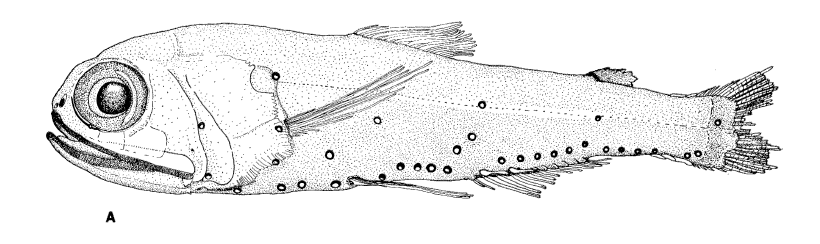
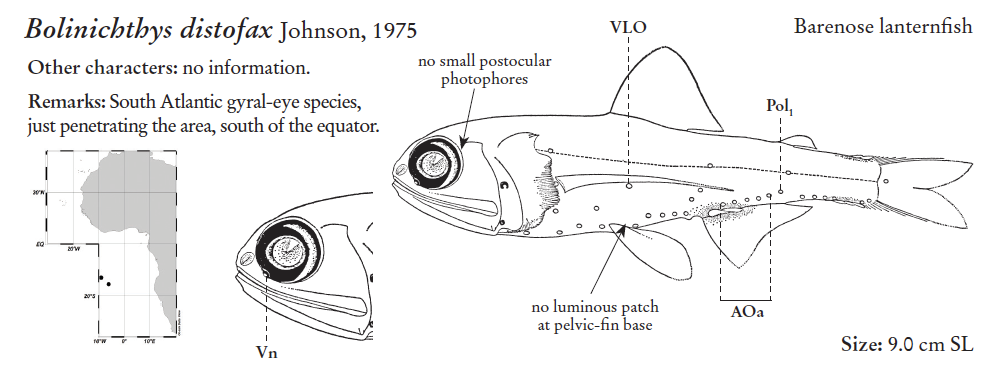
No Common Name, Bolinichthys distofax. VLO 3-5 photophore diameters below lateral line; luminous patch at pelvic-fin base absent; small postocular photophores absent. Gill rakers 5 (6) + 1 + 11 (10-12), total 17 (16-18). Pol1 on or touching line through last 2 AOa photophores; Vn below anterior margin of pupil (FAO 2020)..
Bolinichthys indicus, Smoothcheek Lanternfish
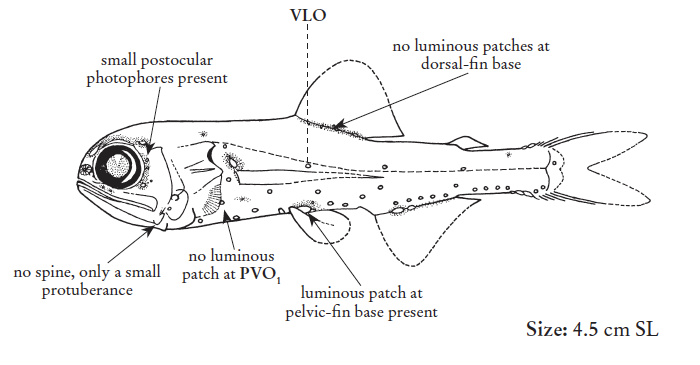
Smoothcheek Lanternfish, Bolinichthys indicus. VLO at or less than 1 photophore diameter below lateral line; luminous patch at pelvic-fin base present; small, postocular photophores present. Preopercle with only a small protuberance at posteroventral margin; luminous patch at PVO1 absent; luminous patches at dorsal-fin base absent (FAO 2020).
Bolinichthys photothorax, Spurcheek Lanternfish
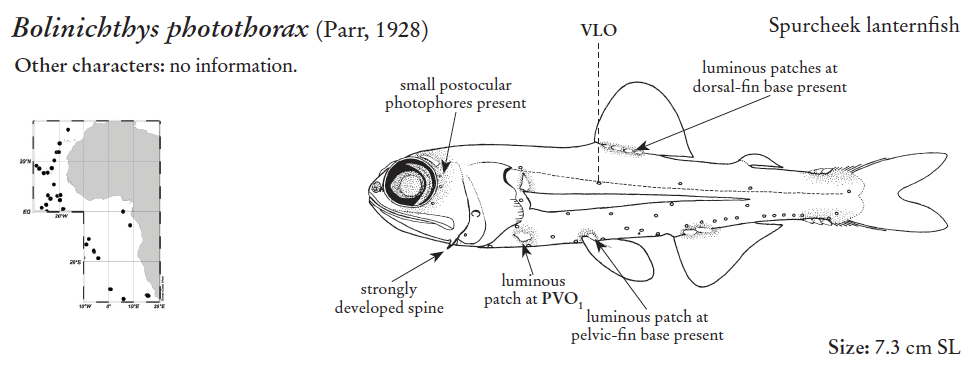
Spurcheek Lanternfish, Bolinichthys photothorax. VLO at or less than 1 photophore diameter below lateral line; luminous patch at pelvic-fin base present; small, postocular photophores present. Preopercle with strongly developed, anteriorly recurved spine at posteroventral margin; luminous patch at PVO1 present; luminous patches at dorsal-fin base present (FAO 2020).
References:
(FAO 2002). The living marine resources of the Western Central Atlantic. Volumes 1-3. K.E. Carpenter (ed.). Food and Agriculture Organization of the United Nations, Rome, Italy. 4099p. (Available at: http://www.fao.org/3/y4160e/y4160e00.htm).
(FAO 2020) Sutton, T.T., P.A. Hulley, R. Wienerroither, D. Zaera-Perez, and J.R. Paxton. 2020. Identification guide to the mesopelagic fishes of the central and south east Atlantic Ocean. FAO Species Identification Guide for Fishery Purposes. Rome, FAO. 2020. https://doi.org/10.4060/cb0365en.
Johnson, R.K. 1975. A new myctophid fish, Bolinichthys distofax, from the western and central North Pacific Ocean, with notes on other species of Bolinichthys. Copeia 1975 (1): 53-60.
Parr, A.E. 1928. Deepsea fishes of the order Iniomi from the waters around the Bahama and Bermuda islands. With annotated keys to the Sudididae, Myctophidae, Scopelarchidae, Evermannellidae, Omosudidae, Cetomimidae and Rondeletidae of the world. (Scientific results of the third oceanographic expedition of the “Pawnee” 1927). Bulletin of the Bingham Oceanographic Collection Yale University Volume 3 (Article 3): 1-193.