
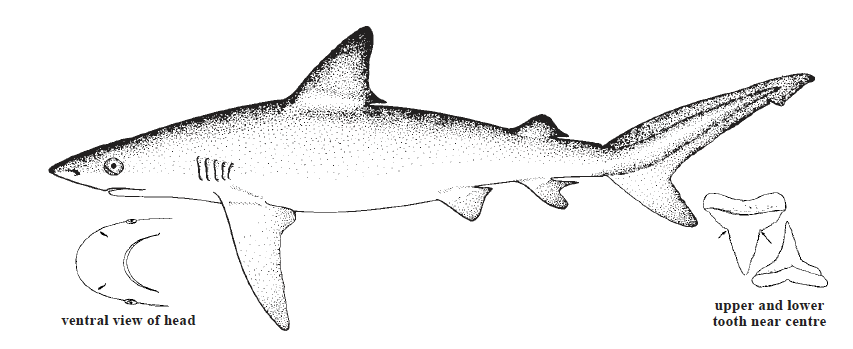
Source: FAO 2002.
| Family | Scientific Name | Author | Year | Common Name |
| Carcharhinidae | Carcharhinus perezi | (Poey) | 1876 | Reef Shark |
All Carcharhinus — Upper labial folds short to rudimentary, almost vertical at mouth corners. Spiracles usually absent. Lateral keels usually absent. Second dorsal fin considerably smaller than first, height 0.2-0.5 times first dorsal-fin height. Midlength of first dorsal-fin base usually closer to pectoral-fin insertions than to pelvic-fin origins, sometimes equidistant between pectoral and pelvic-fin bases. No gill rakers. Back grey, blue-grey, or brownish. Preanal ridges very short or absent.
Carcharhinus perezi
Unique Characters: Unique Characters: Pectoral and first dorsal fins tapering distally and usually pointed or narrowly rounded. First dorsal-fin origin over or anterior to pectoral-fin free rear tips; inner margin of second dorsal fin shorter and generally less than twice fin height. Fins not mottled white, often black tipped but without black saddles on the caudal peduncle. Interdorsal ridge present. Snout shorter, narrowly to broadly rounded, preoral length less than 1.6 times internarial width. Cusps of upper anterolateral teeth regularly serrated. Serrations on feet of upper anterolateral teeth small and fine. Upper anterolateral teeth with narrow cusps; anteroposterior teeth in 12-13/11-12 rows on each side.
Similar Species:
Bull Shark
Carcharhinus leucas

Source: FAO 2002
Bull Shark, Carcharhinus leucas. Pectoral and first dorsal fins tapering distally and usually pointed or narrowly rounded. Fins not mottled white, often black tipped but without black saddles on the caudal peduncle. Interdorsal ridge absent. Snout very short and broadly rounded, preoral length 0.7-1.0 times internarial width. Heavy bodied. Upper anterolateral teeth with very broad, triangular cusps and straight to concave distal margins; lower anterolateral teeth with strongly arched roots.
Blacknose Shark
Carcharhinus acronotus
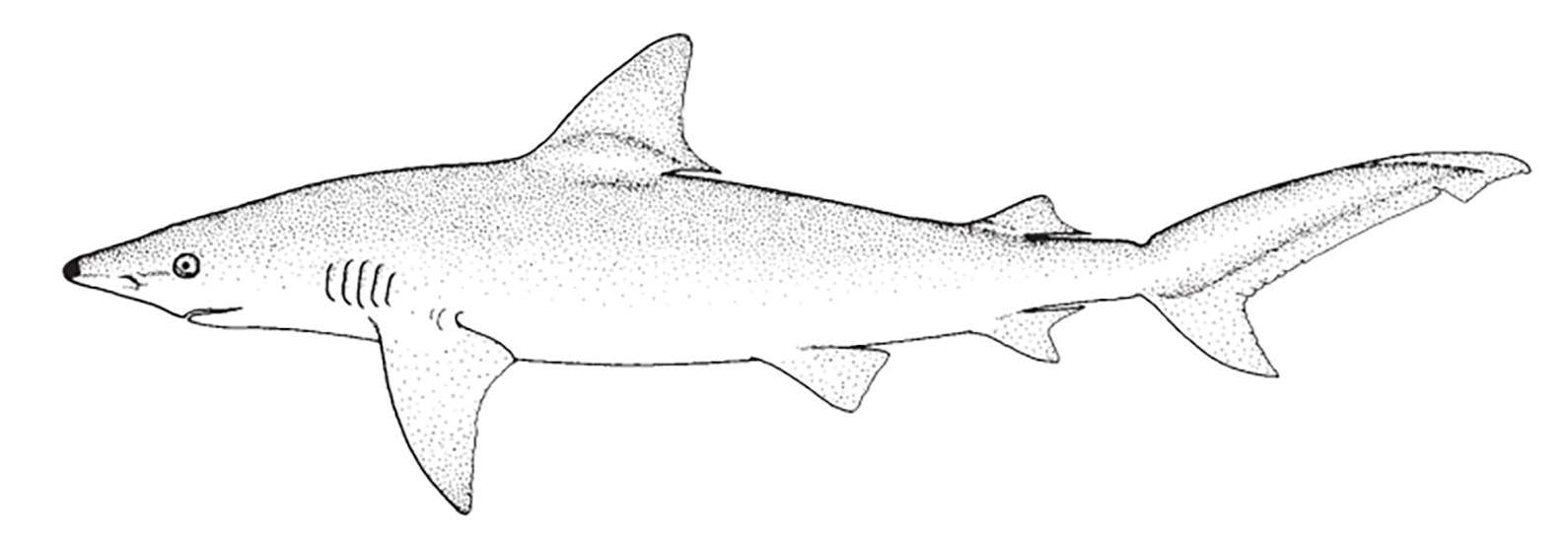
Source: FAO 2002
Blacknose Shark, Carcharhinus acronotus. Pectoral and first dorsal fins tapering distally and usually pointed or narrowly rounded. Fins not mottled white, not black tipped, without black saddles on the caudal peduncle.; tip of caudal fin dusky. Interdorsal ridge absent. Snout longer and parabolic or wedge-shaped to pointed, tip with a dusky or black blotch. Preoral length 1.1-1.8 times internarial width. Gill slits shorter, third gill slit 2.4-3.2% of total length. Upper anterolateral teeth with narrow cusps and strongly notched distal margins; lower anterolateral teeth with nearly transverse roots. Only 12 or 13 rows of upper anteroposterior teeth; upper anterolateral teeth with oblique cusps; lower anterolateral teeth with mostly oblique cusps.
Finetooth Shark
Carcharhinus isodon
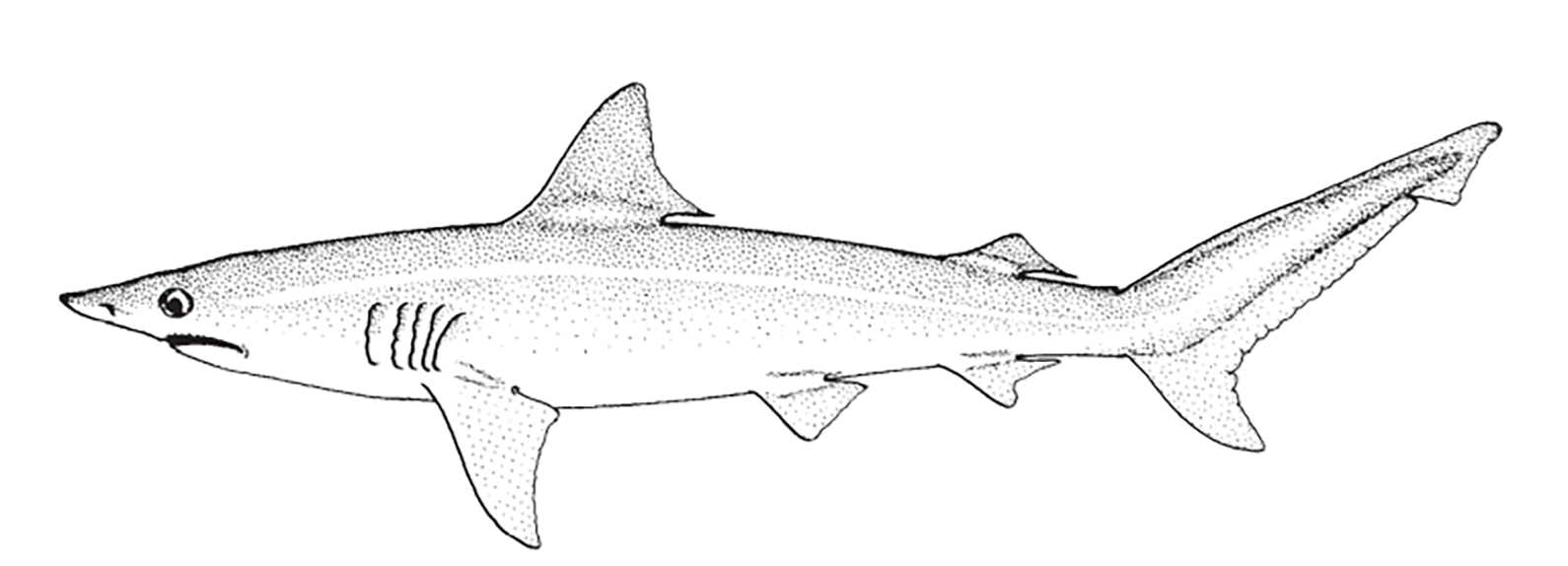
Source: FAO 2002
Finetooth Shark, Carcharhinus isodon. Pectoral and first dorsal fins tapering distally and usually pointed or narrowly rounded. Fins not mottled white, no black tips on fins, without black saddles on the caudal peduncle. First dorsal fin higher, its height 7.5-12.4% of total length and at least 0.45 times the interdorsal space; first dorsal-fin origin over or just behind pectoral-fin insertions. Snout longer and parabolic or wedge-shaped to pointed. Preoral length 1.1-1.8 times internarial width. Upper labial furrows shorter and less noticeable. Gill slits longer, third gill slit 4.8-6.5% of total length. Teeth with smooth edges in both jaws, except for weakly and irregularly serrated upper teeth of adults. 12-16 rows of anteroposterior teeth on each side, usually 15 or fewer; upper anterolateral teeth with narrow cusps and strongly notched distal margins. Lower anterolateral teeth with nearly transverse roots.
Blacktip Shark
Carcharhinus limbatus
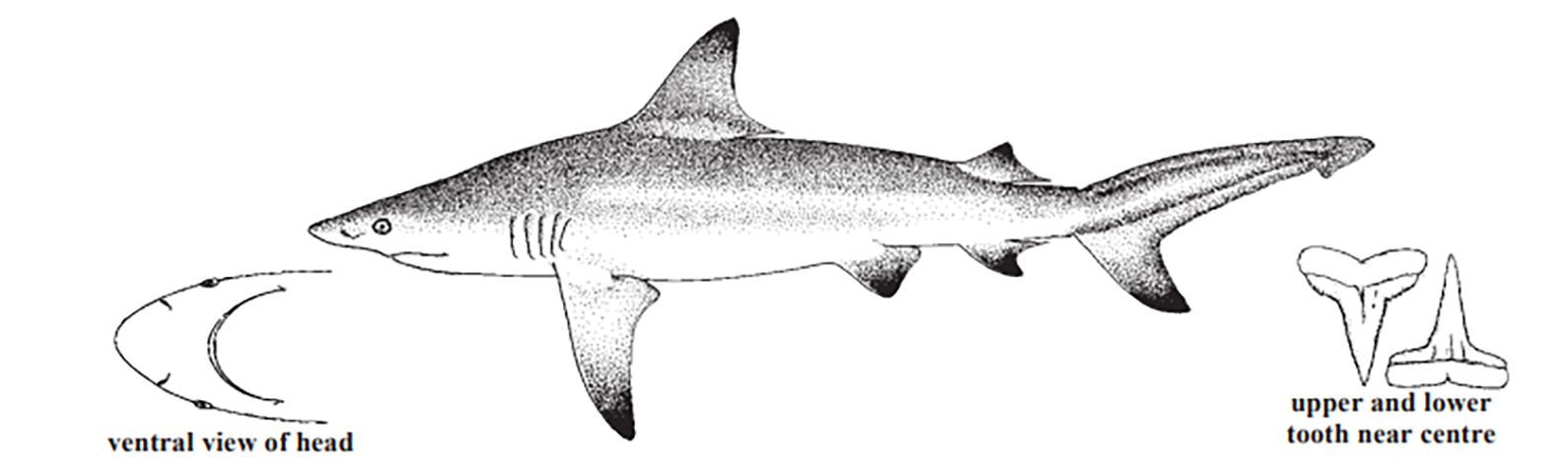
Source: FAO 2002
Blacktip Shark, Carcharhinus limbatus. Slender body. Distinct white stripe on flank. Tips of fins black. Inside tip of pectoral fin black. Pectoral and first dorsal fins tapering distally and usually pointed or narrowly rounded. Fins not mottled white, often black tipped but without black saddles on the caudal peduncle. First dorsal-fin origin over or just behind pectoral-fin insertions; first dorsal fin higher, its height 7.5-12.4% of total length and at least 0.45 times the interdorsal space. Interdorsal ridge absent. Snout longer and parabolic or wedge-shaped to pointed, preoral length 1.1-1.8 times internarial width; without a dark blotch. Third gill slit 3.8 to 4.9% of total length. Upper labial furrows shorter and less noticeable. Teeth with serrated edges in both jaws. 12-16 rows of anteroposterior teeth on each side, usually 15 or fewer. Upper anterolateral teeth with erect or nearly erect narrow cusps and strongly notched distal margins. Lower anterolateral teeth with mostly erect cusps and nearly transverse roots.
Sandbar Shark
Carcharhinus plumbeus
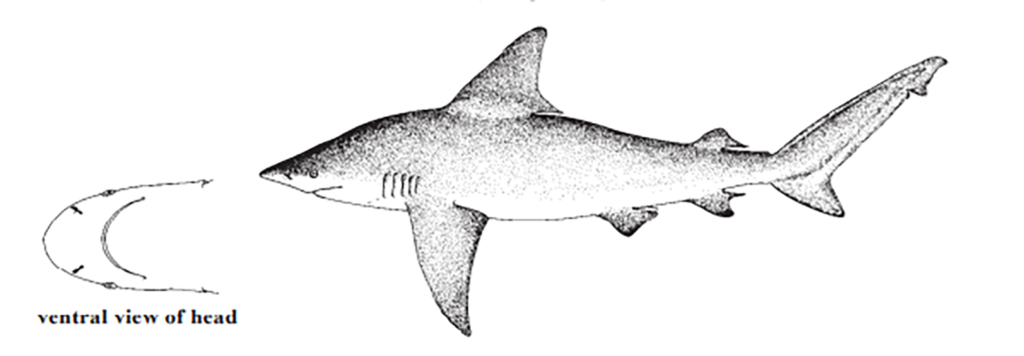
Source: FAO 2002
Sandbar Shark, Carcharhinus plumbeus. Heavy bodied. Pectoral and first dorsal fins tapering distally and usually pointed or narrowly rounded. Fins not mottled white, often black tipped but without black saddles on the caudal peduncle. First dorsal fin very high, with height about half predorsal space from snout tip to first dorsal origin in adults. First dorsal-fin origin over or anterior to pectoral-fin free rear tips. Inner margin of second dorsal fin shorter and generally less than twice fin height. Interdorsal ridge present, low. Snout shorter, narrowly to broadly rounded, preoral length less than 1.6 times internarial width. Anterior nasal flaps usually low and inconspicuous; distance from nostrils to mouth more than 2.4 times in mouth width. Upper anterolateral teeth in 13-15 rows on each side but usually in 14 rows. Upper anterolateral teeth with broad-based cusps, triangular in form, regularly serrated. Serrations on feet of upper anterolateral teeth small and fine.
Dusky Shark
Carcharhinus obscurus

Source: FAO 2002
Dusky Shark, Carcharhinus obscurus. Large body. Pectoral and first dorsal fins tapering distally and usually pointed or narrowly rounded. Fins not mottled white, often black tipped but without black saddles on the caudal peduncle. First dorsal-fin origin over or anterior to pectoral-fin free rear tips. Inner margin of second dorsal fin shorter and generally 2.1 times fin height. Interdorsal ridge present. Snout shorter, narrowly to broadly rounded, preoral length less than 1.6 times internarial width. Upper anterolateral teeth with broad-based cusps, triangular in form; anteroposterior teeth in 13- 16/12 to 16 rows on each side but usually at least 14/13 rows. Cusps of upper anterolateral teeth regularly serrate; serrations on feet of upper anterolateral teeth small and fine.
Silky Shark
Carcharhinus falciformis

Source: FAO 2002
Silky Shark, Carcharhinus falciformis. Body slender. Pectoral and first dorsal fins tapering distally and usually pointed or narrowly rounded. Fins not mottled white, often black tipped but without black saddles on the caudal peduncle. First dorsal-fin origin well behind pectoral-fin free rear tips. Inner margin of second dorsal fin very long, usually over twice fin height but occasionally down to 1.6 times fin height. Interdorsal ridge present. Snout shorter, narrowly to broadly rounded, preoral length less than 1.6 times internarial width. Cusps of upper anterolateral teeth regularly serrated; very coarse serrations or small cusplets on feet of upper anterolateral teeth.
Spinner Shark
Carcharhinus brevipinna

Source: FAO 2002
Spinner Shark, Carcharhinus brevipinna. Slender body. Distinct white stripe on flank. Inside tip of pectoral fin black. Pectoral and first dorsal fins tapering distally and usually pointed or narrowly rounded; fins not mottled white, often black tipped but without black saddles on the caudal peduncle. Snout tip without a dark blotch. First dorsal-fin origin over or just behind pectoral-fin free rear tips. First dorsal fin lower, its height about 6.0-8.8% of total length and less than 0.45 times the interdorsal space. Interdorsal ridge absent. Snout longer and parabolic or wedge-shaped to pointed, preoral length 1.1-1.8 times internarial width. Upper labial furrows noticeably elongated and prominent. Gill slits longer, third gill slit 3.8-6.5% of total length. 15-18 rows of upper anteroposterior teeth on each side, usually at least 16 rows; with narrow cusps and strongly notched distal margins; and with erect or nearly erect cusps. Lower anterolateral teeth with nearly transverse roots and with mostly erect cusps.
Bignose Shark
Carcharhinus altimus
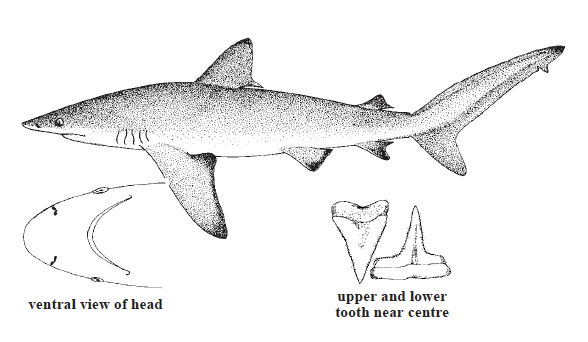
Source: FAO 2002.
Bignose Shark, Carcharhinus altimus. Pectoral and first dorsal fins tapering distally and usually pointed or narrowly rounded. First dorsal-fin origin in front or over pectoral-fin insertions or at least nearer to the pectoral-fin insertions than to pectoral-fin free rear tips. First dorsal fin lower, with height much less than half predorsal space in adults. Inner margin of second dorsal fin shorter and generally less than twice fin height. Fins not mottled white, often black tipped but without black saddles on the caudal peduncle. Interdorsal ridge high. Snout shorter, narrowly to broadly rounded, preoral length less than 1.6 times internarial width. Anterior nasal flaps usually high and triangular; distance from nostrils to mouth less than 2.4 times in mouth width. Upper anterolateral teeth with broad-based cups, triangular in form; cusps of upper anterolateral teeth regularly serrated, very high and narrow; serrations on feet of upper anterolateral teeth small and fine. Anteroposterior teeth in 13-16/12-16 rows on each side, but usually at least 14/13 rows. Upper anterolateral teeth in 14-16 rows on each side (usually in 15 rows).
Night Shark
Carcharhinus signatus
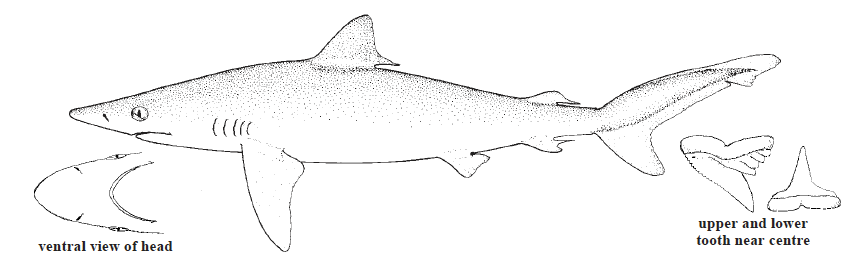
Source: FAO 2002.
Night Shark, Carcharhinus signatus. Pectoral and first dorsal fins tapering distally and usually pointed or narrowly rounded. Fins not mottled white, often black tipped but without black saddles on the caudal peduncle. Interdorsal ridge present. Snout very long, narrow and pointed, preoral length 1.7-1.9 times internarial width. Cusps of upper anterolateral teeth smooth-edged or weakly serrated.
Oceanic Whitetip Shark
Carcharhinus longimanus
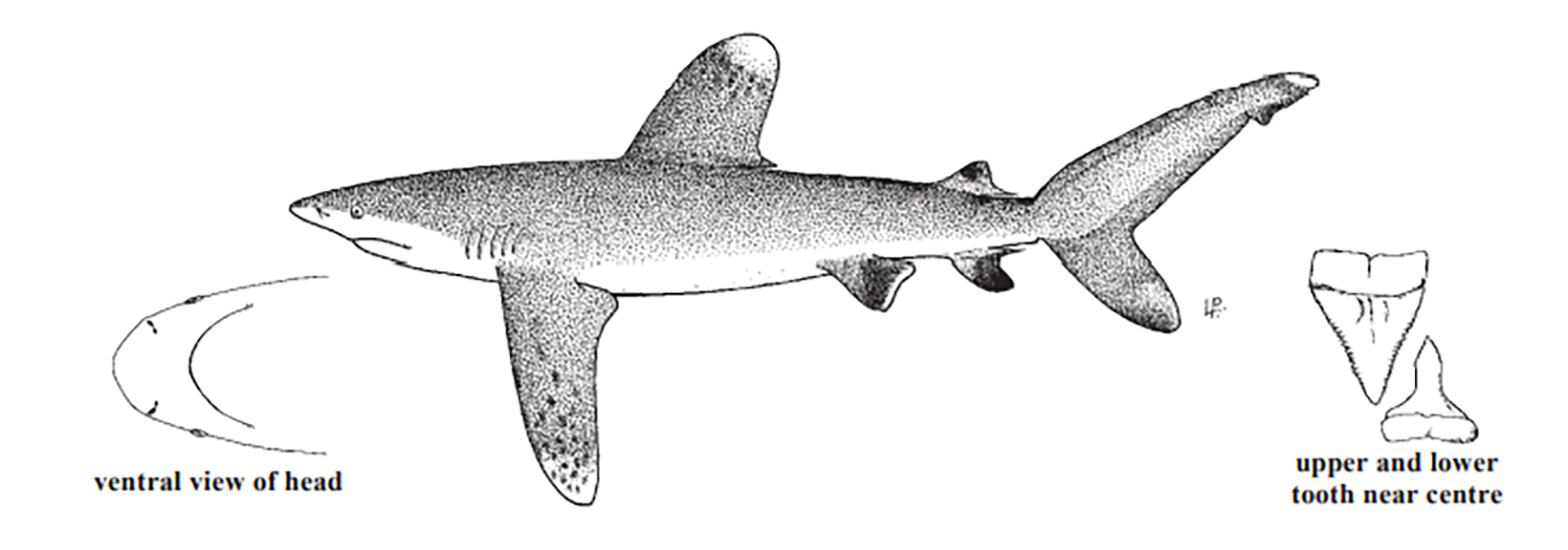
Source: FAO 2002
Oceanic Whitetip Shark, Carcharhinus longimanus. Pectoral and first dorsal fins very broad distally and broadly rounded apically, only slightly tapering toward their apices. Most fin tips mottled white in adults, also black-tipped and with black dorsal saddle-marks on the caudal peduncle in juveniles. Interdorsal ridge present.