
| Family | Scientific Name | Author | Year | Common Name |
| Liparidae | Careproctus ranula | (Goode & Bean) | 1879 | Scotian Snailfish |
Careproctus ranula
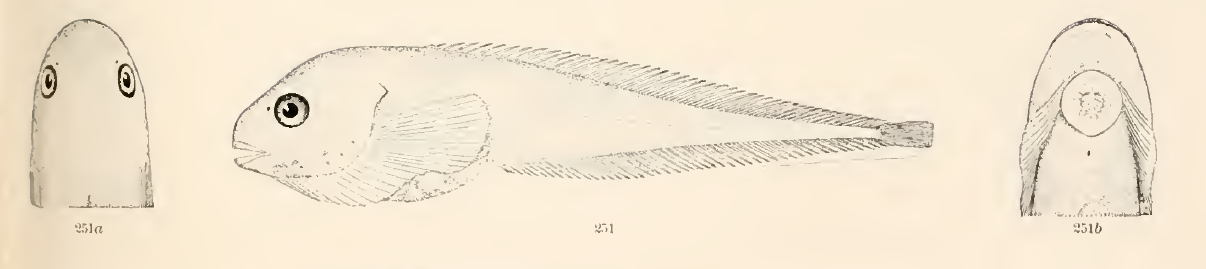
Unique Characteristics: The body is thick, subcylindrical anteriorly, rapidly tapering to the tail, covered with a thick lax integument; its greatest height (.25) equals the length oi the head and is one-fourth of the total length of the body without caudal.
The head is somewhat tumescent at the nape; its height (over the ventral disc and eyes) contained something over six times in the length of the body; its greatest width (.18) very slightly greater and equaling twice the width of the ventral disc. The snout is broad, with prominent vertical profile; its length about one-fourth that of the head. The cleft of the mouth is horizontal, and does not extend to the perpendicular from the anterior margin of the orbit. The lips are covered with thick lax skin, the upper jaw extending beyond the lower.
The length of the upper jaw is about one-third of the length of the head; that of the mandible slightly greater than the length of the ventral disc. Each jaw armed with a band of villiform teeth. The tongue is thick, obtuse. The eye is lateral, not interfering with the upper profile of the head; its diameter (.07) more than one-fourth of the length of the head, and contained about fourteen times in the length of the body. The width of the interorbital area is contained two and one-half times in the length of the head. The nostril is close to the eye. The gill-opening is a vertical slit, extending upon the upper part of the root of the pectoral.
The dorsal fin is inserted at a distance from the snout equal to one-third of the length of the body. It contains about 48 rays, though to count them is almost impossible. The anal fin originates at a distance
from the snout equal to two-fifths of the length of the body, and in the perpendicular from the eighth dorsal ray. It contains at least 45 rays. The pectoral fin is moderately broad, with 15 long rays and 12 or 13 shorter ones. The long rays are twice as long as the ventral disc and extend nearly or quite to the perpendicular from the vent.
The ventral disc is slightly longer (.10) than its distance from the snout (.09), which precisely equals its width. It has fourteen papillae. The color is uniform whitish, almost colorless, and translucent in life (Goode and Bean 1879).
Similar Species: None
References:
Goode, G.B. and T.H. Bean. 1879. Description of a new species of Liparis (L. ranula) obtained by the United States Fish Commission off Halifax, Nova Scotia. Proceedings of the United States National Museum. Volume 2 (No. 65): 46-48.
Goode, G.B. and T.H. Bean. 1896. Oceanic ichthyology. A treatise on the deep-sea and pelagic fishes of the world, based chiefly upon the collections made by the Steamers Blake, Albatross, and Fish Hawk in the northwestern Atlantic, with an atlas containing 417 figures. Special Bulletin. Smithsonian Institution. United States National Museum. Washington, DC. 927 pp.