
| Family | Scientific Name | Author | Year | Common Name |
| Myctophidae | Ceratoscopelus warmingii | (Lutken) | 1892 | Grand Lanternfish |
All Ceratoscopelus Species: Three or more Prc (1 may be at or above lateral midline at base of caudal peduncle. Dn absent. Supra- and infracaudal glands overlapping scale-like plates, never bordered by jet-black pigment. Luminous tissue over base of anal or dorsal fins and on other portions of body. Four (3+1) Prc; eye without whitish crescent; no luminous tissue above eyes. PO4 not elevated; VO only slightly arched; medial luminous tissue present at bases of pelvic fins or between pelvic fins and anal-fin origin; pectoral fins moderate, not reaching adipose fin (FAO 2002).
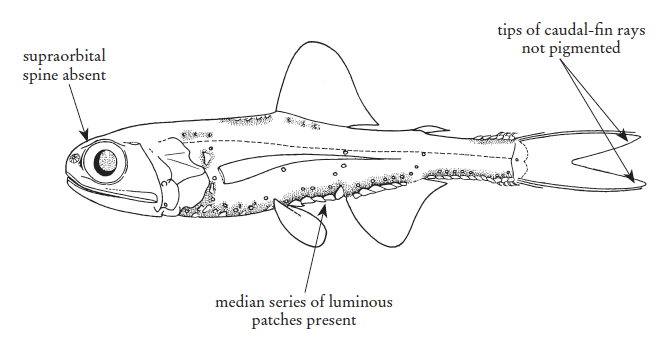
Ceratoscopelus warmingii
Unique Characteristics: Supraorbital spine absent; a median series of luminous patches between inner pelvic-fin bases and anus present; total gill rakers 14 (13-15, rarely 16); tips of caudal-fin rays not pigmented (FAO 2020).
Similar Species:
Ceratoscopelus maderensis, Horned Lanternfish
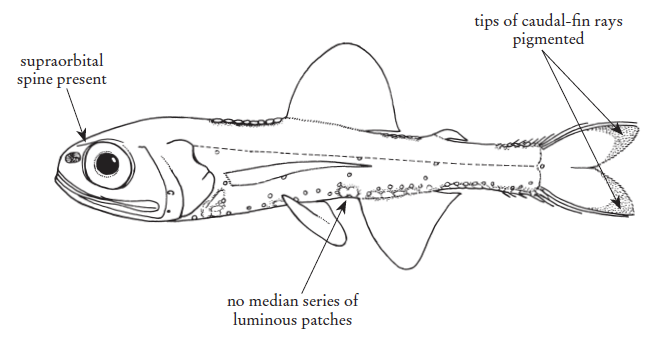
Horned Lanternfish, Ceratoscopelus maderensis. Supraorbital spine present; no median series of luminous patches between inner pelvic-fin bases and anus; total gill rakers 19 (18-21, rarely 17 or 22); tips of caudal-fin rays pigmented (FAO 2020).
References:
(FAO 2002). The living marine resources of the Western Central Atlantic. Volumes 1-3. K.E. Carpenter (ed.). Food and Agriculture Organization of the United Nations, Rome, Italy. 4099p. (Available at: http://www.fao.org/3/y4160e/y4160e00.htm).
(FAO 2020) Sutton, T.T., P.A. Hulley, R. Wienerroither, D. Zaera-Perez, and J.R. Paxton. 2020. Identification guide to the mesopelagic fishes of the central and south east Atlantic Ocean. FAO Species Identification Guide for Fishery Purposes. Rome, FAO. 2020. https://doi.org/10.4060/cb0365en.