
| Family | Scientific Name | Author | Year | Common Name |
| Anthiadidae | Choranthias tenuis | (Nichols) | 1920 | Threadnose Bass |
Choranthias tenuis
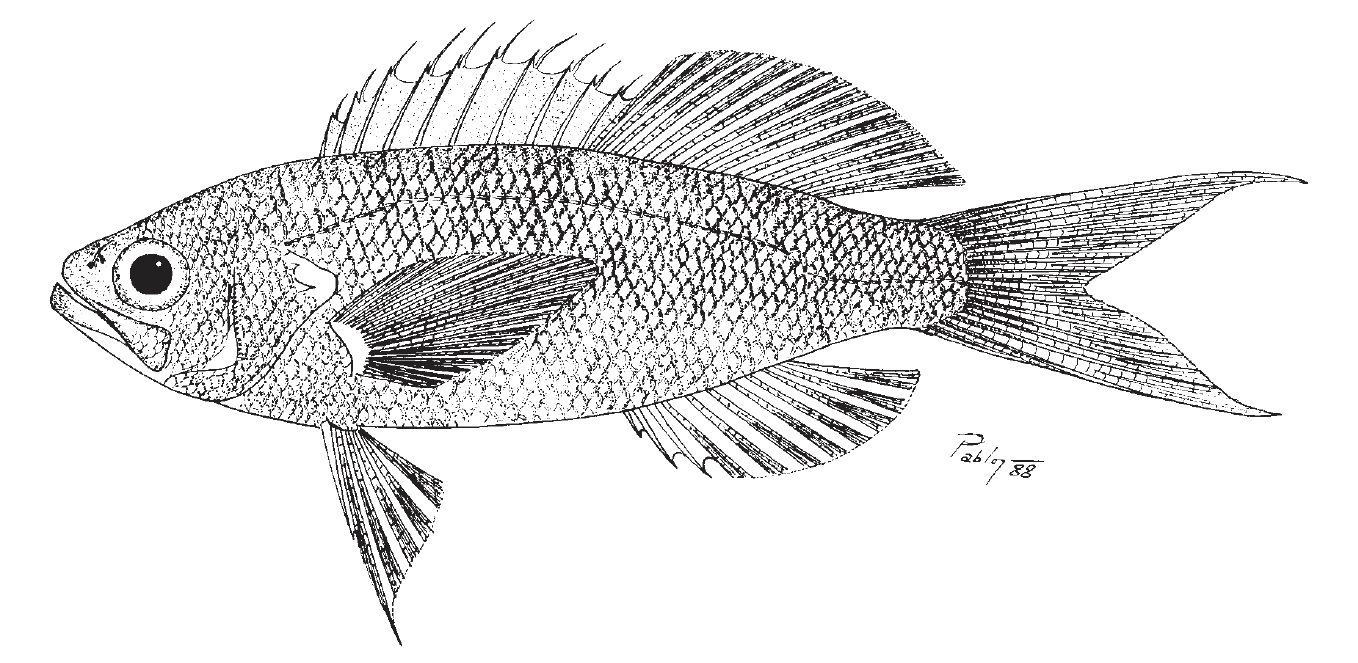
Unique Characteristics: Dorsal fin with 10 spines and 14 or 15 rays; anal fin with 3 spines and 6-13 rays; pectoral-fin rays 18-21; soft rays in anal fin 7-9 (almost always 8). Caudal fin deeply forked; branched caudal-fin rays 13. Most of upper edge of operculum free, not connected by skin to body. No scaly flap of skin joining upper part of pectoral-fin base to body; soft dorsal and anal fins mostly naked. Head length contained 2.3-3.3 times (28-32%) in standard length; body depth at first dorsal-fin spine 26-32% standard length. Preopercle without a large antrorse spine; middle opercle spine not reaching edge of operculum. Front nostrils variously shaped, but always closer to rear nostrils than to upper lip; posterior border of anterior nostril produced into slender filament that reaches or falls slightly short of orbit when reflected; 2 nostrils on each side of head fairly well separated, internarial distance 4 or 5 times in snout length. Maxilla and interorbital area scaly; supramaxilla absent; posterior process of premaxilla broad and near tip of alveolar ramus. Upper jaw moderately protrusile; jaw teeth distinct and fixed (not depressible); vomer and palatines with teeth; vomerine tooth patch triangular or V-shaped; tongue usually without teeth. Branchiostegal rays 7. Lateral line interrupted for short distance ventral to base of soft dorsal fin; lateral-line scales 51-57. Total gill rakers on first arch 34-39 (usually 35-37) (FAO 2002).
Similar Species: None