
| Family | Scientific Name | Author | Year | Common Name |
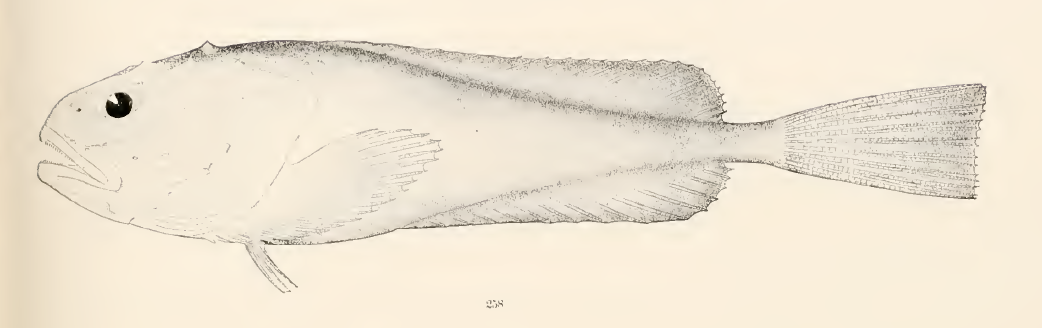
| Psychrolutidae | Cottunculus thomsonii | (Gunther) | 1882 | Pallid Sculpin |
All Cottunculus Species: Dorsal fin continuous. Spinous-dorsal little developed, continuous with soft dorsal, the spines slender, concealed in the loose naked skin. Gill membranes broadly joined to isthmus; no slit behind last gill. Teeth on vomer and palatines.
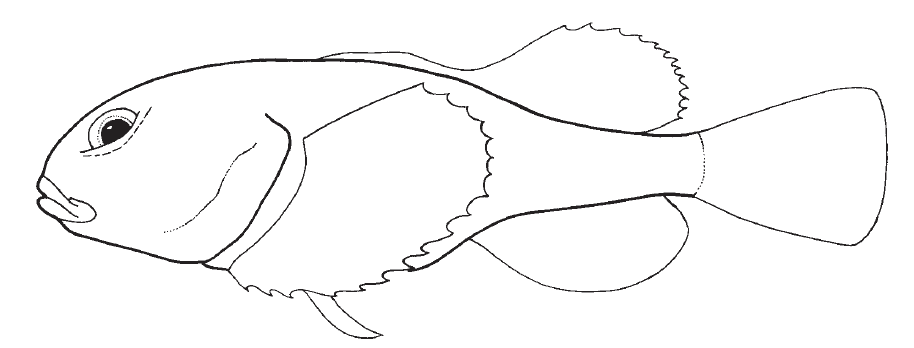
Tadpole shaped, the head extremely large, the body tapering from shoulders to the slender tail; mouth rather large, terminal, oblique. Villiform teeth in the jaws; a double patch on vomer; no teeth on the palatines. No spines on the head, the tubercular surface of the skull covered by skin; skull thin, its bones not firm. Gills 3 1/2, no slit behind the last arch; gill-membranes broadly joined to the isthmus, their union extending to above the lower edge of the base of the pectorals. Pseudobranchiae very small; no cirri, scales, or prickles; the skin thin and movable, smooth, or roughened with small warts. Spinous dorsal little developed; the two fins usually continuous; spines very slender, flexible, embedded in the skin; pectorals short, procurrent below; ventrals very short, well separated, their rays I, 3; caudal rounded (Goode and Bean 1896).
Cottunculus thomsonii
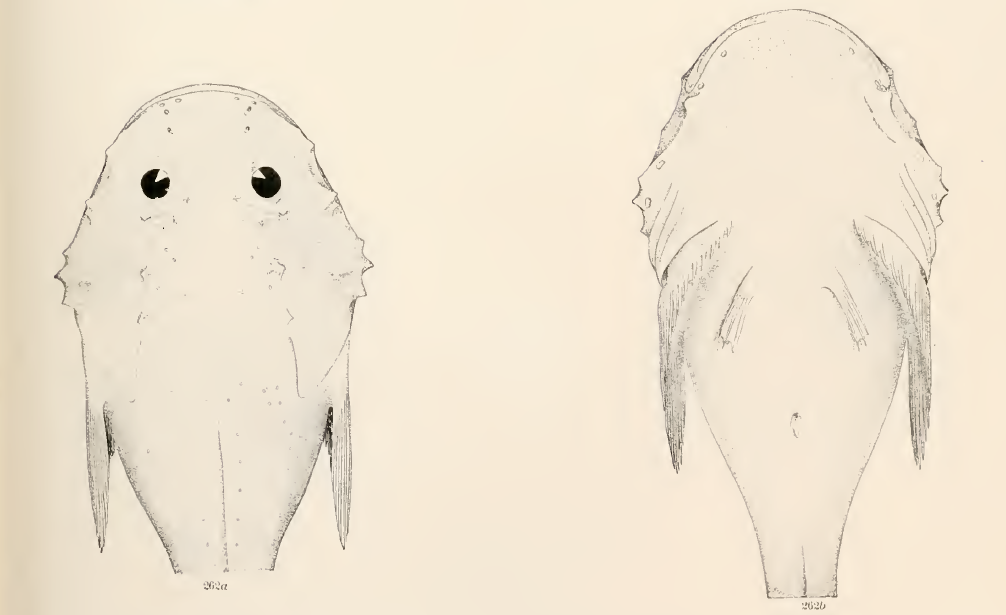
Unique Characteristics: Head and body smooth, scaleless, covered with a tough, lax skin. The length of the head is nearly one-third of the extreme length of the body, including the caudal; its greatest height, one fourth of the body without the caudal. The greatest width of the head is twice the length of the maxilla. The distance of the vent from the insertion of the anal equals the length of the maxilla. The eye is close to the dorsal profile. The length of the orbit is about equal to that of the snout, and is contained about 1 1/2 times in the greatest length of the head. The intermaxillary is long and slender, its length contained slightly more than 3 times in the distance from the tip of the snout to the insertion of the first dorsal (3 1/2 times in the length of the head). The maxilla is very slender, except in its posterior third, where it is considerably expanded. The mandible is very stout, posteriorly widened, its length contained nearly 2 1/3, times in that of the head. Teeth in broad villiform bands on the intermaxillary and the mandible. Two short, separate, similar bands on the vomer. None on the palatines. Head armed with blunt spines, as in Cottunculus microps.
The distance of the dorsal from the tip of the snout is nearly equal to one-third of the total length, caudal included. It consists of 6 spines and 17 rays. The anal fin is located midway between the tip of the snout and the end of the caudal fin; it consists of 13 rays. The length of the upper pectoral rays is equal to that of the postorbital portion of the head. The pectoral rays diminish rapidly in size, the lowest being exceedingly short. The number of rays is 22. The distance of the ventral from the tip of the snout is one -third of the total length without the caudal. The length of the free portion of the ventral equals that of the eye. The fin consists of 1 spine and 3 rays. The caudal consists of 10 developed rays. Color light brown, the fins somewhat darker (Goode and Bean 1896).
Similar Species:
Cottunculus microps, Polar Sculpin
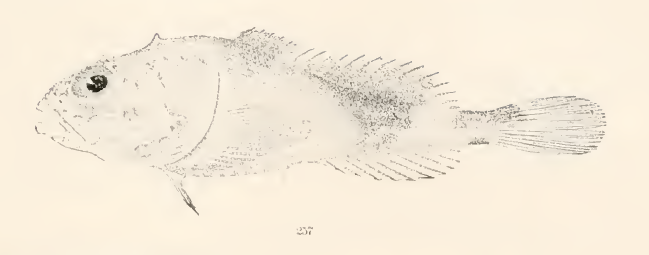
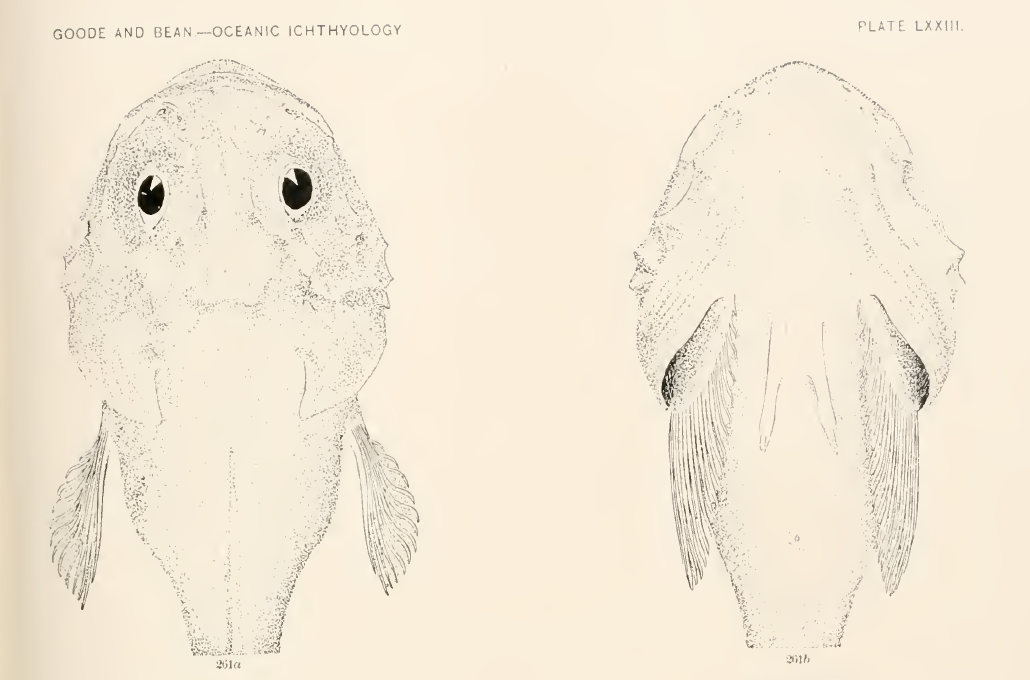
Polar Sculpin, Cottunculus microps. Head very large, its length, breadth, and depth nearly equal; the greatest depth at the nape; four bony tubercles on top of head and some at the sides, all covered by the skin; lower jaw included. Maxillary extending to below the middle of the eye, which is equal to the snout, and about 4 1/2 in head; suborbital stay and the roughish edge of the preopercle both covered by smooth skin; chin and preorbital with pores. Skin everywhere thin, somewhat movable, its surface roughened by small, blunt warts. Dorsal fin continuous, the feeble spines lower than the soft rays; pectorals barely reaching anal; caudal long. Head 2 2/3; depth 3 1/2. Radial formula: D. VI, 19; A. 10. Color, pale, with three broad, dusky cross bands on body and fins, one on head, one through spinous dorsal and pectoral, one through second dorsal and anal, besides a small band at base of caudal (Goode and Bean 1896).
Reference:
(FAO 2016). Carpenter, K.E. and N. De Angelis, N., eds. 2016. The living marine resources of the Eastern Central Atlantic. Volume 3: Bony fishes part 1 (Elopiformes to Scorpaeniformes). FAO Species Identification Guide for Fishery Purposes, Rome, FAO. pp. 1511–2342.
Goode, G.B. and T.H. Bean. 1895 (1896). Oceanic ichthyology, a treatise on the deep-sea and pelagic fishes of the world, based chiefly upon the collections made by the steamers Blake, Albatross, and Fish Hawk in the northwestern Atlantic, with an atlas containing 417 figures. Smithsonian Institution, United States National Museum, Special Bulletin. No. 30.