
| Family | Scientific Name | Author | Year | Common Name |
| Cyclopteridae | Cyclopterus lumpus | Linnaeus | 1758 | Lumpfish |
Cyclopterus lumpus
Unique Characteristics: anteriorly and posteriorly and somewhat polygonal in transverse section at the middle. The head is short and thick and the snout rounded and blunted. The mouth is terminal, opening slightly upwards. The teeth are simple, small, conical, and arranged in several rows anteriorly. The eye is moderate in size and gill openings large. The first dorsal fin is covered by thick skin, forming a high and long crest with large compressed tubercles on the front and top of the crest in adult fish. The height of this crest increases with age such that the back is humped in older specimens. As such, the depth of the body changes with growth stage; although it is much less than half the length in small young specimens, in large specimens it is nearly equal to half the whole length of the body.
The pelvic fins are modified to 6 pairs of fleshy knobs surrounded by a circular flap of skin forming an adhesive disc (sucker). The sucker is slightly longer than wide and about 1/5-1/6 of the body length. It is the spherical shape, the presence of rows of tubercles and the sucker that make this species easily recognizable.
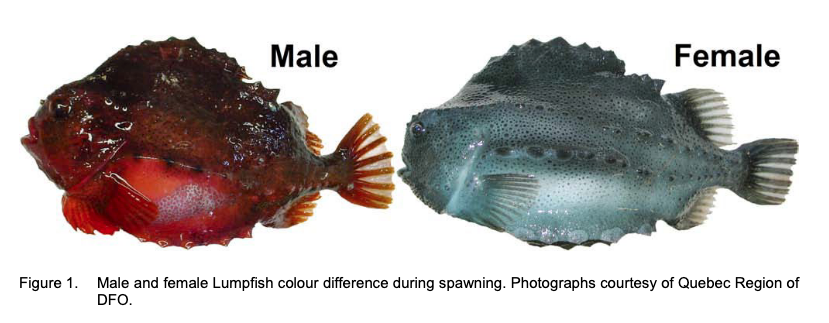
Lumpfish are sexually dimorphic: adult males are smaller in body size than females. Males and females also swim differently: the male relies primarily on a tail stroke, while the female relies mainly on her pectoral fins although the tail muscles are occasionally used for propulsion (Davenport and Kjørsvik 1986). The colour is variable, often matching surroundings, especially in the young. There can be tints of blue, bluish grey to greenish and yellowish or whitish below. The exception is with breeding males that have orange to red fins and belly, plus a metallic silver patch behind each pectoral fin (COSEWIC 2017).
Etymology:
Cyclopterus lumpus Linnaeus 1758 from the Anglo-Saxon lump, the fish having been called Lumpus anglorum by Gesner (1558), referring to dorsal fin so enveloped by a thick and tubercular skin that it might be mistaken for a lump (https://etyfish.org/perciformes21/; accessed July 09, 2026).
Similar Species: None
Reference:
COSEWIC. 2017. COSEWIC assessment and status report on the Lumpfish Cyclopterus lumpus in Canada. Committee on the Status of Endangered Wildlife in Canada. Ottawa. xi + 78 pp. (http://www.registrelep-sararegistry.gc.ca/default.asp?lang=en&n=24F7211B-1).