| Family | Scientific Name | Author | Year | Common Name |
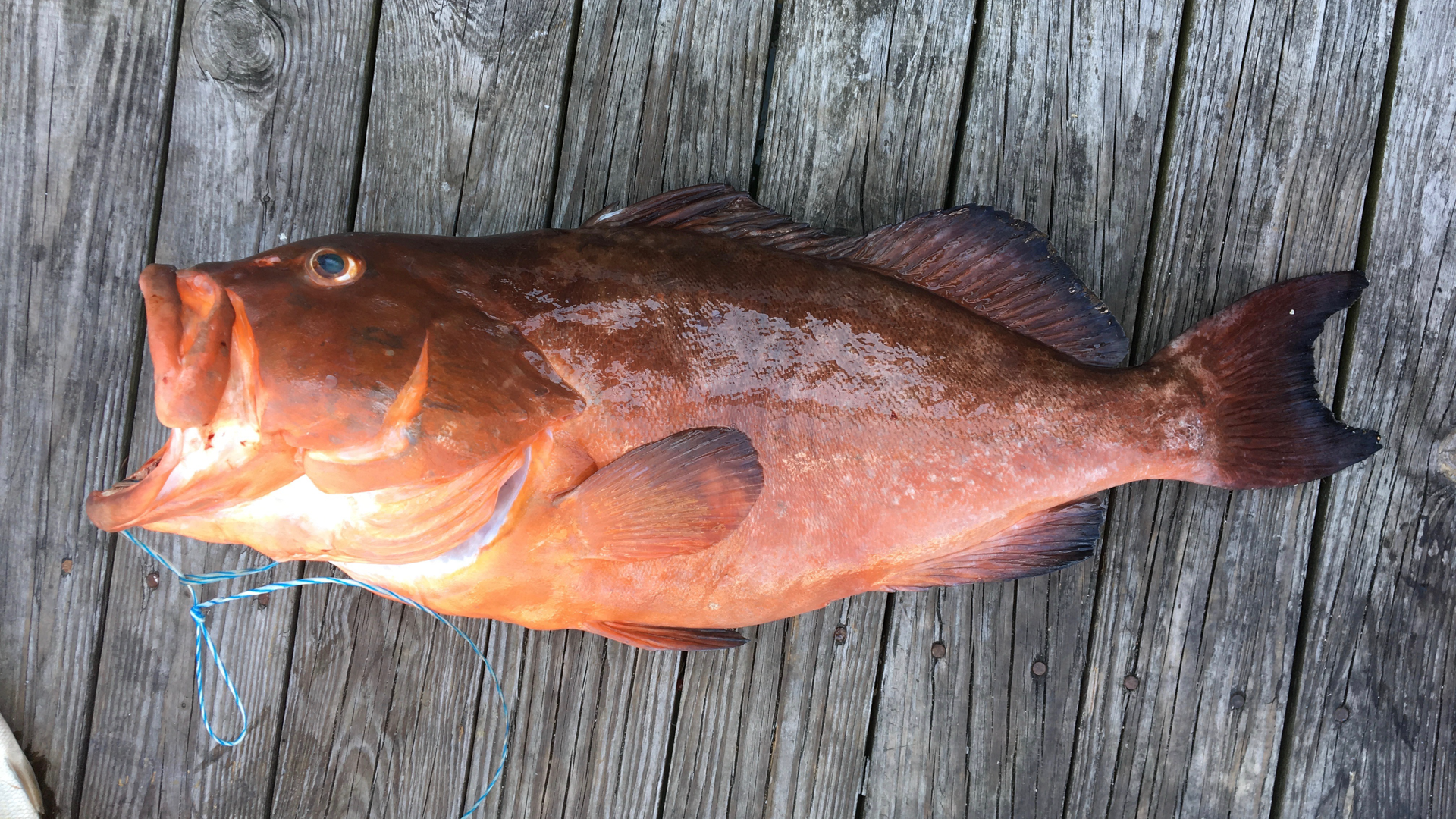
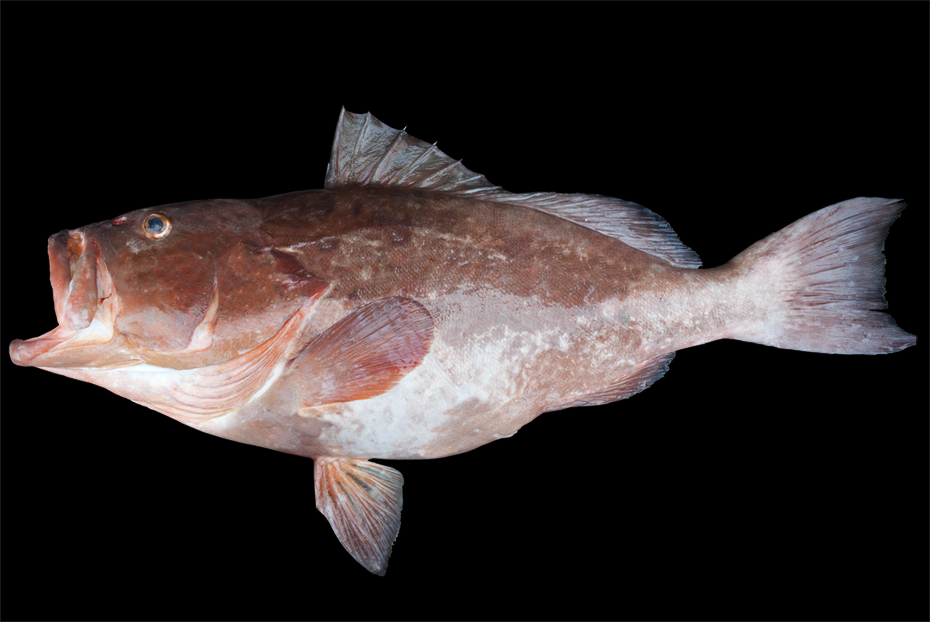
| Epinephelidae | Epinephelus morio | (Valenciennes) | 1828 | Red Grouper |
All Epinephelus Species: Dorsal fin with 10 or 11 spines and 13-19 rays; anal fin with 3 spines and 7-9 (rarely 10) rays. Most of upper edge of operculum free, not connected by skin to body. Caudal fin rounded or truncate. Head larger, its length contained 2.3-3.3 times in standard length; body depth usually not greater than head length, 2.5-3.6 times in standard length. Preopercle without a large antrorse spine in most species, but there may a few enlarged, ventrally-directed serrae there; middle opercle spine not reaching edge of operculum. Front nostrils variously shaped, but always closer to rear nostrils than to upper lip. A thin, moveable supramaxilla bone along upper, rear edge of maxilla (supramaxilla is covered by skin and not obvious, but it can be discerned by pushing the upper edge of the maxilla with a fingernail or dissecting needle; the supramaxilla is more apparent if the skin is cut and peeled off the free, rear part of the maxilla). Most teeth depressible (hinged). Scaly flap of skin joining upper part of inner (posterior) side of pectoral-fin base to body. Soft dorsal and anal fins mostly covered with thick skin and scales; scales on body small; midlateral body scales rough or smooth. Lateral scale series (69-146) more numerous than lateral-line scales. Snout longer than eye diameter (FAO 2002).
Body robust, oblong, compressed, deepest at origin of dorsal fin; rear of top jaw exposed when mouth closed, without bony knob at lower rear corner; teeth depressible; sides of roof of mouth with teeth; operculum edge with 3 flat spines; preoperculum serrate, with larger serrae at angle; pectoral fin symmetrically rounded; length of base of soft part not longer than that of spiny part; pelvics usually insert behind the base of the pectoral fin; tail fin usually rounded; body scales rough or smooth (https://biogeodb.stri.si.edu/caribbean/en/thefishes/taxon/1118).
Epinephelus morio
Unique Characters: Dorsal-fin rays 14-18; anal-fin rays 8-10. Pelvic-fin origin below or behind lower end of pectoral-fin base; pelvic fins not longer than pectoral fins (usually less than 90% pectoral-fin length). Rear margin of caudal fin truncate (FAO 2002).
Similar Species:
Epinephelus adscensionis, Rock Hind
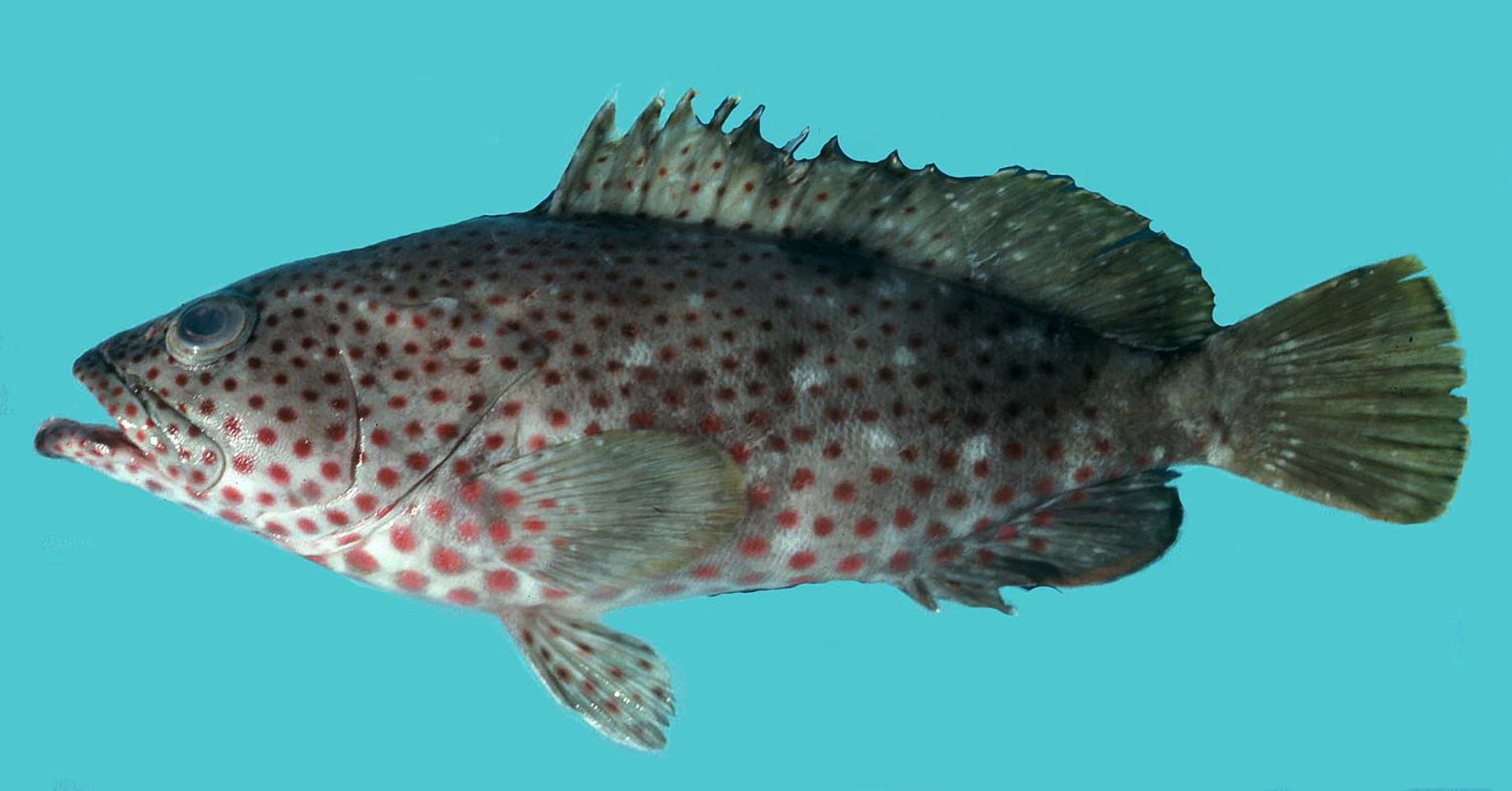
Rock Hind, Epinephelus adscensionis. Dorsal-fin rays 14-18; anal-fin rays 8; pectoral-fin rays 18-20. Pelvic-fin origin below or behind lower end of pectoral-fin base; pelvic fins not longer than pectoral fins (usually less than 90% pectoral-fin length). Anal-fin rays 8. Caudal fin convex or rounded. 2nd, 3rd, or 4th dorsal-fin spines longest, longer than anterior dorsal rays. Body width usually less than half of body depth. Head and body covered with dark orange-brown or dark red spots. Black saddle blotch on caudal peduncle and 3-5 dark blotches at base of dorsal fin; no blackish margin on soft-rayed part of dorsal fin (FAO 2002).
Epinephelus guttatus, Red Hind

Red Hind, Epinephelus guttatus. Dorsal-fin rays 14-18; anal-fin rays 8; pectoral-fin rays 16-18. Pelvic-fin origin below or behind lower end of pectoral-fin base; pelvic fins not longer than pectoral fins (usually less than 90% pectoral-fin length). Caudal fin convex or rounded. 2nd, 3rd, or 4th dorsal-fin spines longest, longer than anterior dorsal rays. Body width usually less than half of body depth. Head and body covered with dark orange-brown or dark red spots. No black saddle on peduncle; no dark blotches at base of dorsal fin; soft-rayed part of dorsal fin with blackish margin (FAO 2002).
Epinephelus itajara, Atlantic Goliath Grouper
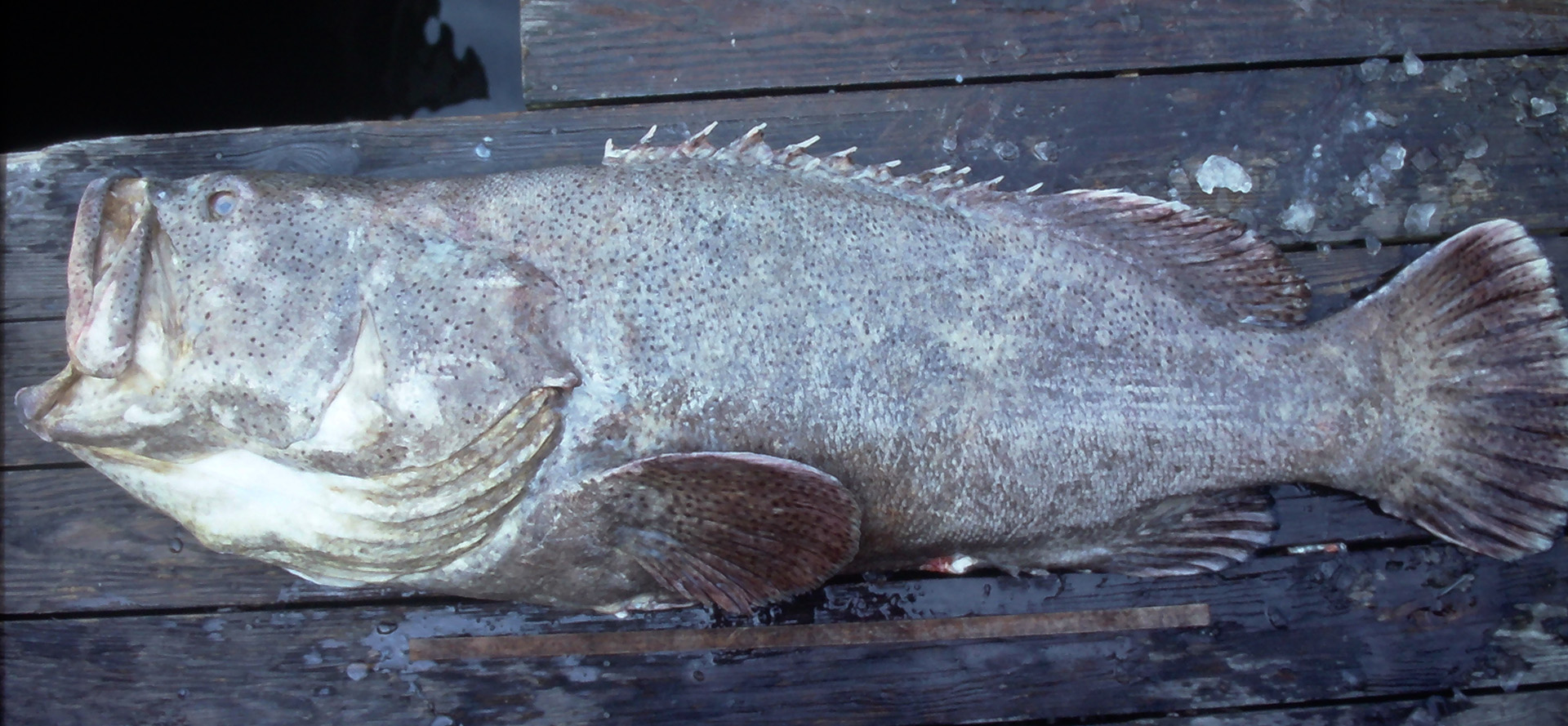
Atlantic Goliath Grouper, Epinephelus itajara. Dorsal-fin rays 14-18; anal-fin rays 8. Pelvic-fin origin below or behind lower end of pectoral-fin base; pelvic fins not longer than pectoral fins (usually less than 90% pectoral-fin length). Anal-fin rays 8. Caudal fin convex or rounded. 3rd to 11th dorsal-fin spines about equal and distinctly shorter than anterior dorsal-fin rays. Head and body very broad, the greatest body width equals half or more of body depth (FAO 2002).
Epinephelus striatus, Nassau Grouper
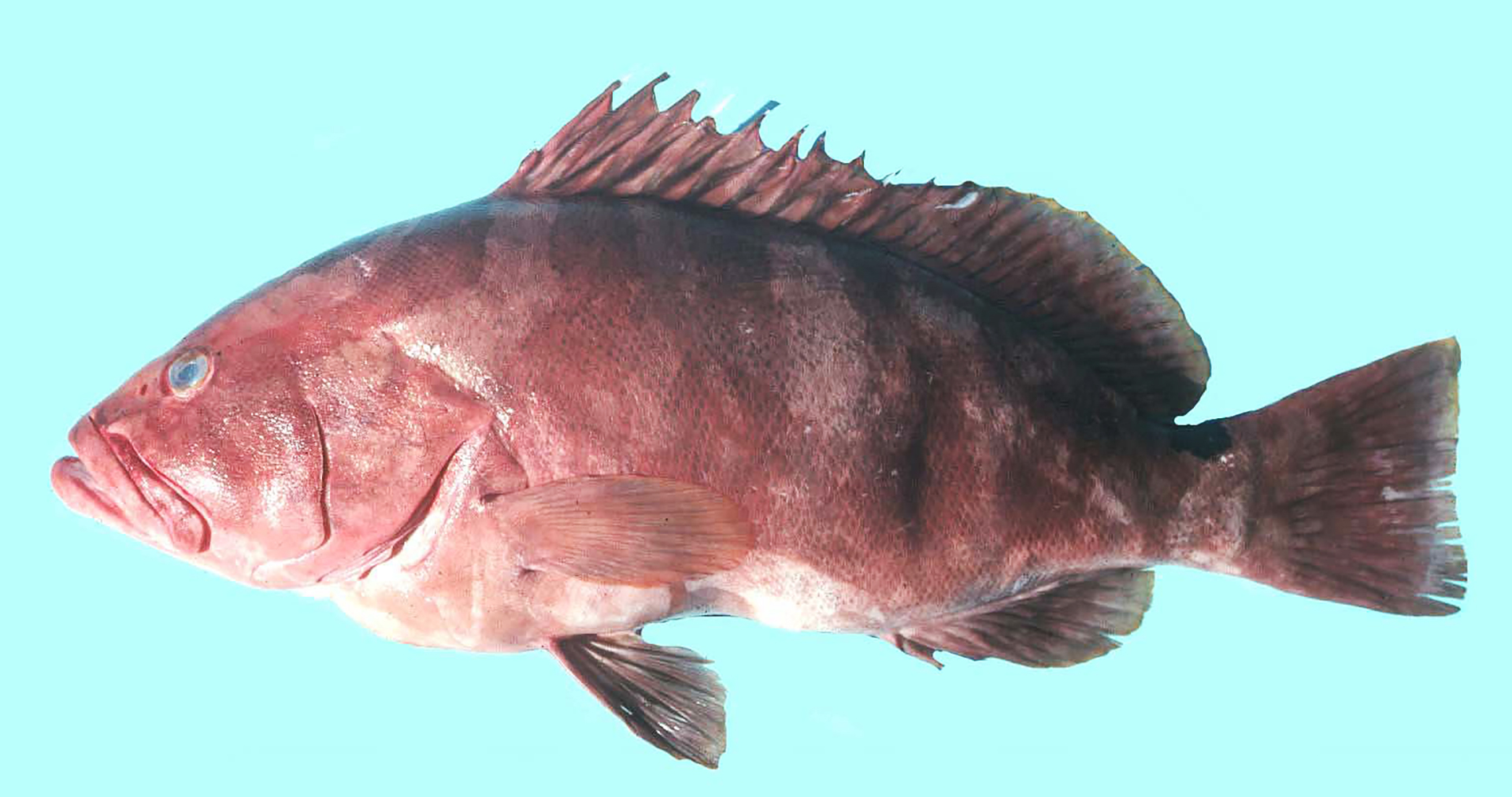
Nassau Grouper, Epinephelus striatus. Dorsal-fin rays 14-18; anal-fin rays 8. Pelvic-fin origin below or behind lower end of pectoral-fin base; pelvic fins not longer than pectoral fins (usually less than 90% pectoral-fin length). Caudal fin convex or rounded. 2nd, 3rd, or 4th dorsal-fin spines longest, longer than anterior dorsal rays. Body width usually less than half of body depth. No dark orange-brown or dark red spots. Head and body pale, with irregular dark bars or bands (but color can change from almost white to uniform dark brown in less than a minute); black saddle blotch on peduncle; black dots below and behind eye; dark tuning-fork mark between the eyes. Lateral-line scales about 50 (FAO 2002).
Gallery