
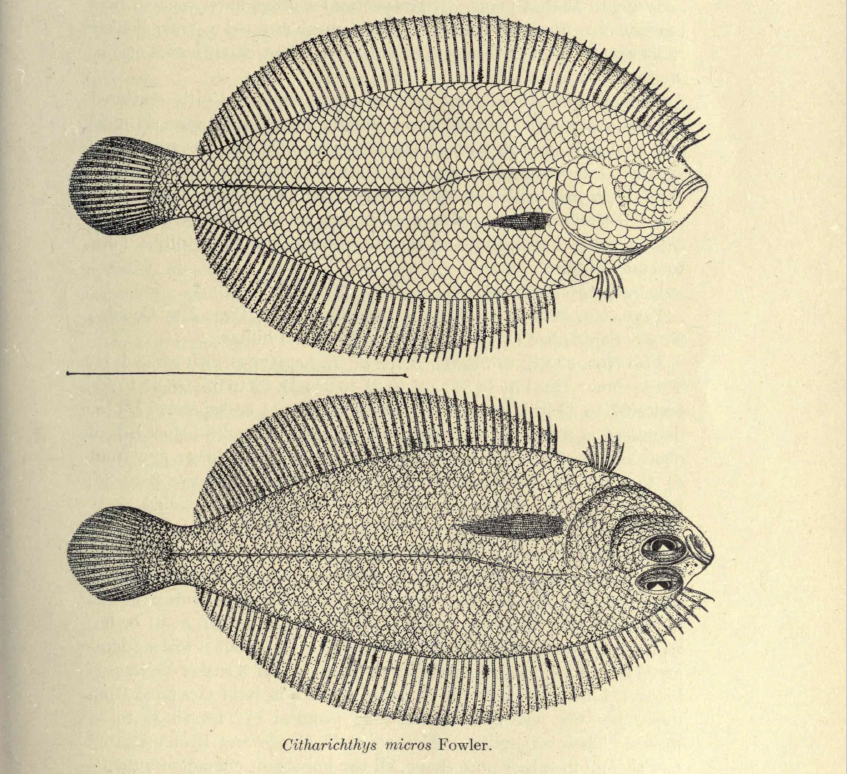
Source: Fowler 1911.
| Family | Scientific Name | Author | Year | Common Name |
| Cyclopsettidae | Etropus microstomus | (Gill) | 1864 | Smallmouth Flounder |
All Etropus Species: Mouth small, maxilla 3.5 to 4.2 in head length nearly reaching vertical through front margin of eye. Jaws on blind side arched; no enlarged teeth, front teeth in both jaws equal in size to lateral teeth.
Etropus microstomus
Unique Characters: Accessory scales present. Gill rakers on lower limb of first arch 3-6 (rarely 7). With scales on snout. Mandible relatively symmetrical. Accessory scales cover 1/2 or less of exposed surface of primary scales in fish larger than about 60 mm standard length. Greatest body depth usually less than 50% standard length. Number of gill rakers on upper limb of first arch usually equal to or less than number on lower limb.
Similar Species:
Etropus crossotus, Fringed Flounder
Etropus rimosus, Gray Flounder
Etropus cyclosquamus, Shelf Flounder
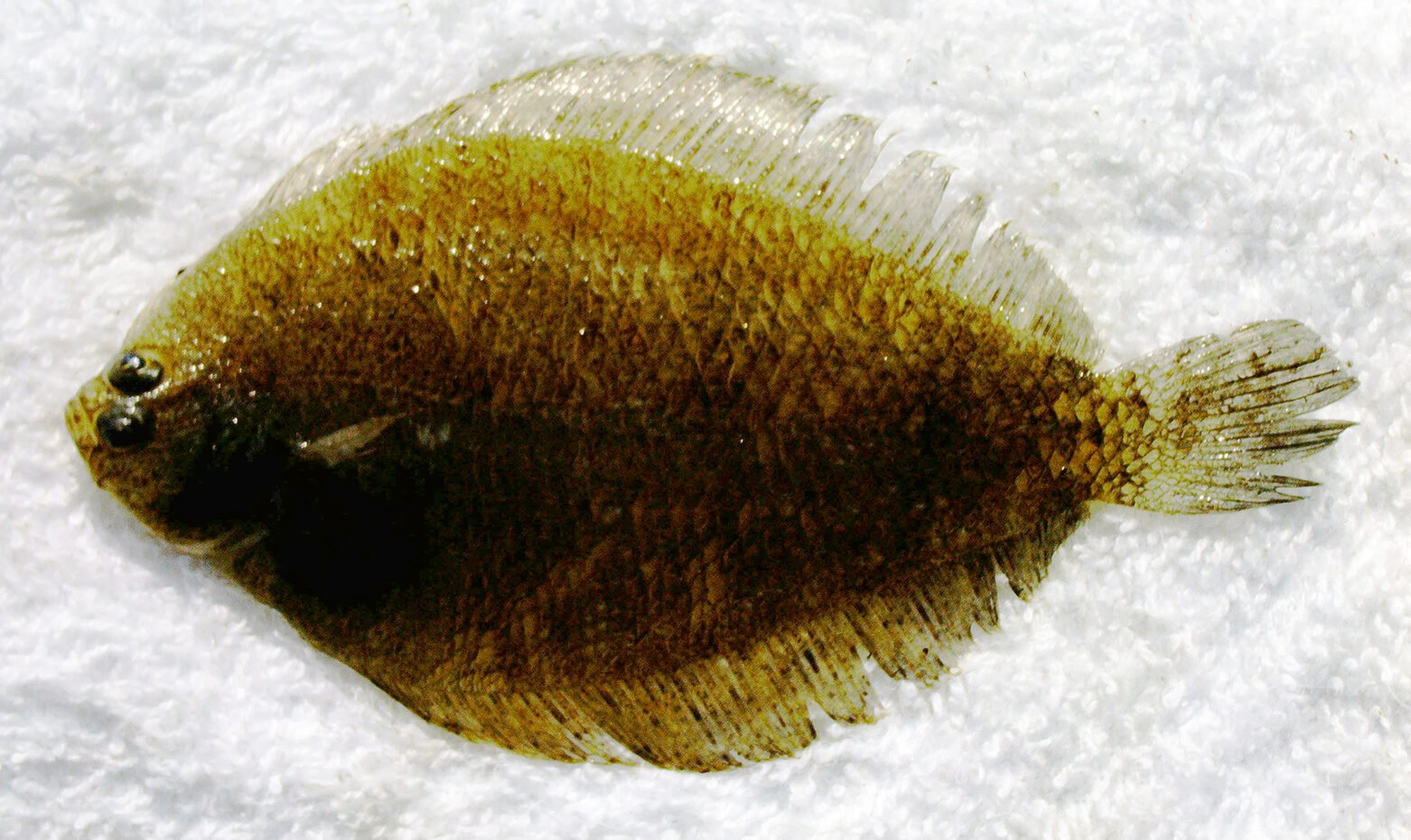
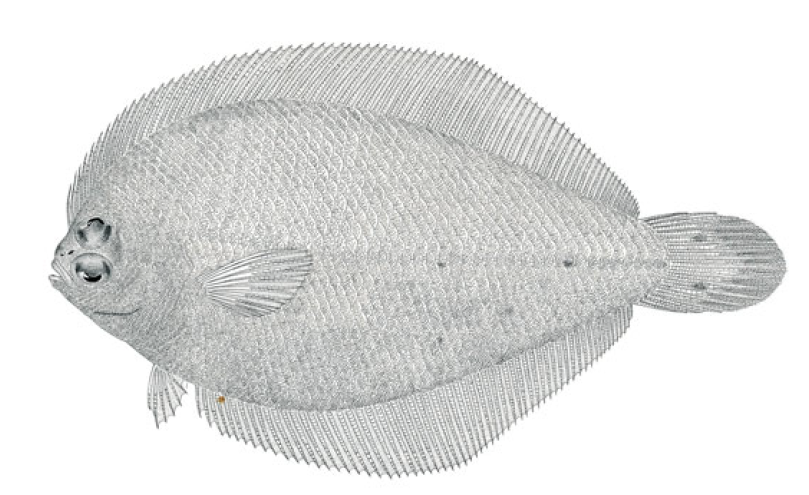
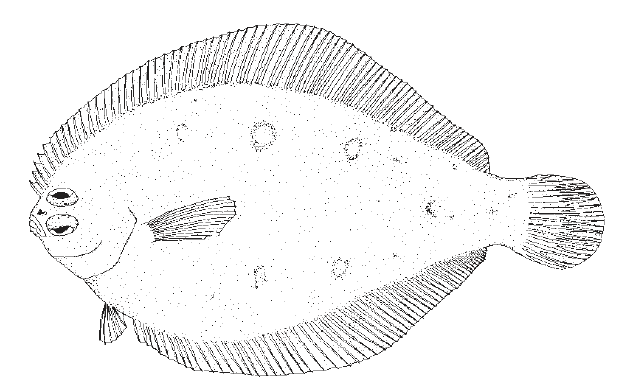
Source: FAO 2002.
Fringed Flounder Etropus crossotus. Mouth small, maxilla 3.5 to 4.2 in head length nearly reaching vertical through front margin of eye. Jaws on blind side arched; no enlarged teeth, front teeth in both jaws equal in size to lateral teeth..
Gray Flounder, Etropus rimosus. Accessory scales present. Gill rakers on lower limb of first arch 3-6 (rarely 7). With scales on snout. Mandible not symmetrical. Accessory scales cover 3/4 of exposed surface of primary scales in fish larger than about 60 mm standard length. Greatest body depth usually more than 50% standard length. Number of gill rakers on upper limb of first arch usually exceeds number on lower limb. Snout with scales forward of a line between ocular- and blind-side nostrils in fishes greater than 30 mm standard length. Ctenii on snout scales highly modified, especially in large males; Primary scales of blind side ctenoid, but ctenii may be indistinct on fish less than 50 mm standard length. Without dark circles on ocular side.
Shelf Flounder, Etropus cyclosquamus. Accessory scales present. Gill rakers on lower limb of first arch 3-6 (rarely 7). With scales on snout. Mandible not symmetrical. Accessory scales cover 3/4 of exposed surface of primary scales in fish larger than about 60 mm standard length. Greatest body depth usually more than 50% standard length. Number of gill rakers on upper limb of first arch usually exceeds number on lower limb. Snout without scales forward of a line between ocular- and blind-side nostrils in fishes greater than 30 mm standard length, or rarely, with 1 or 2 scales present in large specimens. Ctenii on snout scales simple; primary scales of blind side cycloid. Often with row of 4-6 small dark circles on ocular side above and below lateral line, but circles may be indistinct on fish collected over dark substrate.
Reference:
Fowler, H.W. 1911. A new flatfish from New Jersey. Proceedings of the Academy of Natural Sciences of Philadelphia 63: 200-203.