
| Family | Scientific Name | Author | Year | Common Name |
| Stomiidae | Eustomias bigelowi | Welsh | 1923 | Swollenbulb Dragonfish |
Family Melanostomiidae (genera Bathophilus, Chirostomias, Echiostoma, Eustomias, Flagellostomias, Gramatostomias, Leptostomias, Melantostomias, Pachystomias, and Photonectes) – Small, oblique denticles posteriorly on maxilla. Chin barbel present; ranging widely in length, with or without branches or terminal elaborations. Dorsal fin located well posteriorly, directly above anal fin; dorsal adipose fin absent (except in Chirostomias). Suborbital photophore absent; postorbital photophore usually present, located posteroventrally to eye, sometimes reduced or absent in females (FAO 2002).
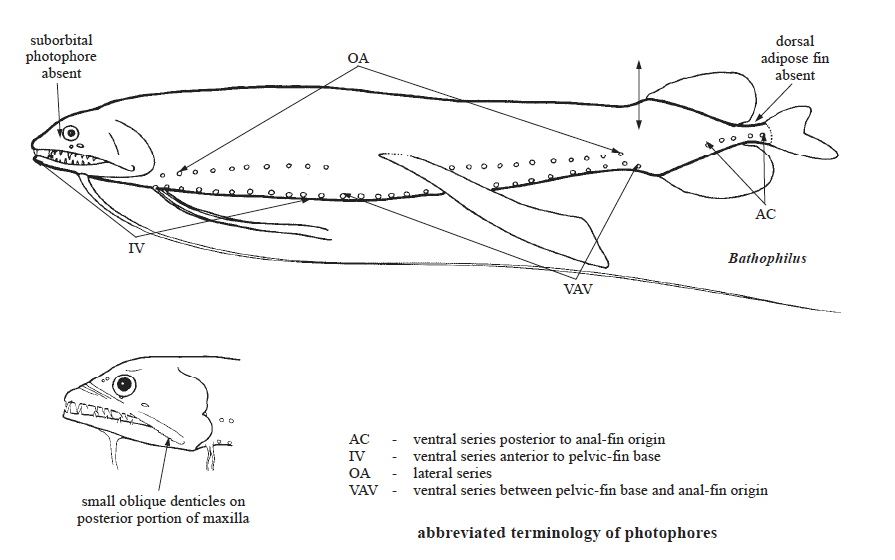
All Eustomias Species: Body without scales or hexagonal scale pockets. Dorsal and anal fins located near caudal fin; dorsal adipose fin absent. Anal-fin base much longer than dorsal-fin base, its origin anterior to dorsal-fin. Mouth with floor, lower jaws connected by membrane. First pectoral-fin ray, if present, not separated from remaining rays; snout tapering and protrusible (FAO 2020).
Ventral [pelvic] fins inserted close to the ventral outline of t he body. Mouth comparatively moderate or long and curved, always with a complete floor between t he limbs of the lower jaw. Barbel present. Only one conspicuous suborbital organ on each side of the head. Anal fin originating well in advance of the considerably shorter dorsal fin. Maxillaries and praemaxillaries anteriorly movably attached to the ethmoidal region of the head, thus forming a protractile, usually long and rather pointed snout (Parr 1927).
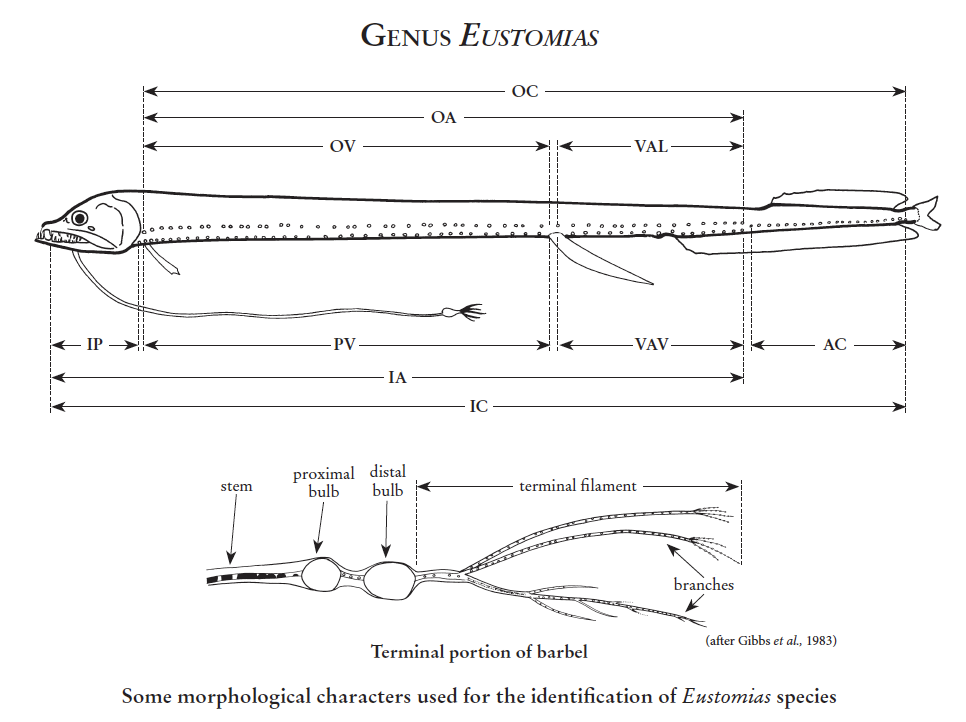
Eustomias bigelowi
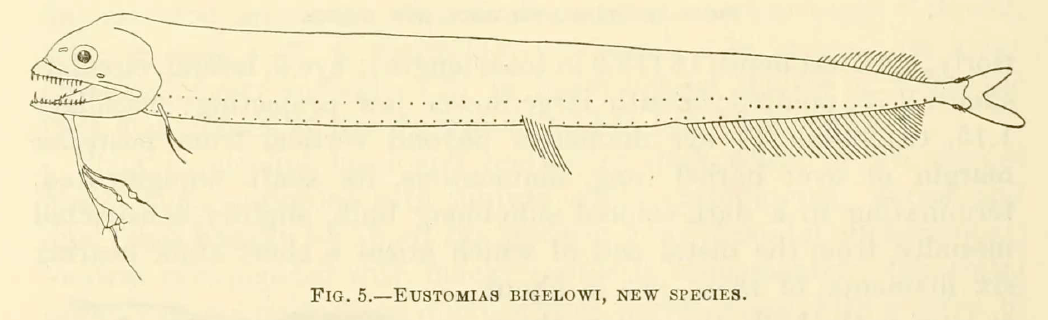
Unique Characteristics: A small triangular luminous area close to maxillary behind vertical from posterior margin of eye; two rows of small, circular, nearly equidistant photophores along side of body ventrally, extending to about the 6th anal ray; from this point to the caudal peduncle a single intermediate row of somewhat larger photophores; upper row, gill opening to ventrals, 29; ventrals to anal, 10; along anal, 4; lower row, isthmus to pectorals, 9; pectorals to ventrals, 29; ventrals to anal, 10; along anal, 4; intermediate row along anal to caudal peduncle, 21 (Welsh 1923).
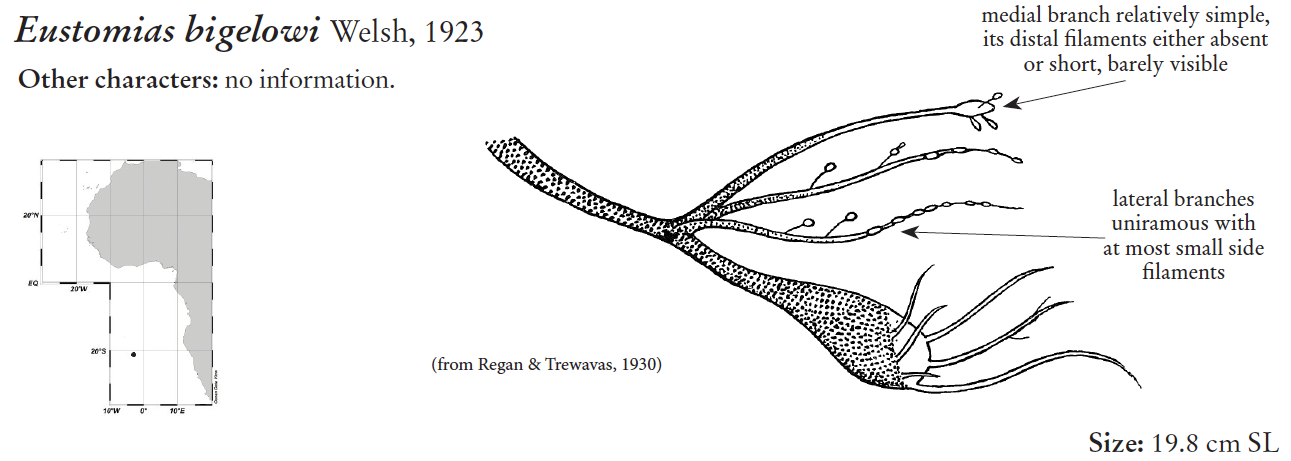
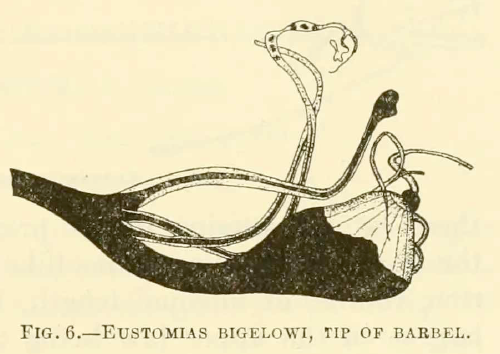
Terminal bulb with at least one medially based filament (paired lateral filaments may also be present; terminal bulb pigmented only on ventral surface, pigment reaching to or almost to bulb tip (not clear in some large females with very small bulbs); lateral branches relatively simple, uniramous (Clarke 2000).
Pectoral fins present; pectoral-fin rays 2, with the second not minute.Pectoral fin-rays closely bound by a black membrane; a deep, wide but short ventral body groove present. Terminal bulb either with at least 1 medially based filament (paired lateral filaments may also be present). Lateral branches arising from medial branch well distal to origin of latter from barbel stem. Lateral branches uniramous with at most small side filaments; medial branch relatively simple, its distal filaments either absent or short, barely visible (FAO 2020).
Similar Species:
Eustomias borealis, Sidefilament Dragonfish
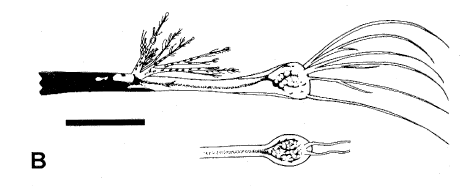
Sidefilament Dragonfish, Eustomias borealis. Terminal bulb with at least one medially based filament (paired lateral filaments may also be present. Terminal bulb either with at least some of its dorsal surface pigmented; lateral branches variable, relatively simple only in combination with pigment on dorsal surface of terminal bulb. Lateral branches arising from stem together medial branch or arising from medial branch immediately distal to the medial origin. Terminal bulb length less than half distal barbel or, if greater, with pigment on dorsal surface, not tightly constricted distally. Terminal bulb more or less spheroidal, its length less than twice its thickness. Distal barbel unpigmented except for small patches or lines on terminal bulb. Terminal bulb with small streaks or patches of pigment on dorsal surface; a pair of laterally based terminal filaments and one or more medial terminal filaments present. Pigment on terminal bulb limited to irregular streaks more or less outlining internal ovoid bodies (Clarke 2000).
Eustomias braueri, Muliray Dragonfish
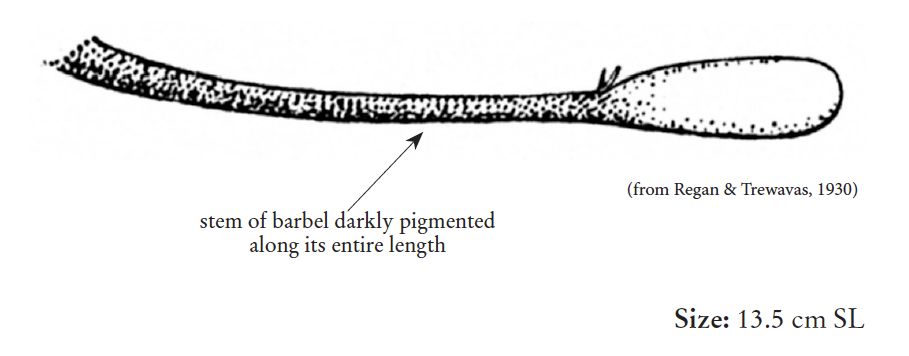
Muliray Dragonfish, Eustomias braueri. Pectoral fins present; pectoral fin rays 2 or more. Pelvic fin rays 8. Wide groove present on the ventral body margin behind the pectoral fins. Stem of barbel darkly pigmented along its entire length; a series of round luminous spots on the lower side of the body that resemble large photophores (FAO 2020).
Eustomias contiguus, Nearbulb Dragonfish
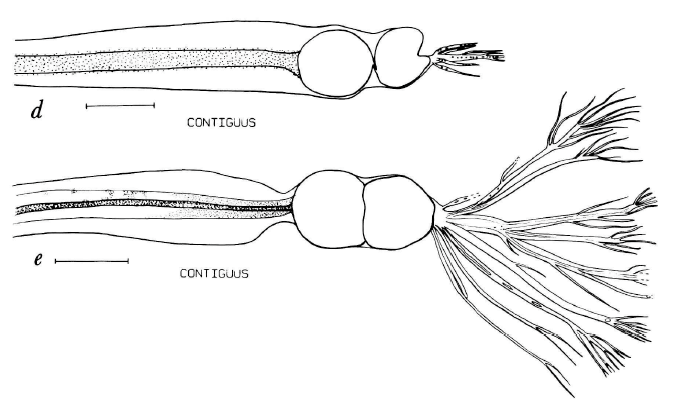
Nearbulb Dragonfish, Eustomias contiguus. Two contiguous terminal bulbs, spheroidal to ovoid in shape. Both bulbs 0.6%-1.2% standard length; distal bulb 75% of to 1.3 times length of proximal bulb. Five to nine terminal filaments arising together from distal bulb or from a short stem, one usually thicker than others with one or more bifurcations, trifurcations, or side branches; most filaments with numerous side branches giving a bushy appearance. Longest filament 1.5%-3.8% standard length, 1.7-4.9 times distal bulb length. Barbel length 15%-49% standard length. Stem axis darkly pigmented except in smallest specimens. External chevron-shaped or roundish striated areas on stem unpigmented. Paired middorsal spots between occiput and dorsal-fin origin usually 8, occasionally 7 (Gomon and Gibbs 1985).
Eustomias enbarbatus, Simplebranch Dragonfish
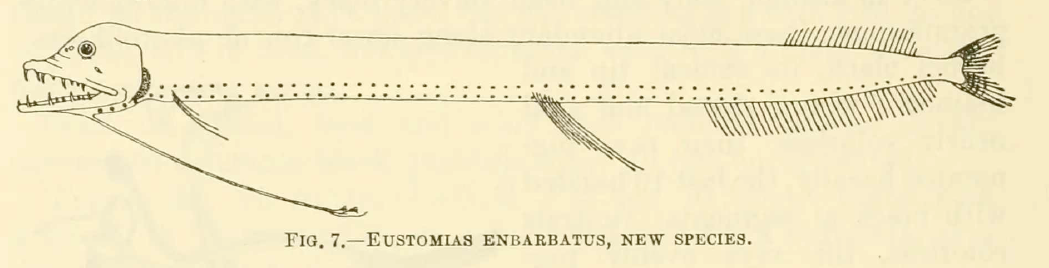
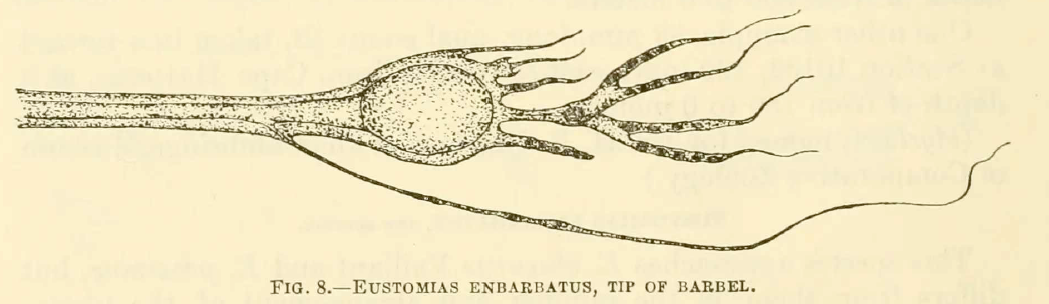
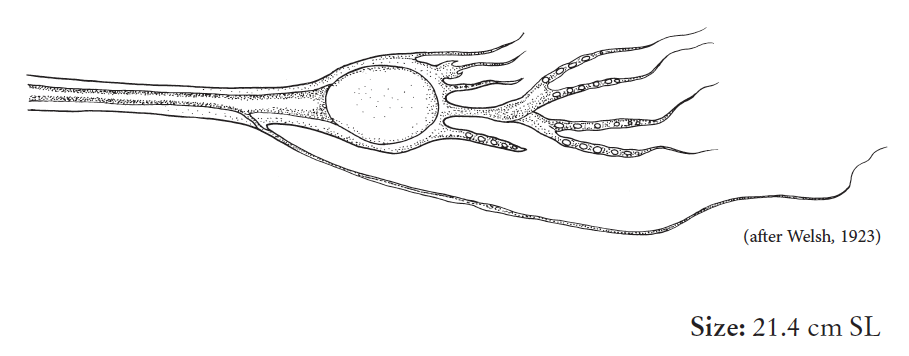
Simplebranch Dragonfish, Eustomias enbarbatus. Pectoral fins present; pectoral-fin rays 4. Wide groove on the ventral body margin behind the pectoral fins absent (FAO 2020).
Barbel long, filamentous, an ovoid bulb at tip; near the base of this bulb arises a long filament containing at intervals yellowish ovoid bodies; from the distal portion of the bulb arise five short filaments, four of which are simple, two of them containing ovoid bodies; the fifth terminates in an ovoid body from which spring two longer filaments, tridentlike, both of which bifurcate; each of these latter contains in its proximal half several yellow bodies, the distal half being threadlike. A small oval luminous area close to maxillary behind eye; two rows of small, circular, nearly equidistant photophores on sides of body ventrally, the upper row extending to end of anal, the lower to 5th anal ray, 27 in each row from pectorals to ventrals [pelvic fins] (Welsh 1923].
Eustomias filifer, Ovallight Dragonfish
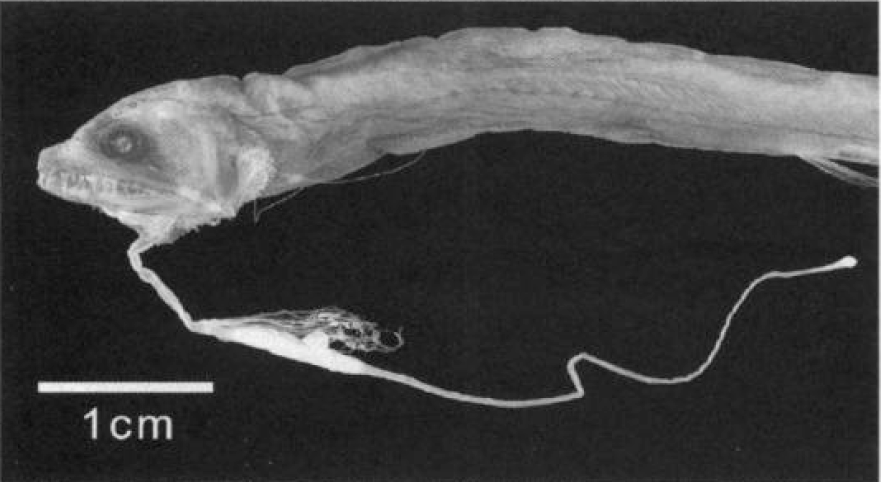
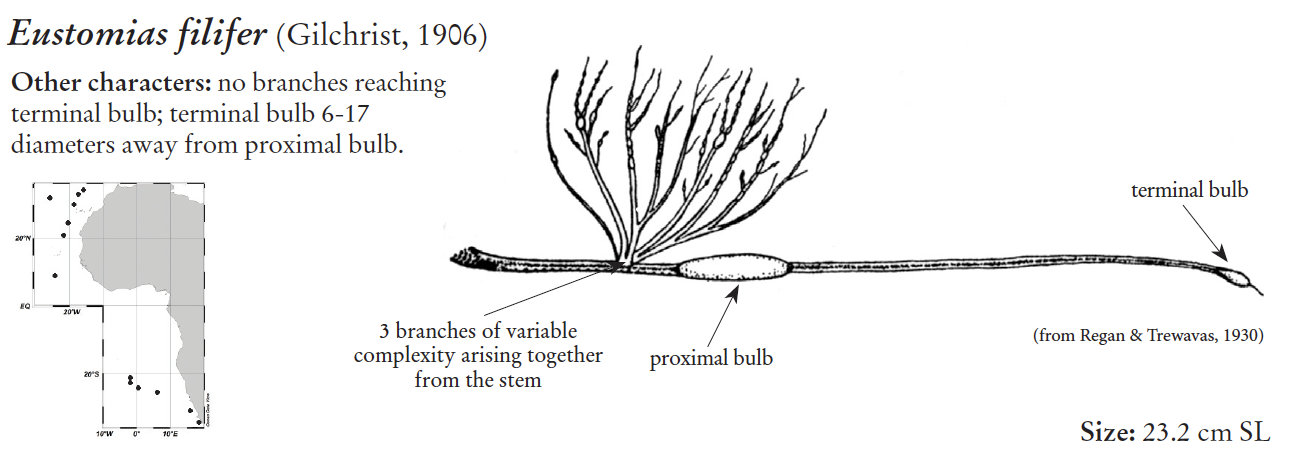
Ovallight Dragonfish, Eustomias filifer. Pectoral fins present. Pectoral-fin rays 2, but 1 is minute (the minute ray sometimes absent) giving the impression of only a single pectoral-fin ray being present; barbel with 3 branches of variable complexity arising together from the stem. Barbel with a single, well-defined proximal bulb on main stem between point of branching and terminal bulb (FAO 2020).
Eustomias jimcraddocki, Tearbulb Dragonfish
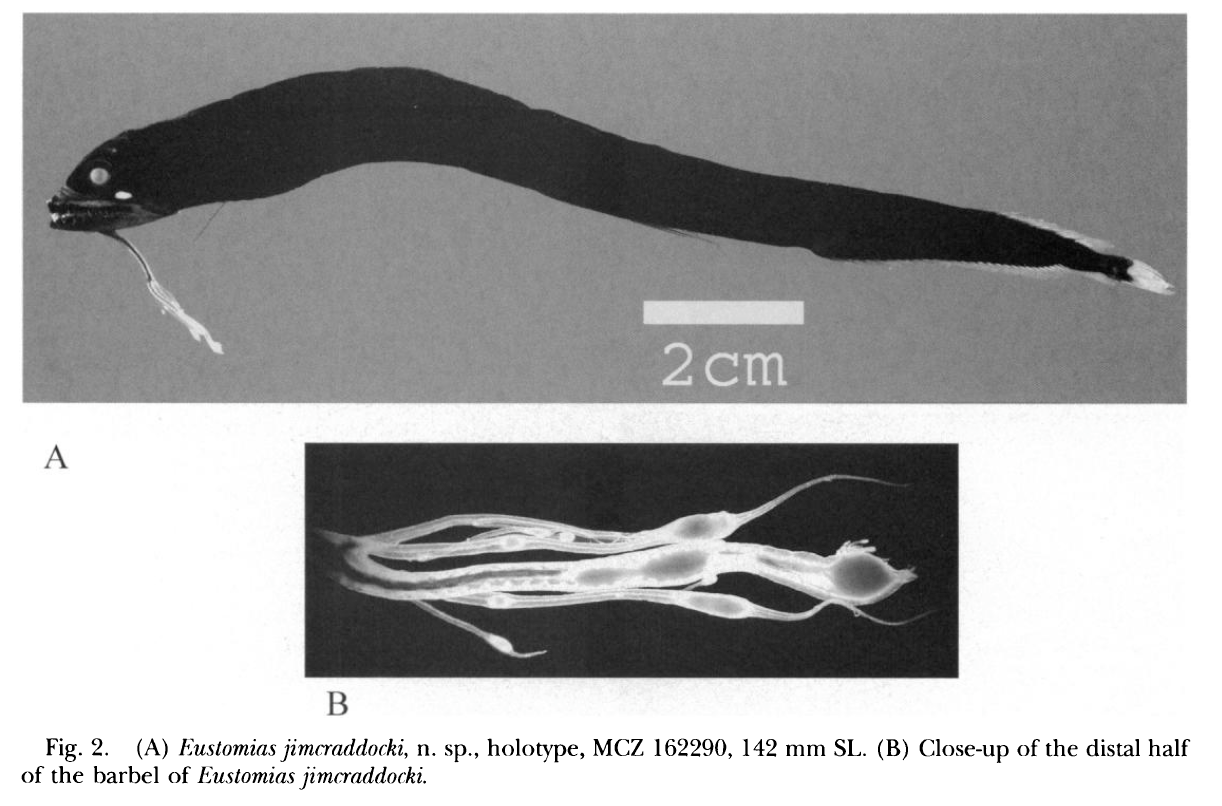
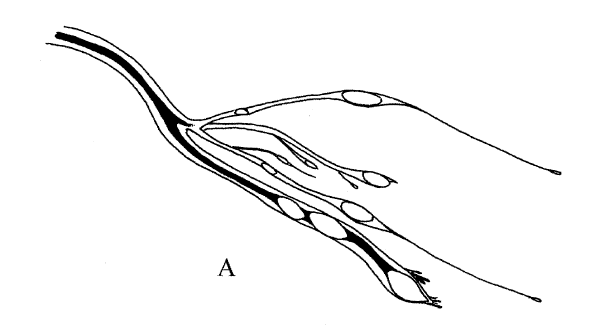
Tearbulb Dragonfish, Eustomias jimcraddocki. Two pectoral rays (one as tiny rudiment), and a barbel with three branches arising proximal to mid-length of the stem, followed by two ovoid swellings (bulbs), either contiguous or separated, and a large terminal bulb. The tear-shaped terminal bulb larger in diameter than the stem or proximal bulbs, with the acuminate end posteriad and upturned dorsally, and bears multiple filaments and bulblets in two groups, one at its anterodorsal surface and one at its terminus. Barbel relatively short (≤ 20% standard length) (Sutton and Hartel 2004).
Barbel with two or more discrete proximal bulbs on main stem, or two contiguous bulbs forming one long (20-25% main stem length) irregular bulb, between point of branching and terminal bulb. Barbel with two discrete or contiguous proximal bulbs on main stem between point of branching and terminal bulb; main stem beyond branches thickening to a large terminal bulb with two groups of filaments (Sutton and Hartel 2004).
Eustomias macronema, Bigbarb Dragonfish
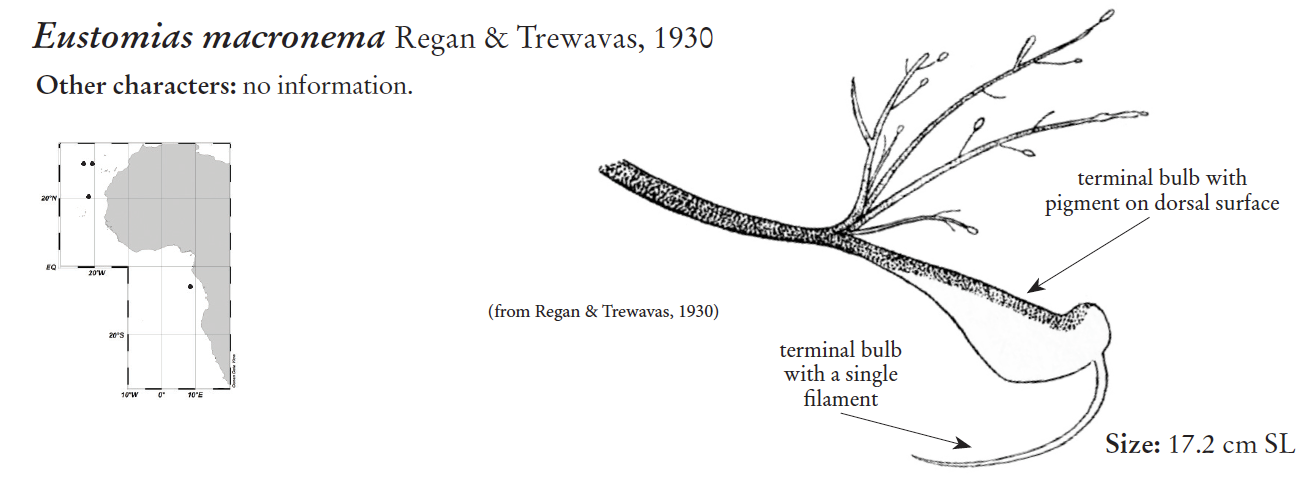
Bigbarb Dragonfish, Eustomias macronema. Terminal bulb with at least one medially based filament (paired lateral filaments may also be present. Terminal bulb either with at least some of its dorsal surface pigmented; lateral branches variable, relatively simple only in combination with pigment on dorsal surface of terminal bulb. Lateral branches arising from stem together medial branch or arising from medial branch immediately distal to the medial origin. Terminal bulb length less than half distal barbel or, if greater, with pigment on dorsal surface, not tightly constricted distally. Terminal bulb elongate, its length greater than twice its thickness. Five branches off stem; medial branch nearly equal to or longer than lateral branches; bulb with a single terminal filament (Clarke 2000).
Pectoral fins with rays 2, with the second not minute. Pectoral fin-rays closely bound by a black membrane; a deep, wide but short ventral body groove present. Terminal bulb with a single filament and with at least 1 medially based filament. Lateral branches arising from medial branch immediately distal to medial’s origin. Terminal bulb length less than 1/2 distal barbel length or, if greater, with pigment on dorsal surface. Five branches arising from stem (2 pairs of lateral branches and 1 medial branch); one pair of lateral branches may actually arise from the other just distal to stem (FAO 2020).
Eustomias monodactylus, North Atlantic Dragonfish
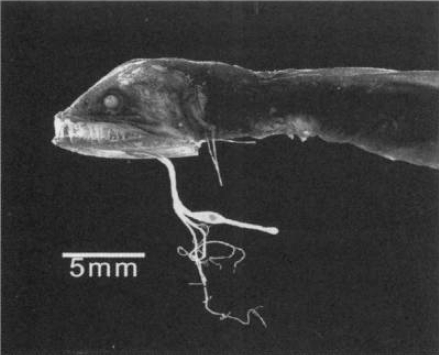
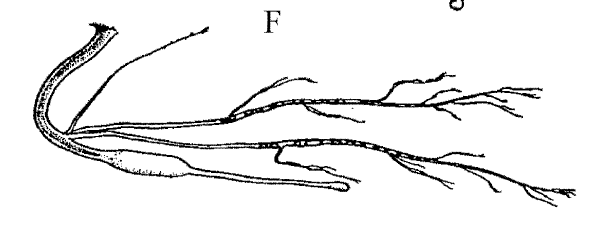
North Atlantic Dragonfish, Eustomias monodactylus. Barbel with a single, well-defined proximal bulb on main stem between point of branching and terminal bulb. Barbel main stem length less than 25% standard length; or more branches reaching terminal bulb; terminal bulb less than four diameters from proximal bulb (Sutton and Hartel 2004).
Eustomias obscurus, Pairedlight Dragonfish
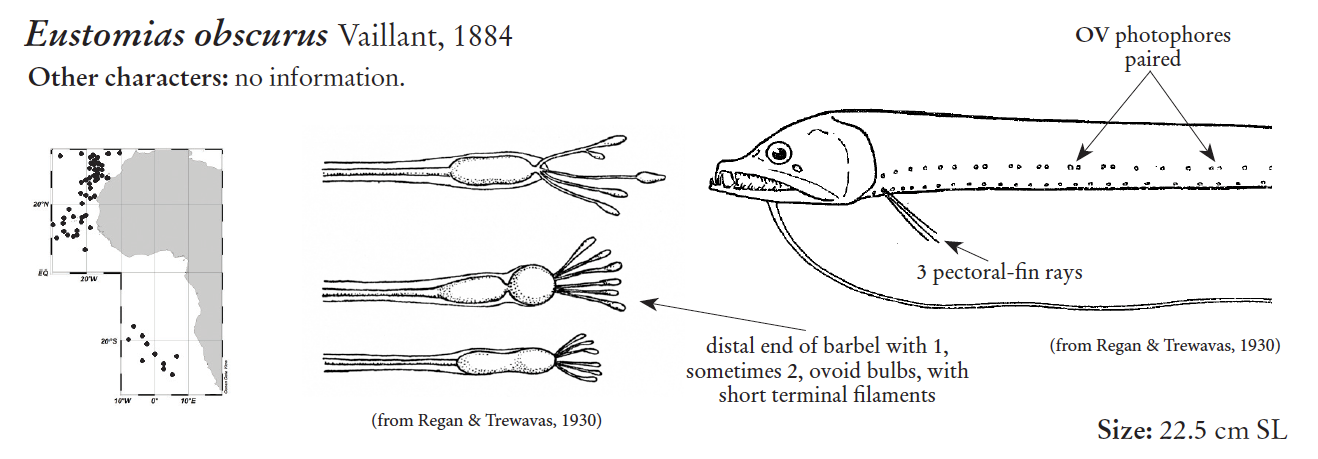
Pairedlight Dragonfish, Eustomias obscurus. Pectoral fins present with 3 rays.OVphotophores paired (single in all other species); distal end of barbel with 1, sometimes 2, ovoid bulbs, with short terminal filaments (FAO 2020).
References:
Clarke, T.A. 2000. Review of nine species of North Atlantic Eustomias, subgenus Dinematochirus (Pisces: Stomiidae), with the description of two new species. Copeia, 2000 (1): 96-111.
FAO. 2002. The living marine resources of the Western Central Atlantic. Volumes 1-3. K.E. Carpenter (ed.). Food and Agriculture Organization of the United Nations, Rome, Italy. 4099 pp. http://www.fao.org/3/y4160e/y4160e00.htm.
(FAO 2020) Sutton, T.T., P.A. Hulley, R. Wienerroither, D. Zaera-Perez, and J.R. Paxton. 2020. Identification guide to the mesopelagic fishes of the central and south east Atlantic Ocean. FAO Species Identification Guide for Fishery Purposes. Rome, FAO. 327 pp. https://doi.org/10.4060/cb0365en.
Gomon, J.R. and R.H. Gibbs, Jr. 1985. Taxonomy and distribution of the stomioid fish genus Eustomias (Melanostomiidae), II: Biradiostomias, new subgenus. Smithsonian Contributions to Zoology No. 409: 1-58.
Parr, A.E. 1927. The Stomiatoid fishes of the suborder Gymnophotodermi (Astronesthidae, Melanostomiatidae, Idiacanthidae) with a complete review of the species. (Scientific Results of the Third Oceanographic Expedition of the “Pawnee” 1927). Bulletin of the Bingham Oceanographic Collection Yale University 3 (2): 1-123.
Sutton, T.T. and K.E. Hartel. 2004. New species of Eustomias (Teleostei: Stomiidae) from the western North Atlantic, with a review of the subgenus Neostomias. Copeia 2004 (1): 116-121.
Welsh, W.W. 1923. Seven new species of fish of the order Malacopterygii. Proceedings of the United States National Museum, 62 (2449): 1-11.