
| Family | Scientific Name | Author | Year | Common Name |
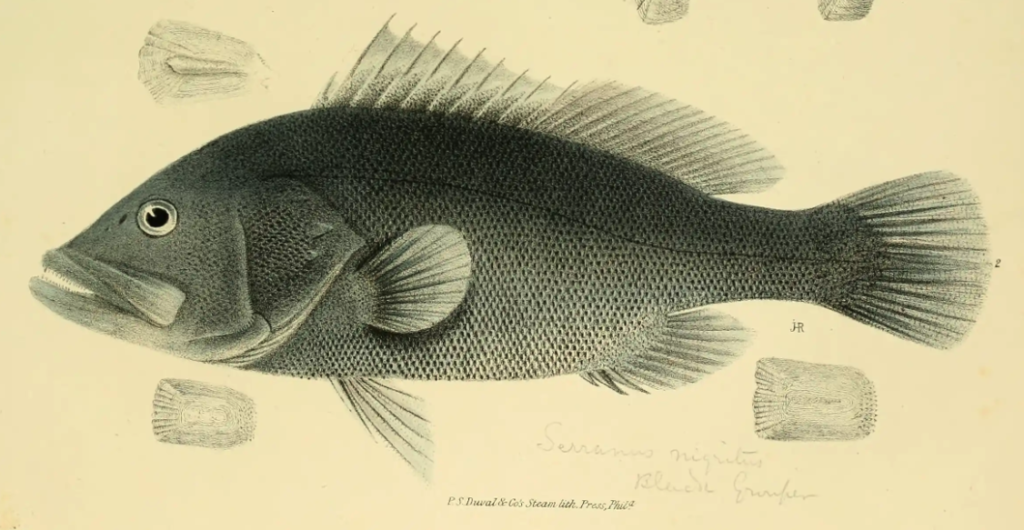
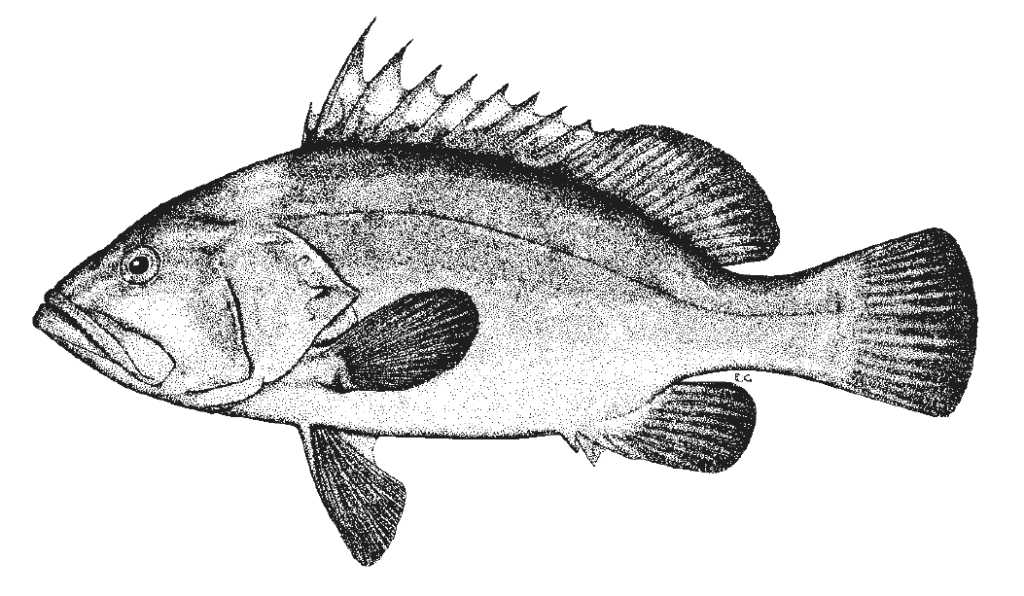
| Epinephelidae | Hyporthodus nigritus | (Holbrook) | 1855 | Warsaw Grouper |
All Hyporthodus Species: Body robust, relatively deep and oval, compressed, deepest at origin of dorsal fin. Rear of top jaw exposed when mouth closed, without bony knob at lower rear corner. Teeth depressible; sides of roof of mouth with teeth. Operculum edge with 3 flat spines; preoperculum serrate, with larger serrae at angle. Pectoral fin symmetrically rounded. Dorsal fin X-XI, 13-15; length of base of soft part not longer than that of spiny part. Anal fin III, 9. Pelvic fins inserted below or before the base of the pectoral fin. Tail fin usually rounded. Body scales rough or smooth (https://biogeodb.stri.si.edu/caribbean/en/thefishes/taxon/4815).
Hyporthodus nigritus
Unique Characteristics: Dorsal-fin rays 13-15; anal-fin rays 9. Pelvic-fin origin in front of vertical at lower end of pectoral-fin base; pelvic fins (of fish 10-50 cm standard length) about equal to or longer than pectoral fins. Head and body not covered with dark red spots. Dorsal-fin spines 10, the 2nd spine longest, twice length of 10th spine. Adults dark reddish brown or brownish grey to black; juveniles with yellow caudal fin and scattered white spots on body; no black bar or saddle blotch on caudal peduncle (FAO 2002).
Similar Species:
Hyporthodus drummondhayi, Speckled Hind
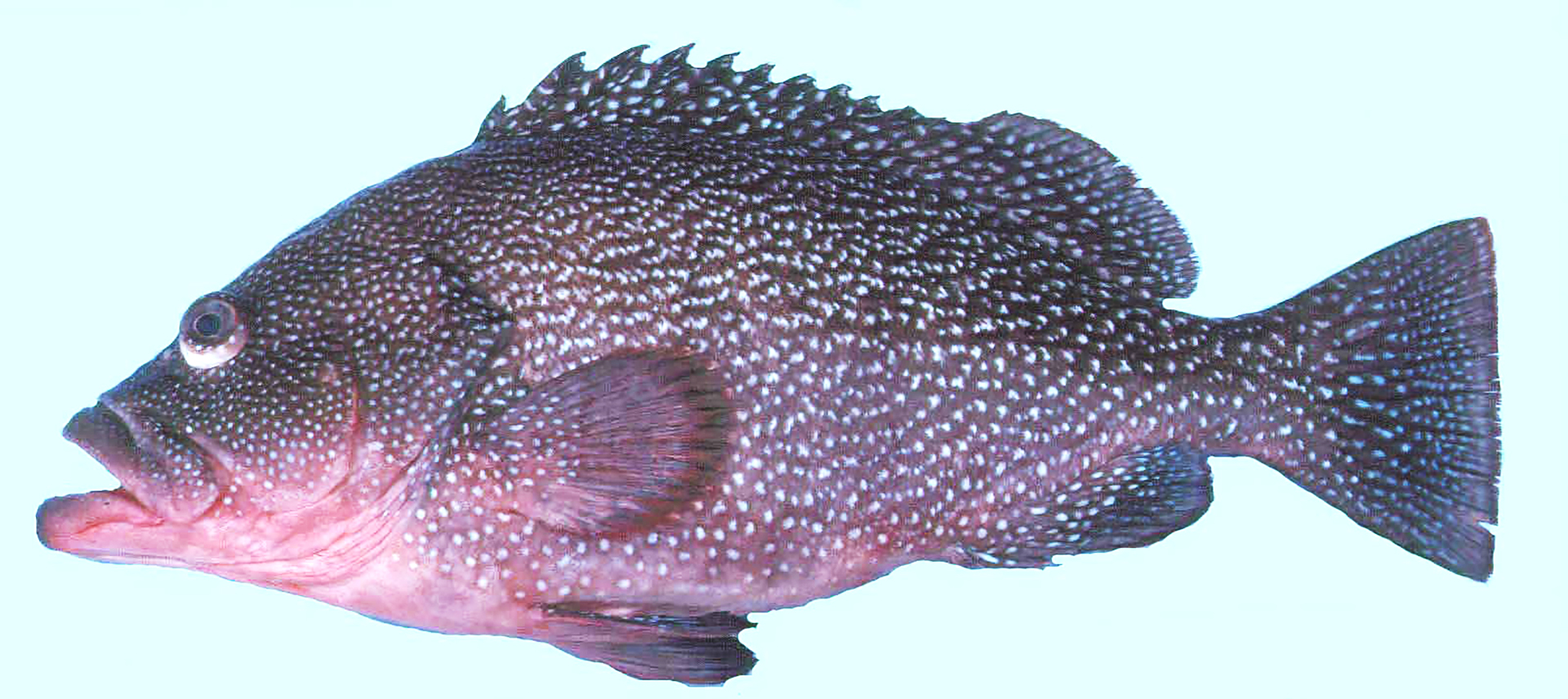
Speckled Hind, Hyporthodus drummondhayi. Dorsal-fin rays 14-18; anal-fin rays 8-10. Pelvic-fin origin below or behind lower end of pectoral-fin base; pelvic fins not longer than pectoral fins (usually less than 90% pectoral-fin length). Rear margin of caudal fin truncate or concave. Dorsal-fin membranes distinctly incised between the spines, the third or fourth spine longest. Adults dark reddish brown, the head, body and median fins covered with small white spots (most spots smaller than pupil); juveniles bright yellow, covered with small bluish white spots (FAO 2002).
Hyporthodus flavolimbatus, Yellowedge Grouper
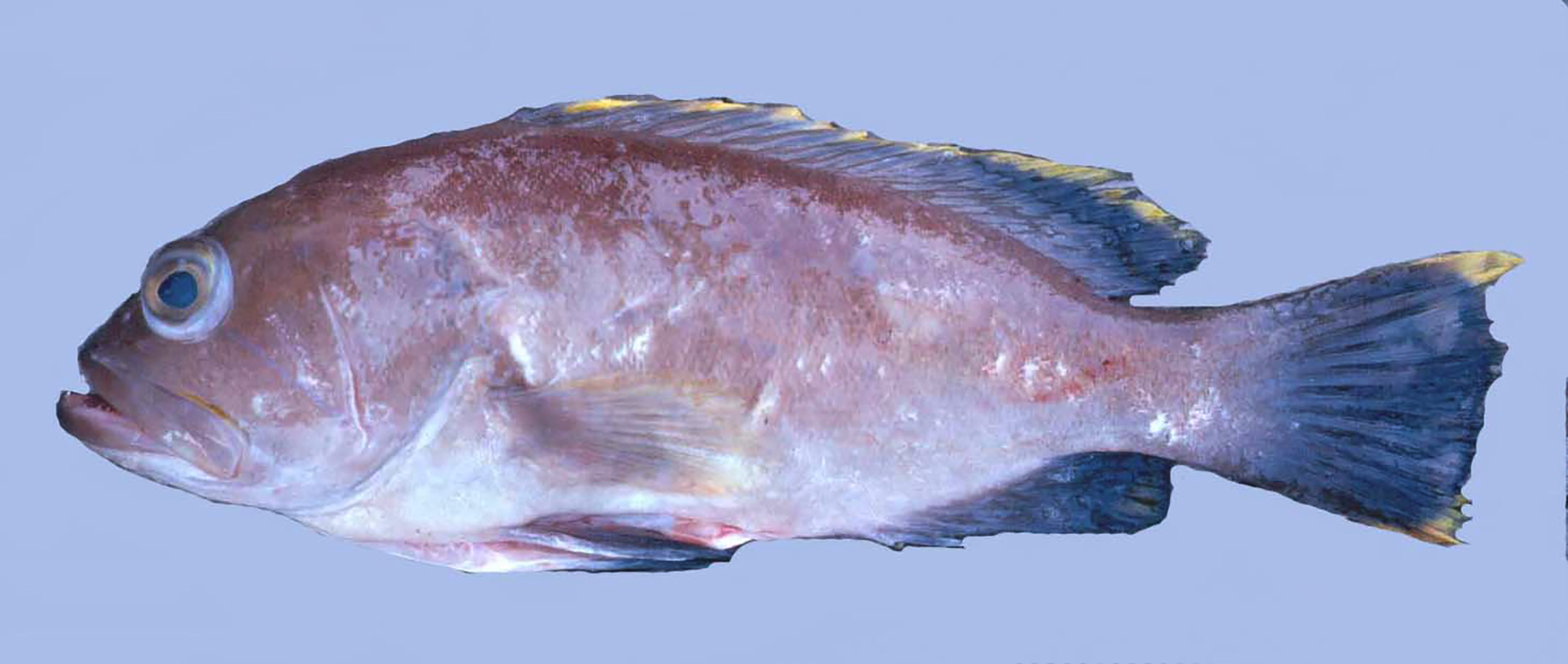
Yellowedge Grouper, Hyporthodus flavolimbatus. Dorsal-fin rays 13-15; anal-fin rays 9. Pelvic-fin origin in front of vertical at lower end of pectoral-fin base; pelvic fins (of fish 10-50 cm standard length) about equal to or longer than pectoral fins. Head and body not covered with dark red spots. Dorsal-fin spines 11, the 3rd or 4th longest, but scarcely longer than 10th spine. Juveniles (less than 20 cm standard length) with a black bar or saddle blotch on caudal peduncle. No dark bars on body. Interspinous dorsal-fin membranes not deeply incised, their margin yellow or yellowish green in juveniles and small adults. Nostrils subequal. A pearly blue line from eye to corner of preopercle; black saddle on caudal peduncle not reaching below lateral line (FAO 2002).
Hyporthodus mystacinus, Misty Grouper
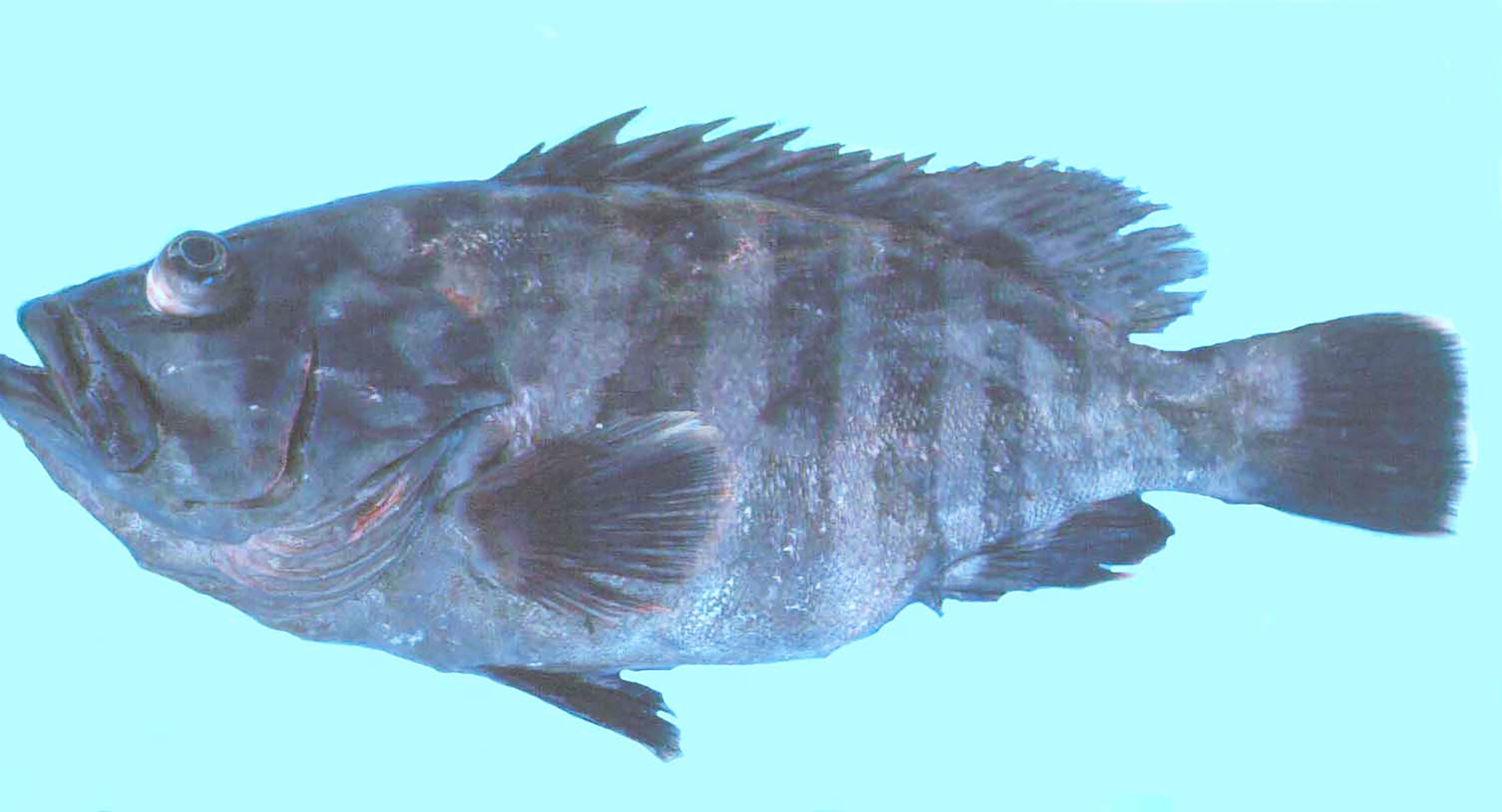
Misty Grouper. Hyporthodus mystacinus. Dorsal-fin rays 13-15; anal-fin rays 9. Pelvic-fin origin in front of vertical at lower end of pectoral-fin base; pelvic fins (of fish 10-50 cm standard length) about equal to or longer than pectoral fins. Head and body not covered with dark red spots. Dorsal-fin spines 11, the 3rd or 4th longest, but scarcely longer than 10th spine. Juveniles (less than 20 cm standard length) with a black bar or saddle blotch on caudal peduncle. Body brownish, with 8 or 9 dark bars (last 2 bars may be fused into a wide band on caudal peduncle) (FAO 2002).
Hyporthodus niveatus, Snowy Grouper

Snowy Grouper, Hyporthodus niveatus. Dorsal-fin rays 13-15; anal-fin rays 9. Pelvic-fin origin in front of vertical at lower end of pectoral-fin base; pelvic fins (of fish 10-50 cm standard length) about equal to or longer than pectoral fins. Head and body not covered with dark red spots. Dorsal-fin spines 11, the 3rd or 4th longest, but scarcely longer than 10th spine. Juveniles (less than 20 cm standard length) with a black bar or saddle blotch on caudal peduncle. No dark bars on body. Interspinous dorsal-fin membranes deeply incised, their margin black; no blue line from eye to preopercle. Posterior nostrils 3-5 times larger than anteriors (except in fish less than 15 cm standard length). Black saddle on caudal peduncle of juveniles reaching below lateral line (FAO 2002).
Reference:
Holbrook, J.E. 1855. Ichthyology of South Carolina. Charleston, SC. John Russell publisher. 182 pp, 27 pls.