
| Family | Scientific Name | Author | Year | Common Name |
| Myctophidae | Lampanyctus cuprarius | Taning | 1928 | Atlantic Blackcap Lanternfish |
All Lampanyctus Species: Three or more Prc (1 may be at or above lateral midline at base of caudal peduncle). Dn absent. Supra- and infracaudal glands overlapping scale-like plates, never bordered by jet-black pigment. Luminous tissue restricted to caudal luminous glands and occasionally at base of adipose fin. Pectoral fin long, at least reaching SAO photophores, often to anterior anal fin (FAO 2002).
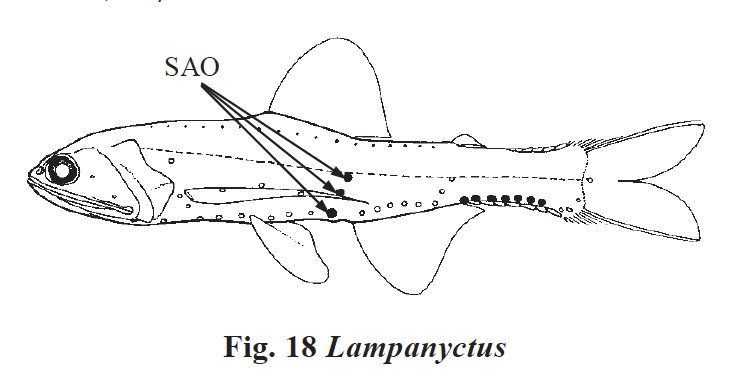
Lampanyctus cuprarius
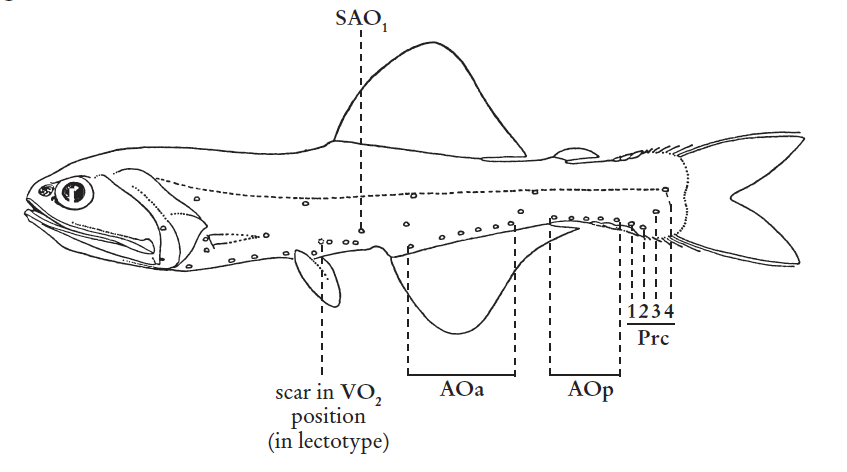
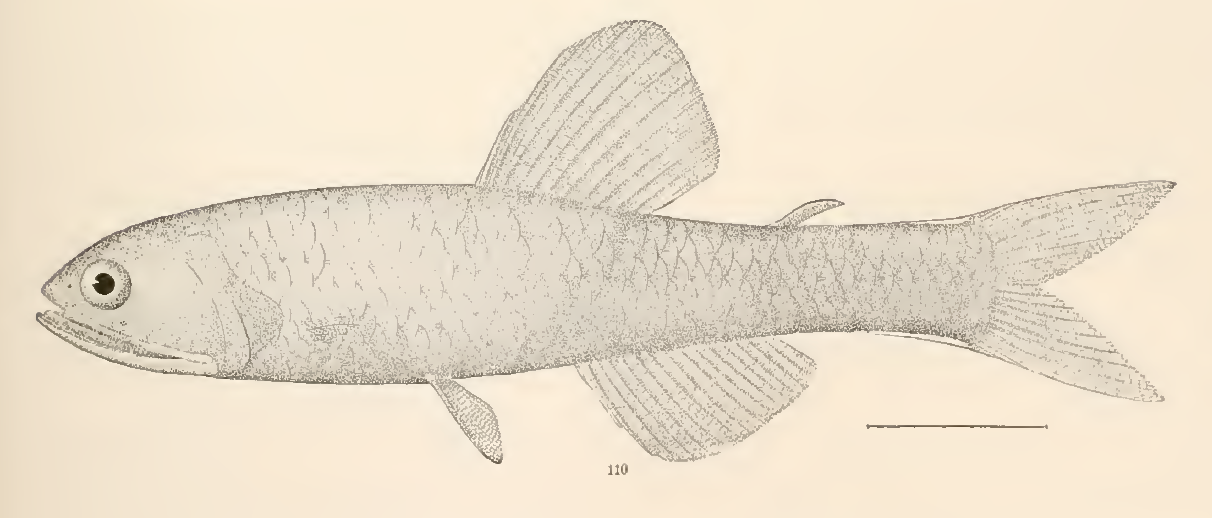
Unique Characteristics: Pectoral fins absent, rudimentary or short, seldom reaching PO4. Gill rakers less than or equal to 20; musculature weak, body usually soft and flaccid; no cheek photophores or luminous patch at adipose-fin origin. Pectoral fins present.Black pigment cap covering posterior tips of SCO and ICO (sometimes abraded); SAO1 behind vertical through VO3. Caudal-peduncle length less than upper-jaw length; total AO 11-12; Prc3 on Prc2-Prc4 straight oblique line. Atypically lectotype (shown in figure) has 5 VO (4 + 1 scar) on left side (FAO 2020).
Similar Species:
Lampanyctus alatus, Winged Lanternfish
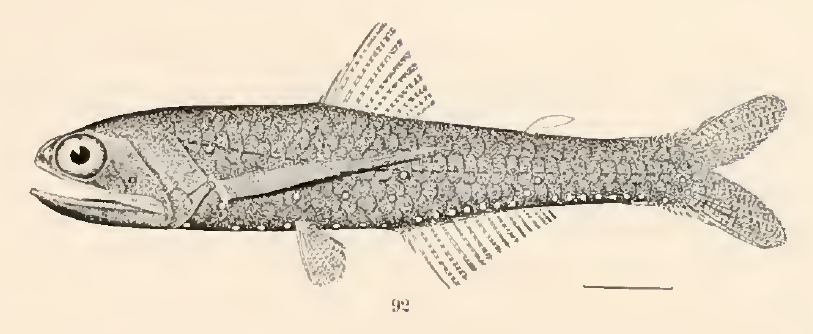
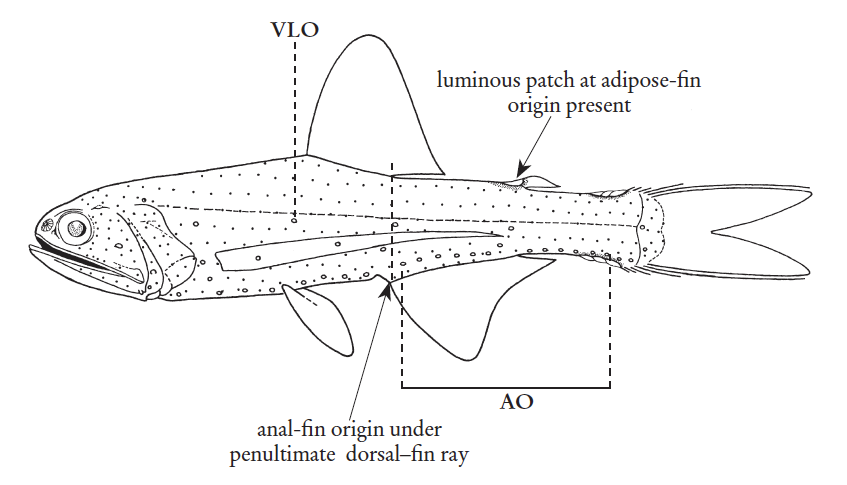
Winged Lanternfish, Lampanyctus alatus. Pectoral fins long, reaching at least to SAO1. Branchiostegal membrane with minute serial photophores between branchiostegal rays. Luminous patch present at adipose-fin origin; VLO at or 1 photophore diameter below lateral line. (FAO 2020).
Lampanyctus ater, Dusky Lanternfish
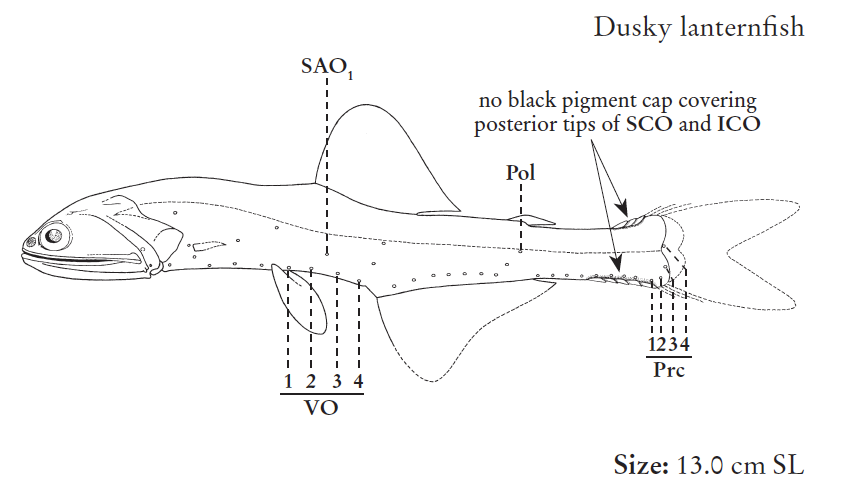
Dusky Lanternfish, Lampanyctus ater. Pectoral fins absent, rudimentary or short, seldom reaching PO4. Gill rakers less than or equal to 20; musculature weak, body usually soft and flaccid; no cheek photophores or luminous patch at adipose-fin origin. Pectoral fins present. No black pigment cap covering posterior tips of SCO and ICO; SAO1 before vertical through VO3 (FAO 2020).
Lampanyctus crocodilus, Jewel Lanternfish
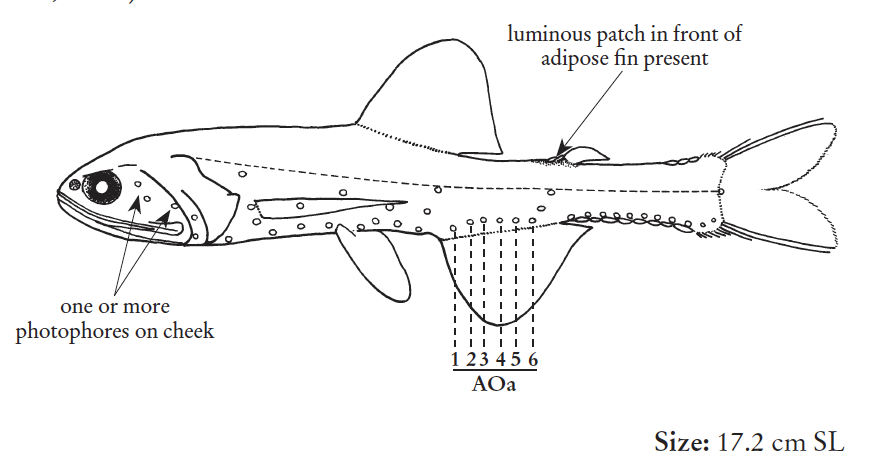
Jewel Lanternfish, Lampanyctus crocodilus. Pectoral fins long, reaching at least to SAO1. No minute serial photophores on branchiostegal membrane between branchiostegal rays. One or more photophores on cheek. Luminous patch at adipose-fin origin present (FAO 2020).
Lampanyctus festivus, Festive Lanternfish
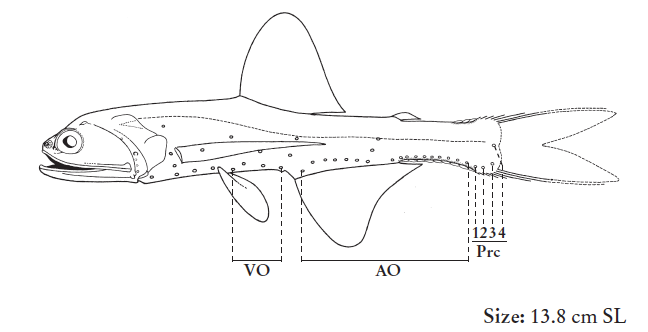
Festive Lanternfish, Lampanyctus festivus. Pectoral fins long, reaching at least to SAO1. No minute serial photophores on branchiostegal membrane between branchiostegal rays. No photophores on cheek. Prc2-Prc4 forming an arc with concavity directed anteriorly and dorsally(FAO 2020).
Lampanyctus lineatus, Longtail Blackcap Lanternfish
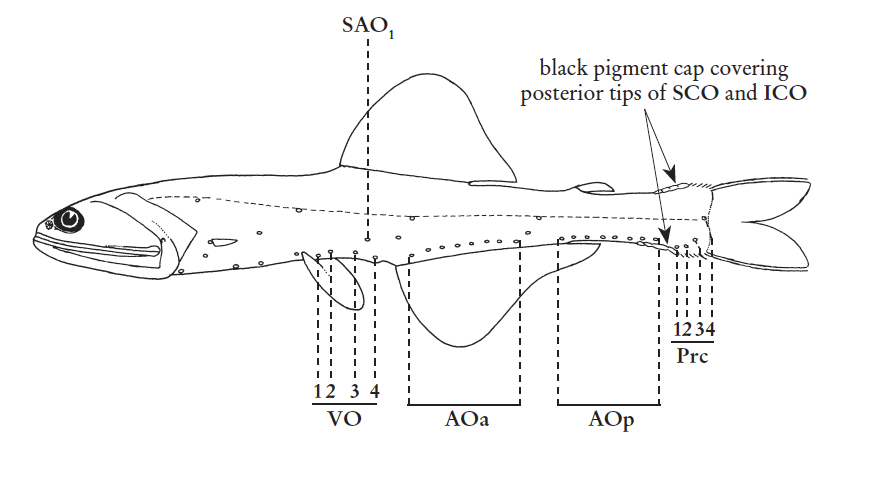
Longtail Blackcap Lanternfish, Lampanyctus lineatus. Pectoral fins absent, rudimentary or short, seldom reaching PO4. Gill rakers less than or equal to 20; musculature weak, body usually soft and flaccid; no cheek photophores or luminous patch at adipose-fin origin. Pectoral fins present. Black pigment cap covering posterior tips of SCO and ICO (sometimes abraded); SAO1 behind vertical through VO3. Caudal-peduncle length more than upper-jaw length; total AO 14-17. Prc3 touching Prc2-Prc4 line or slightly displaced posteroventrally (FAO 2020).
Lampanyctus macdonaldi, Gill Raker Lampfish
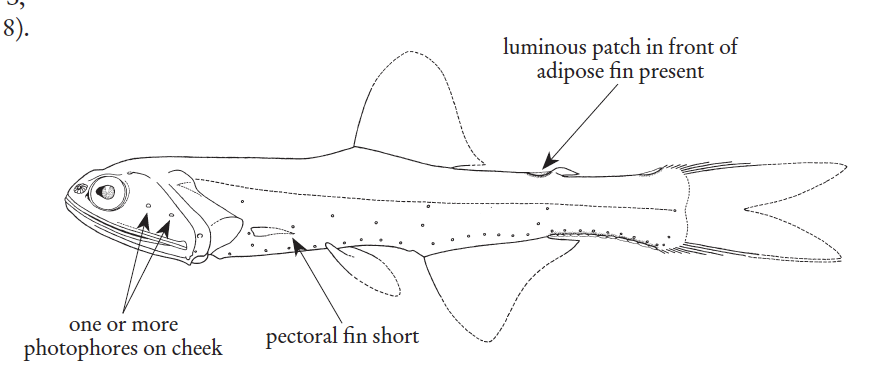
Gill Raker Lampfish, Lampanyctus macdonaldi. Pectoral fins absent, rudimentary or short, seldom reaching PO4. Gill rakers 21-26; musculature strong, body firm; cheek photophores and luminous patch at adipose-fin origin present (FAO 2020).
Lampanyctus nobilis, Noble Lanternfish
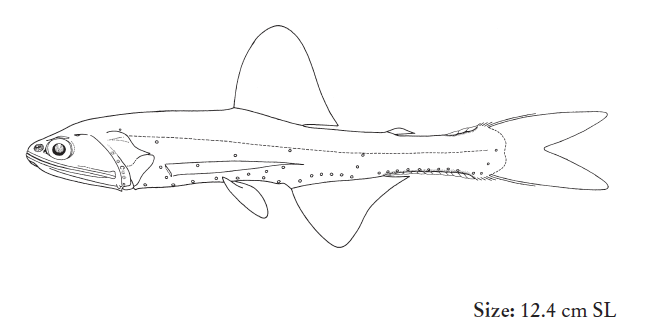
Noble Lanternfish, Lampanyctus nobilis. Pectoral fins long, reaching at least to SAO1. No minute serial photophores on branchiostegal membrane between branchiostegal rays. No photophores on cheek. Prc2-Prc4 forming straight oblique line, with Prc3 on or touching Prc2-Prc4 line, or Prc2-Prc4 only slightly arched with concavity directed posteriorly and ventrally (FAO 2020).
Lampanyctus photonotus, Dotback Lanternfish
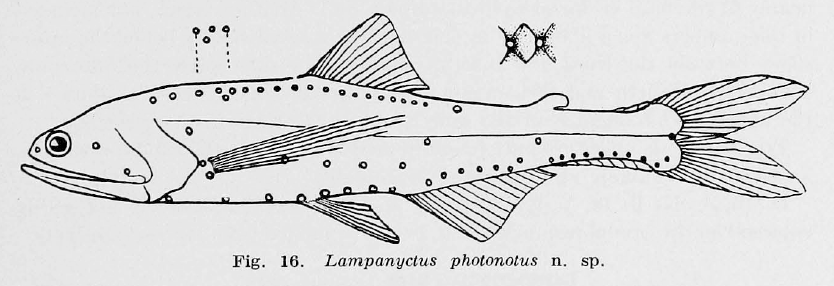
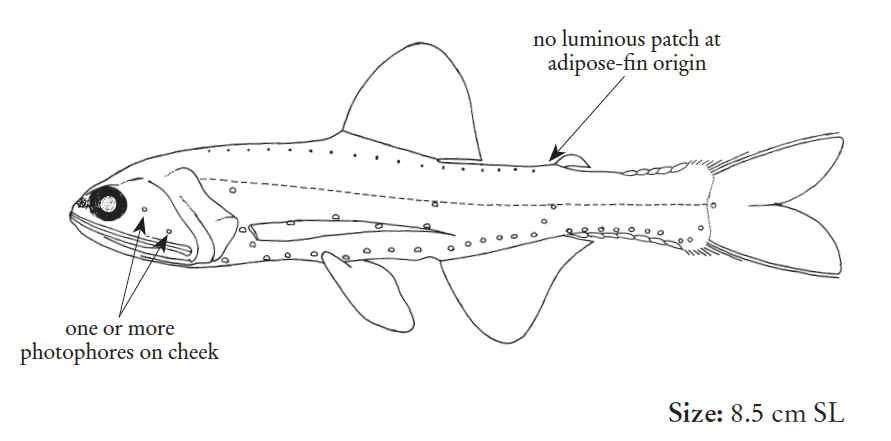
Dotback Lanternfish, Lampanyctus photonotis. Pectoral fins long, reaching at least to SAO1. No minute serial photophores on branchiostegal membrane between branchiostegal rays. One or more photophores on cheek. Luminous patch at adipose-fin origin absent (FAO 2020).
Lampanyctus pusillus, Pigmy Lanternfish
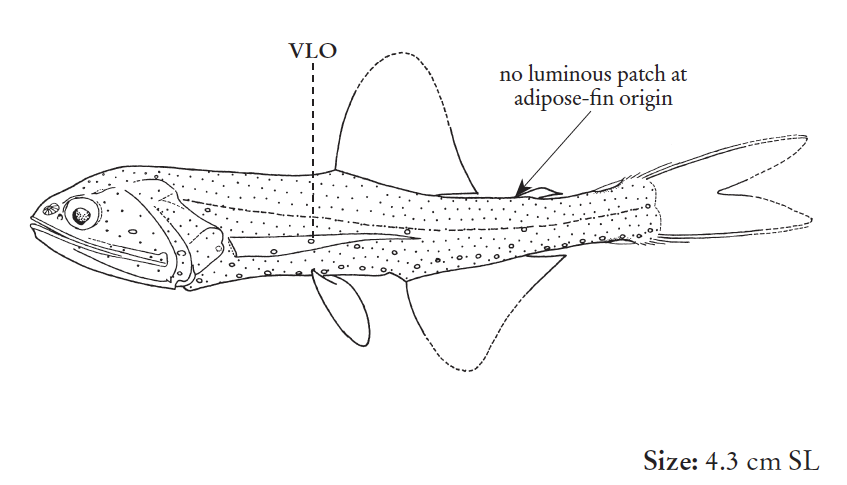
Pigmy Lanternfish, Lampanyctus pusillus. Pectoral fins long, reaching at least to SAO1. Branchiostegal membrane with minute serial photophores between branchiostegal rays. Luminous patch at adipose-fin origin absent; VLO midway between lateral line and pelvic-fin base (FAO 2020).
References:
(FAO 2002). The living marine resources of the Western Central Atlantic. Volumes 1-3. K.E. Carpenter (ed.). Food and Agriculture Organization of the United Nations, Rome, Italy. 4099p. (Available at: http://www.fao.org/3/y4160e/y4160e00.htm).
(FAO 2020) Sutton, T.T., P.A. Hulley, R. Wienerroither, D. Zaera-Perez, and J.R. Paxton. 2020. Identification guide to the mesopelagic fishes of the central and south east Atlantic Ocean. FAO Species Identification Guide for Fishery Purposes. Rome, FAO. 2020. https://doi.org/10.4060/cb0365en.
Goode, G.B. and T.H. Bean. 1896. Oceanic ichthyology, a treatise on the deep-sea and pelagic fishes of the world, based chiefly upon the collections made by the steamers Blake, Albatross, and Fish Hawk in the northwestern Atlantic, with an atlas containing 417 figures. Smithsonian Institution, United States National Museum, Special Bulletin. No. 30.