
| Family | Scientific Name | Author | Year | Common Name |
| Zoarcidae | Lycenchelys verrillii | (Goode and Bean) | 1877 | Wolf Eeelpout |
All Lycenchelys Species: The body elongate, height of t he body contained from 12-24 times in the total length (Gill 1884).
Lycenchelys verrillii
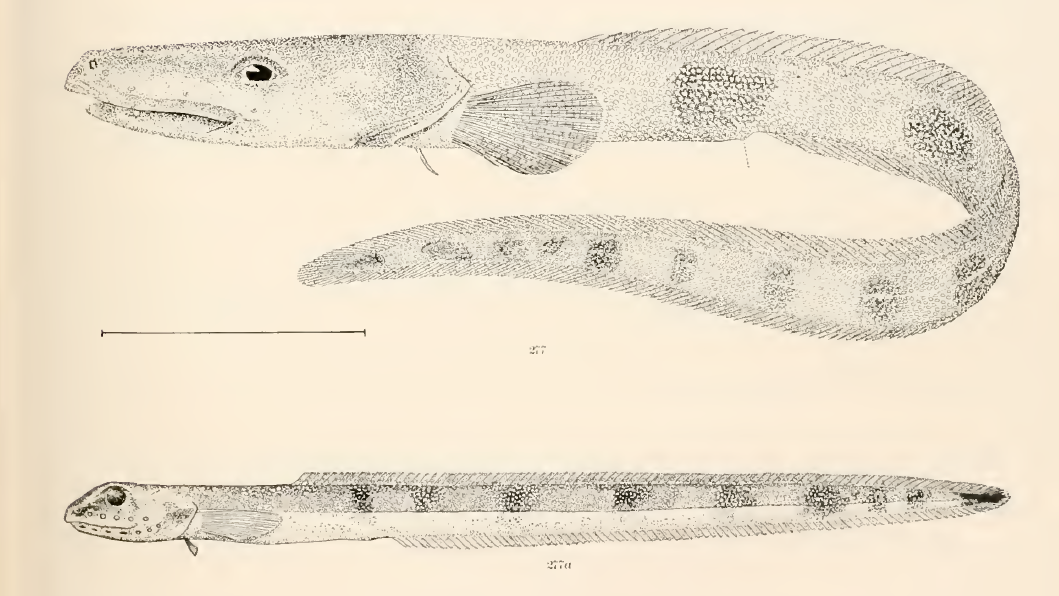
Unique Characters: Grayish brown above, pale below. 7-10 dark, round patches on sides that are bisected by lateral line. Snout long; mouth large; upper jaw slightly projecting over lower jaw. Pelvic fins very small (Kells and Carpenter 2011).
Body very elongate, its height 12-13 in its length. Head much depressed, its length 5 2/3 in that of t he body; maxillary nearly reaching posterior margin of orbit; upper jaw much the longer; profile very convex; snout obtusely rounded above. Radial formula: D. 92; A. 88. Color, light grayish brown above; below, pearly white; sides with irregular brown patches bisected by the lateral line; abdominal region livid blue; a spot of brown on the tip of the tail.
L. verrillii proves, as we have long believed it to be, a pygmy species, reaching maturity at a length of from 5 to 6 inches. The old males are transformed almost beyond specific recognition by an extraordinary development of the entire head in advance of the eyes. The snout becomes shovel-shaped, its length equal to two-fifths that of the head, while in the normal condition it is only one-fourth. We have examined specimens in intermediate condition. The extension of the snout is accompanied by a corresponding enlargement of the muscles of the cheeks (Goode and Bean 1896).
Similar Species:
Lycenchelys paxillus, Common Wolf Eel
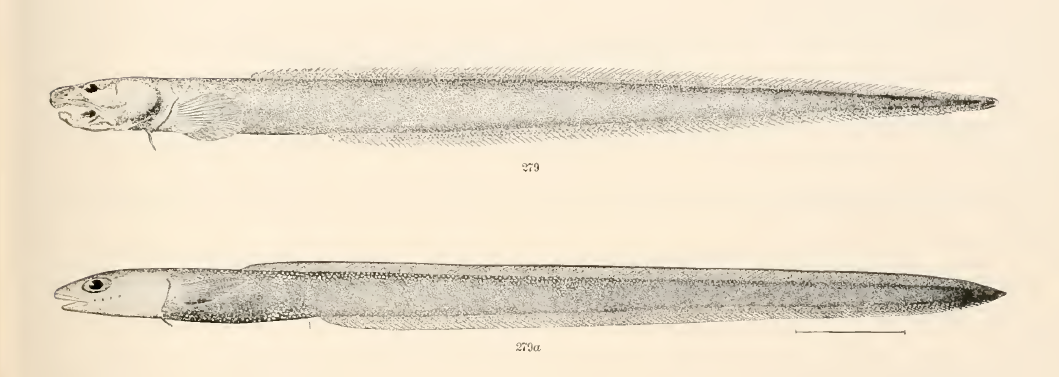
Common Wolf Eel, Lycenchelys paxillus. Body attenuate, its greatest height about half the length of the head, which is broad flat above, with declivous profile; its length contained about eight times in that of body. Upper jaw extending far beyond the lower; cheeks very full and protuberant. Teeth stout, recurved, and sharply pointed, in a single series on both jaws, except at the symphysis; a few teeth clustered at the head of the vomer; palatines with a single series; interorbital space about one-fourth length of snout, which is about equal to that of eye, which is contained 3 1/2 times in length of head. The tubular nostril is much nearer to the tip of the snout than to the eye.
Origin of dorsal over end of the extended pectoral; its distance from the tip of the snout is contained 4 to 4 2/3 times in the total length; that of the anal from the snout 3 1/3 times or less. Vent immediately in front of anal. The length of the pectoral equals one-half that of the head, or a little more. The distance of the. ventral from the snout is contained 8 1/2 times in the total length. The length of the ventral is scarcely more than that of the pupil. Scales very small, present everywhere except on the head and pectorals, extending almost out to the margin of the vertical fins. Radial formula: D. 116; A. 100. Color, light brown, the head somewhat darker.
The form of L. paxillus is rounder and more terete than that of almost any other described species. It is also easily distinguished by its very short head, by the peculiar curvature of the strong jaw. and by the enormous development of the muscles of the cheek (Goode and Bean 1896).
Lycenchelys sarsii, Theologian Eelpout
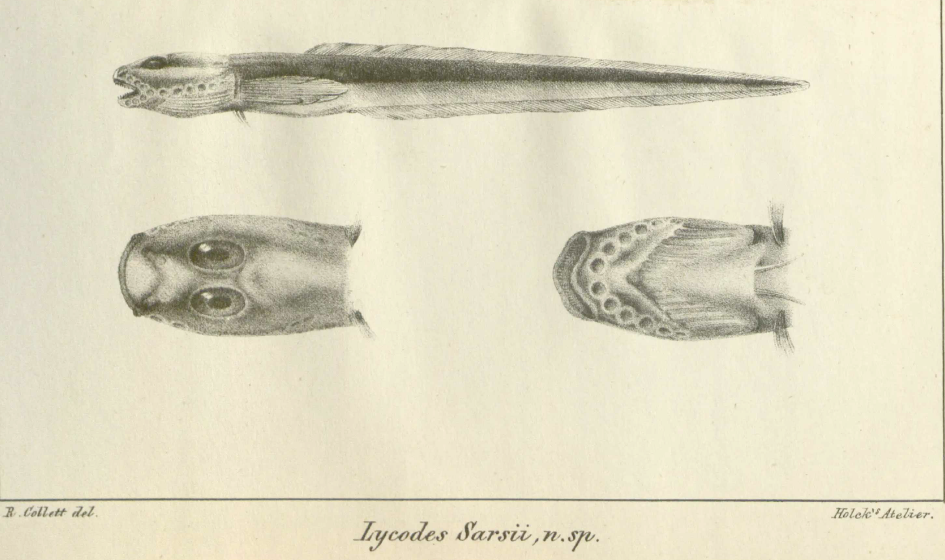
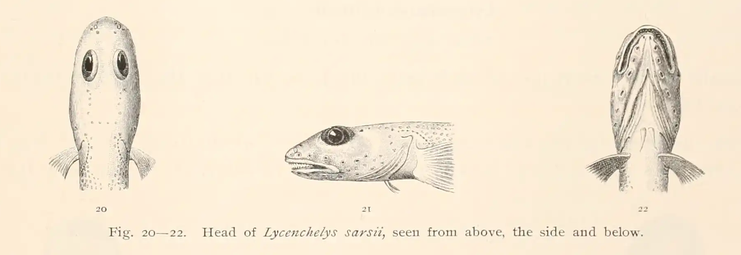

Theologian Eelpout, Lycenchelys sarsii. Body anguilliform. The height over the anus (in medium-sized and adult individuals) 5.2- 59% of the total length. The head tolerably broad, the trunk a little comp1·essed, the tail gradually becoming· more strongly compressed and losing· slowly in height. The length of the head in males 14.1-15%, in females 13.7-14.2% of the total length. The lower jaw reaches almost to the end of the upper. 7 pits for the lateral line along the upper jaw and under the eye. The distance between the snout and the anus is in males 27.2-28.6%, in females 26.2- 27.7% of the total length. The distance of the dorsal fin from the snout 21-24.7% of the total length.
Small specimens uniformly gray-brown along the back, yellow-white on the underside, somewhat larger specimens similar but with irregular, brown to black cross-markings and shades over the back and tail, and with a dark stripe between the eye and the snout; older individuals uniformly yellowish brown with indistinct shadings down the sides. The scales in developed specimens reach to the head and partly out on the unpaired fins. The lateral line ventral, indistinct. Branchiostegal rays 6. Pyloric appendages rudimentary. The size up to 184 mm. D: about 123; A: about 117; P: 15-16 (Jensen 1904; 1938).
References:
Collett, R.1871. Lycodes sarsii, n. sp. ex ordine Anacanthinorum Gadoideorum, descripsit. Forhandlinger i Videnskabs-selskabet i Christiania (1871): 62-66, 1 pl.
Gill, T.N. 1884. On the Anacanthine fishes. Proceedings of the Academy of Natural Sciences of Philadelphia, 36:167-183 (page 180).
Goode, G.B. and T.H. Bean. 1895 (1896). Oceanic ichthyology, a treatise on the deep-sea and pelagic fishes of the world, based chiefly upon the collections made by the steamers Blake, Albatross, and Fish Hawk in the northwestern Atlantic, with an atlas containing 417 figures. Smithsonian Institution, United States National Museum, Special Bulletin. No. 30.
Jensen, A.S. 1904. The Danish Ingolf-Expedition. Volume II. 4. The north-European and Greenland Lycodinae. 10 plates, 1 chart, and 33 figures in the text. Bianco Luno, Copenhagen, Denmark.
Jensen, A.S. 1938. Lycenchelys sarsii Collett 1871. Faune ichthyologique de l’Atlantique , Book 18. 1 pp. https://doi.org/10.17895/ices.pub.24476227.