
| Family | Scientific Name | Author | Year | Common Name |
| Stomiidae | Melanostomias valdiviae | Brauer | 1902 | Bluebeard Dragonfish |
Family Melanostomiidae (genera Bathophilus, Chirostomias, Echiostoma, Eustomias, Flagellostomias, Gramatostomias, Leptostomias, Melantostomias, Pachystomias, and Photonectes) – Small, oblique denticles posteriorly on maxilla. Chin barbel present; ranging widely in length, with or without branches or terminal elaborations. Dorsal fin located well posteriorly, directly above anal fin; dorsal adipose fin absent (except in Chirostomias). Suborbital photophore absent; postorbital photophore usually present, located posteroventrally to eye, sometimes reduced or absent in females (FAO 2002).
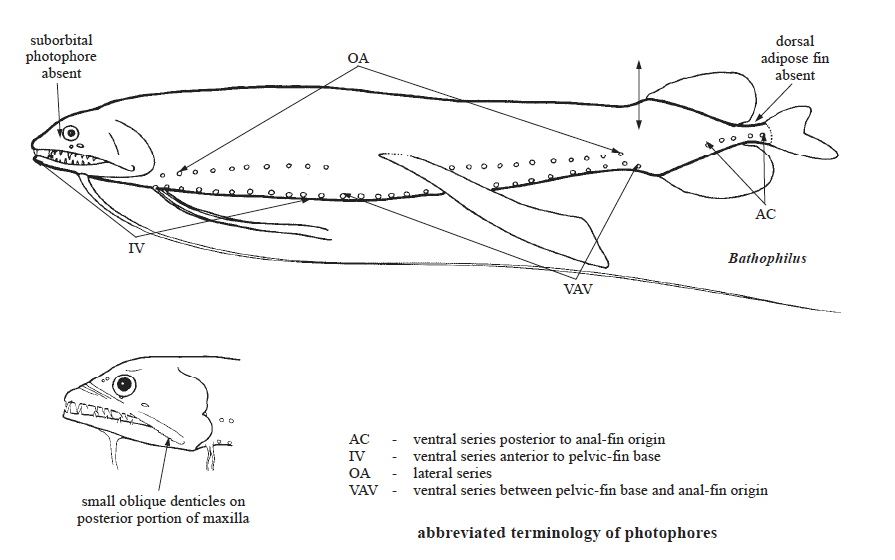
All Melanostomias Species: Body without scales or hexagonal scale pockets. Dorsal and anal fins located near caudal fin; dorsal adipose fin absent. Dorsal and anal-fin bases approximately equal; anal-fin base about equal to dorsal-fin base, its origin opposite to dorsal-fin origin. Mouth with floor, lower jaws connected by membrane. First mandibular tooth not piercing premaxillary. Pelvic-fin insertion near ventral midline. PO and SUO photophores absent, or PO photophore absent and SUO photophore minute; PTO photophore present, or present in males and absent in females. No line or loop of luminous tissue on each side of flank. Lower jaw length about equal to upper jaw, not projecting beyond upper, and not curved upwards; pectoral-fin rays 5 or 6, with none separated. Body depth greater than 10% standard length; PV photophores 30 or less. No large light organ behind eye; usually at least 1 depressible tooth in each jaw (FAO 2020).
Melanostomias valdiviae
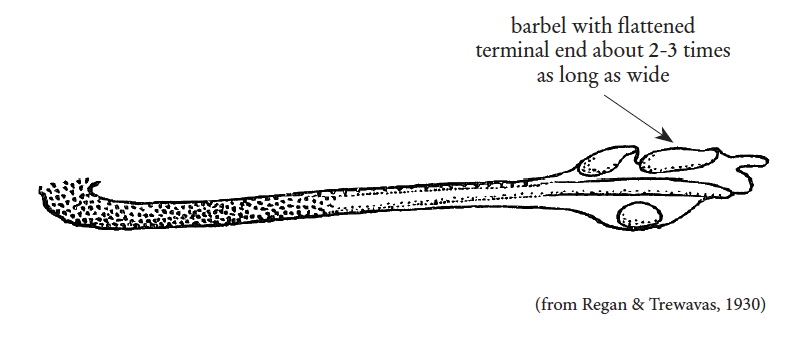
Unique Characteristics: Barbel with its terminal end flattened, variously modified, but not forming a bulb. Barbel with flattened terminal end about 2-3 times as long as wide (FAO 2020).
Similar Species:
Melanostomias bartonbeani, Pointedbeard Dragonfish
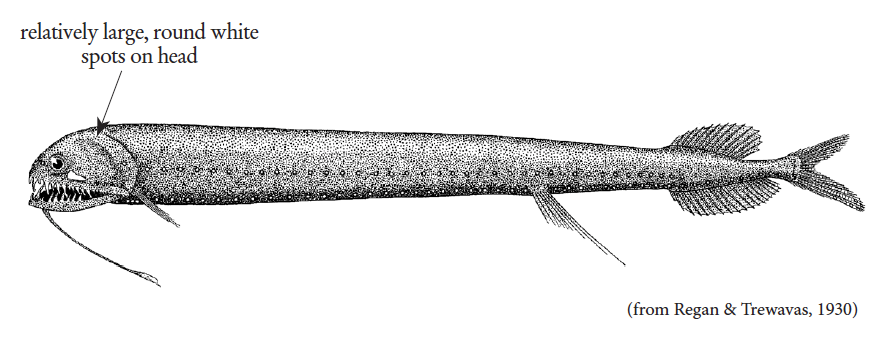
Pointedbeard Dragonfish, Melanostomias bartonbeani. Barbel with its terminal end flattened, variously modified, but not forming a bulb. Barbel with flattened terminal end at least 5 times as long as wide. Barbel stem fully pigmented; filament present or absent at distal end of terminal flattened area. Pectoral-fin rays usually 5; terminal flattened area of barbel usually unpigmented (some spots may be present). Terminal flattened end of barbel with a prominent, tapering extension. Terminal end of barbel with masses of opaque material filling much of the membrane on both sides of the axis; relatively large, round white spots on head (1 at tip of snout, 1 on top of head where it joins body, 1 in front of eye, a pair in front of isthmus) (FAO 2020).
Melanostomias melanopogon, Longclub Dragonfish
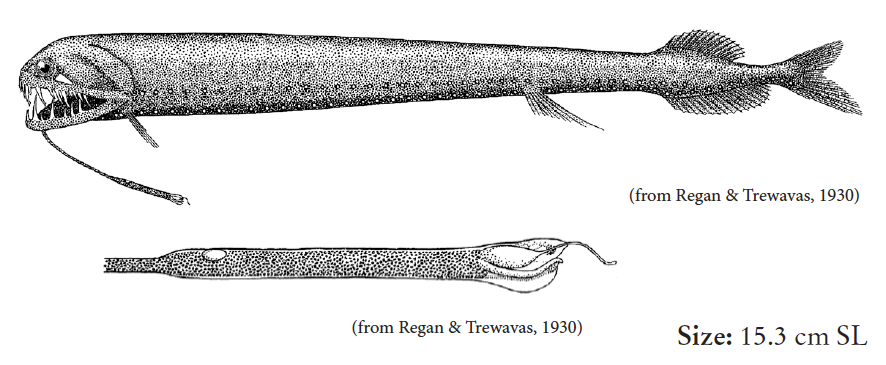
Longclub Dragonfish, Melanostomias melanopogon. Barbel with its terminal end flattened, variously modified, but not forming a bulb. Barbel with flattened terminal end at least 5 times as long as wide. Barbel stem fully pigmented; filament present or absent at distal end of terminal flattened area. Pectoral-fin rays usually 5; terminal flattened area of barbel usually unpigmented (some spots may be present). Terminal flattened end of barbel rounded, without tapering extension; no prominent white spots on head. Axis of terminal flattened end not lined with luminous bodies (FAO 2020).
References:
FAO. 2002. The living marine resources of the Western Central Atlantic. Volumes 1-3. K.E. Carpenter (ed.). Food and Agriculture Organization of the United Nations, Rome, Italy. 4099 pp. http://www.fao.org/3/y4160e/y4160e00.htm.
(FAO 2020) Sutton, T.T., P.A. Hulley, R. Wienerroither, D. Zaera-Perez, and J.R. Paxton. 2020. Identification guide to the mesopelagic fishes of the central and south east Atlantic Ocean. FAO Species Identification Guide for Fishery Purposes. Rome, FAO. 327 pp. https://doi.org/10.4060/cb0365en.