

| Family | Scientific Name | Author | Year | Common Name |
| Paralichthyidae | Paralichthys dentatus | (Linnaeus) | 1766 | Summer Flounder |
All Paralichthys Species: Lateral line distinctly arched above pectoral fin on ocular side and prolonged below inferior eye; pelvic fins symmetrically or nearly symmetrically placed on either side of midventral line (base of neither pelvic fin on midventral line); urinary papilla on ocular side; branched caudal-fin rays 13. Pelvic-fin rays of ocular side not longer than rays of blind side; anterior rays of dorsal fin not prolonged; large, ocellated, dark spots present or absent on body; lower-limb gill rakers on first arch 7-18; dorsal-fin rays 71-104. Prominent ocelli on ocular side (FAO 2002).
Paralichthys dentatus
Unique Characteristics: Many ocelli on ocular side, but with 5 prominent ocellated dark spots on posterior half of body. Eyes separated by a flat space without a ridge. Gill rakers on lower limb of first arch 14 or more (rarely 13). Lateral-line scales 91-106. Dorsal-fin rays 80-96. Anal-fin rays 61-73. Vertebrae 11 precaudal and 30 or 31 caudal.
Similar Species:
Fourspot Flounder
Paralichthys oblongus
Gulf Flounder
Paralichthys albigutta


Fourspot Flounder, Paralichthys oblongus. Four large dark ocelli on ocular side of body, arranged in a trapezoid with 2 in midbody (one above the other on opposite sides of the lateral line) and 2 on the body (one above the other on opposite sides of the lateral line) at a point slightly anterior to caudal peduncle. Eyes relatively large and close set, nearly meeting, separated only by a narrow ridge. Lower-limb gill rakers 7-11. Lateral-line scales 63-95. Dorsal-fin rays 71-86. Anal-fin rays 58-72.
Gulf Flounder, Paralichthys albigutta. Three prominent ocellated dark spots on body arranged in a triangle with 2 (one above the other) in midbody and 1 on the lateral line in posterior part of body. Eyes separated by a flat space without a ridge. Gill rakers on lower limb of first arch 9-12. Dorsal-fin rays 71-85. Anal fin rays 53-63. Lateral-line scales 78-81. Vertebrae 10 precaudal and 27 caudal.
Broad Flounder
Paralichthys squamilentus
Southern Flounder
Paralichthys lethostigma
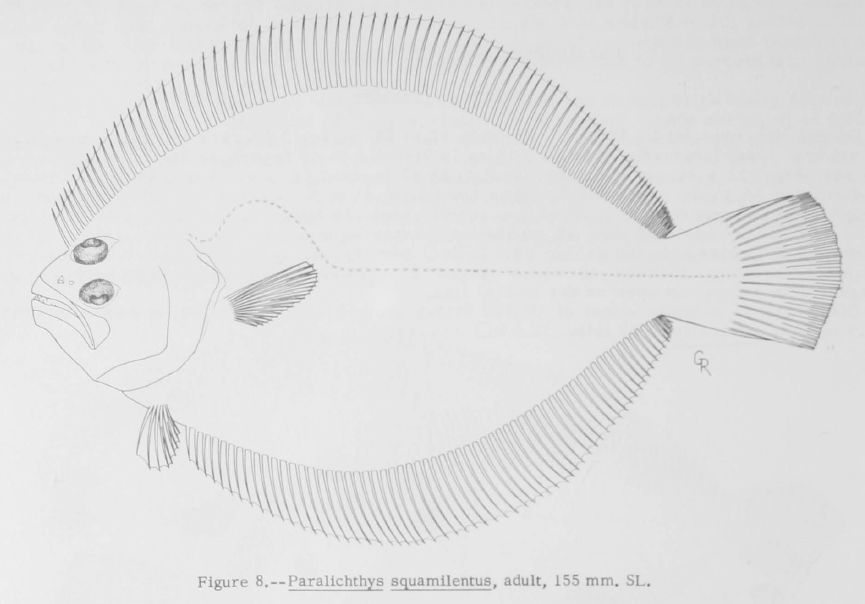

Broad Flounder, Paralichthys squamilentus. No prominent ocelli on ocular side. Lower-limb gill rakers on first arch 7-18. Dorsal-fin rays 71-104. Body depth greater than 47% standard length (mean 50% standard length). Lateral-line scales 104-117. Blind side on larger specimens dusky.
Southern Flounder, Paralichthys lethostigma. No prominent ocelli on ocular side. Lower-limb gill rakers on first arch 7-18. Dorsal-fin rays 71-104. Body depth 47% or less standard length (mean 44% standard length). Lateral-line scales 78-100. Blind side immaculate or dusky.
Reference:
Gutherz, E.J. 1967. Field guide to the flatfishes of the family Bothidae in the western North Atlantic. United States Fish and Wildlife Service. Circular No. 263: i-iv + 1-47.
Gallery

