
| Family | Scientific Name | Author | Year | Common Name |
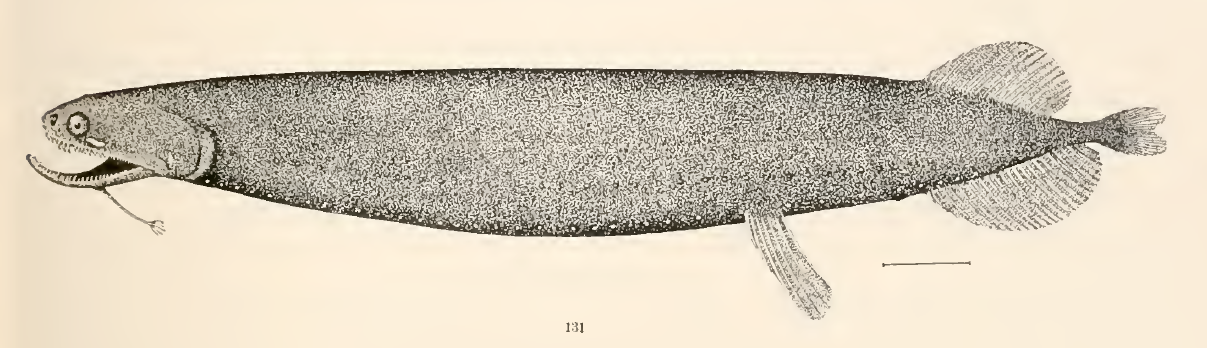
| Stomiidae | Photonectes margarita | (Goode & Bean) | 1896 | Sooty Dragonfish |
Family Melanostomiidae (genera Bathophilus, Chirostomias, Echiostoma, Eustomias, Flagellostomias, Gramatostomias, Leptostomias, Melantostomias, Pachystomias, and Photonectes) – Small, oblique denticles posteriorly on maxilla. Chin barbel present; ranging widely in length, with or without branches or terminal elaborations. Dorsal fin located well posteriorly, directly above anal fin; dorsal adipose fin absent (except in Chirostomias). Suborbital photophore absent; postorbital photophore usually present, located posteroventrally to eye, sometimes reduced or absent in females (FAO 2002).
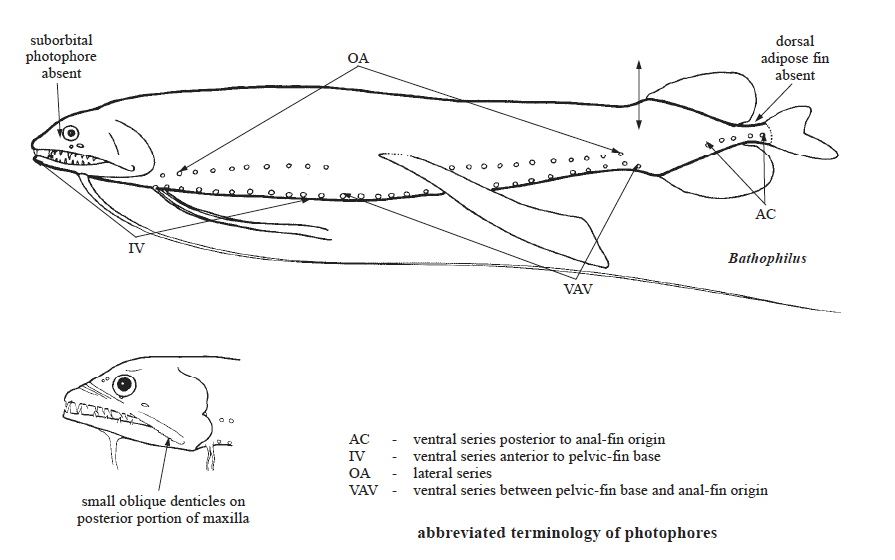
All Photonectes Species: Body without scales or hexagonal scale pockets. Dorsal and anal fins located near caudal fin; dorsal adipose fin absent; dorsal and anal-fin bases approximately equal; anal-fin base about equal to dorsal-fin base, its origin opposite to dorsal-fin origin. Mouth with floor, lower jaws connected by membrane. First mandibular tooth not piercing premaxillary. Pelvic-fin insertion near ventral midline. PO and SUO photophores absent, or PO photophore absent and SUO photophore minute; PTO photophore present, or present in males and absent in females. No line or loop of luminous tissue on each side of flank. Lower jaw long, longer than upper, and strongly curved upwards; pectoral-fin rays 0-3 (FAO 2020).
Photonectes margarita
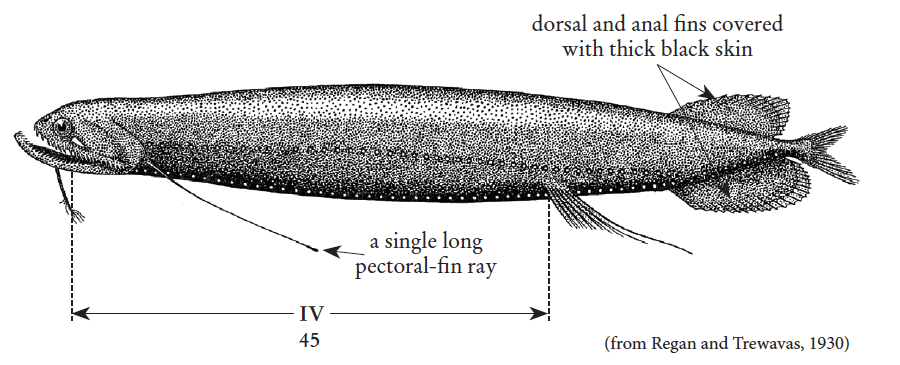
Unique Characteristics:Dorsal and anal fins covered with thick black skin, with only tips of fin rays visible in adults; IV (IP + PV) photophores 41-48. A single long pectoral-fin ray (FAO 2020).
Similar Species:
Photonectes mirabilis, Blueband Dragonfish
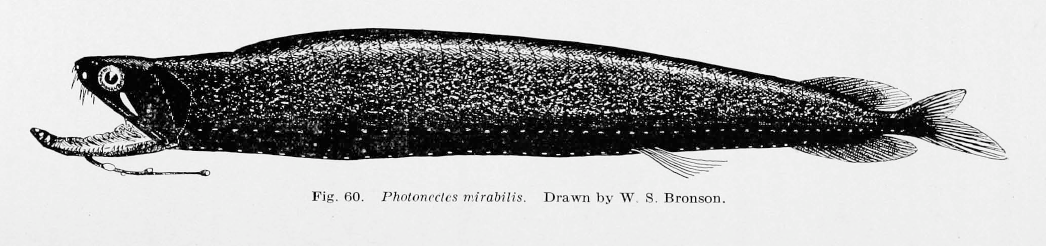
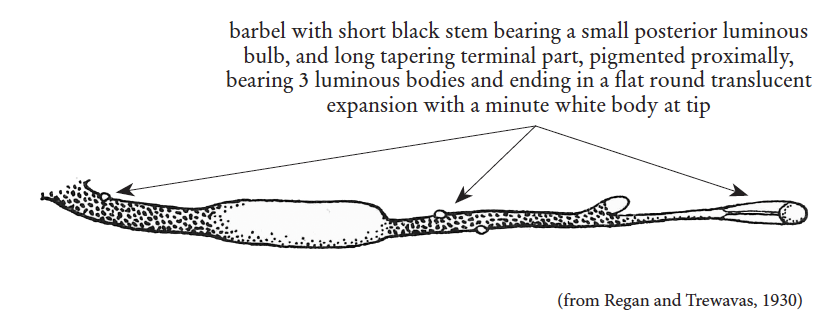
Blueband Dragonfish, Photonectes mirabilis. Dorsal and anal fins not covered with thick black skin, rays clearly visible; IV (IP + PV) photophores 30-37. Pectoral fins absent. A lateral or mid-ventral band of bluish luminous tissue present, and/or superficial luminous tissue on ventral surface of lower jaw, and/or light organs inside of lower jaw. Three pairs of light organs inside lower jaw; blue band present on sides. Barbel with short black stem bearing a small posterior luminous bulb, and long tapering terminal part, pigmented proximally, bearing three luminous bodies and ending in a flat round translucent expansion with a minute white body at tip (FAO 2020).
Photonectes parvimanus, Fleshyfin Dragonfish
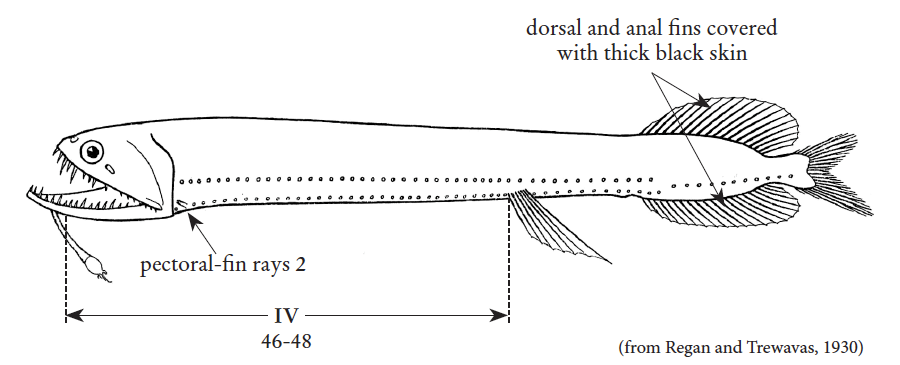
Fleshyfin Dragonfish, Photonectes parvimanus. Dorsal and anal fins covered with thick black skin, with only tips of fin rays visible in adults; IV (IP + PV) photophores 41-48. Pectoral-fin rays 2 (FAO 2020).
References:
FAO. 2002. The living marine resources of the Western Central Atlantic. Volumes 1-3. K.E. Carpenter (ed.). Food and Agriculture Organization of the United Nations, Rome, Italy. 4099 pp. http://www.fao.org/3/y4160e/y4160e00.htm.
(FAO 2020) Sutton, T.T., P.A. Hulley, R. Wienerroither, D. Zaera-Perez, and J.R. Paxton. 2020. Identification guide to the mesopelagic fishes of the central and south east Atlantic Ocean. FAO Species Identification Guide for Fishery Purposes. Rome, FAO. 327 pp. https://doi.org/10.4060/cb0365en.
Goode, G.B. and T.H. Bean. 1896. Oceanic ichthyology, a treatise on the deep-sea and pelagic fishes of the world, based chiefly upon the collections made by the steamers Blake, Albatross, and Fish Hawk in the northwestern Atlantic, with an atlas containing 417 figures. Smithsonian Institution, U.S. National Museum, Special Bulletin. No. 30.
Parr, A.E. 1927. The Stomiatoid fishes of the suborder Gymnophotodermi (Astronesthidae, Melanostomiatidae, Idiacanthidae) with a complete review of the species. (Scientific Results of the Third Oceanographic Expedition of the “Pawnee” 1927). Bulletin of the Bingham Oceanographic Collection Yale University 3 (2): 1-123.