

Photo Credit: G.W. Link
| Family | Scientific Name | Author | Year | Common Name |
| Scombridae | Thunnus atlanticus | (Lesson) | 1831 | Blackfin Tuna |
All Thunnus Species: Two small keels and a large median keel between them on either side of caudal peduncle; 7-10 dorsal and 7-10 anal finlets; adipose eyelids absent. Teeth in jaws slender, conical, hardly compressed; corselet of scales well developed. Upper surface of tongue with 2 longitudinal ridges; 9-16 spines in first dorsal fin. First and second dorsal fins barely separated, at most by eye diameter; 12-16 spines in first dorsal fin; interpelvic process bifid and short, much shorter than pelvic fin rays. No dark longitudinal stripes on belly; gill rakers 19-45 on first arch. Body covered with very small scales behind corselet; no black spots on body; 30-36 pectoral-fin rays (FAO 2002).
Thunnus atlanticus
Unique Characters: Ventral surface of liver without striations; right lobe of liver much longer than left or central lobes. Total gill rakers on first arch 19-28, usually 26 or fewer. Second dorsal and anal fins never greatly elongate, less than 20% of fork length at all sizes.
Similar Species:
Bluefin Tuna
Thunnus thynnus
Albacore
Thunnus alalunga

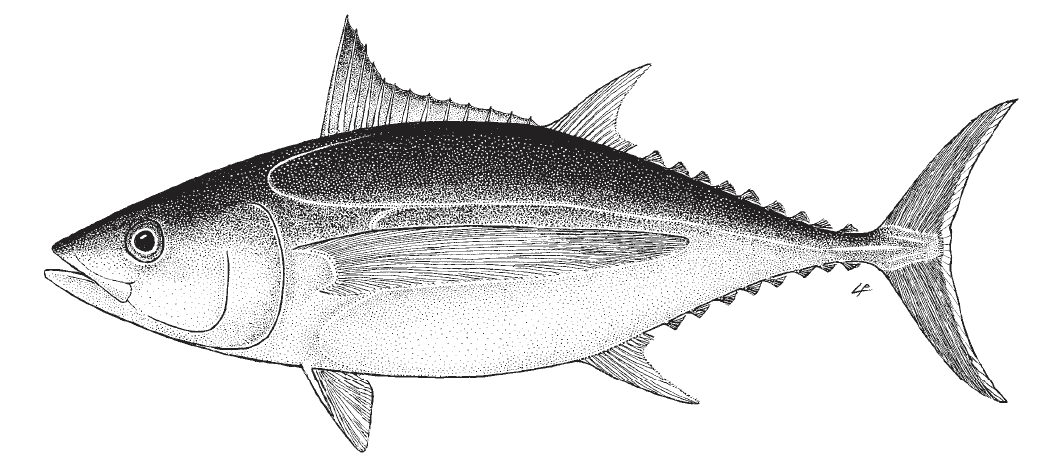
Bluefin Tuna, Thunnus thynnus. Ventral surface of liver covered with prominent striations; central lobe of liver equal to or longer than left and right lobes. Total gill rakers on first arch 31-43 Pectoral fins short, less than 80% of head length, 16.8-21.7% of fork length.
Albacore, Thunnus alalunga. Ventral surface of liver covered with prominent striations; central lobe of liver equal to or longer than left and right lobes. Total gill rakers on first arch 23-31. Pectoral fins moderate to long, more than 80% of head length. Caudal fin with a narrow white posterior border. Pectoral fins very long, reaching well past end of second dorsal-fin base. Greatest body depth at or slightly before level of second dorsal fin.
Yellowfin Tuna
Thunnus albacares
Bigeye Tuna
Thunnus obesus

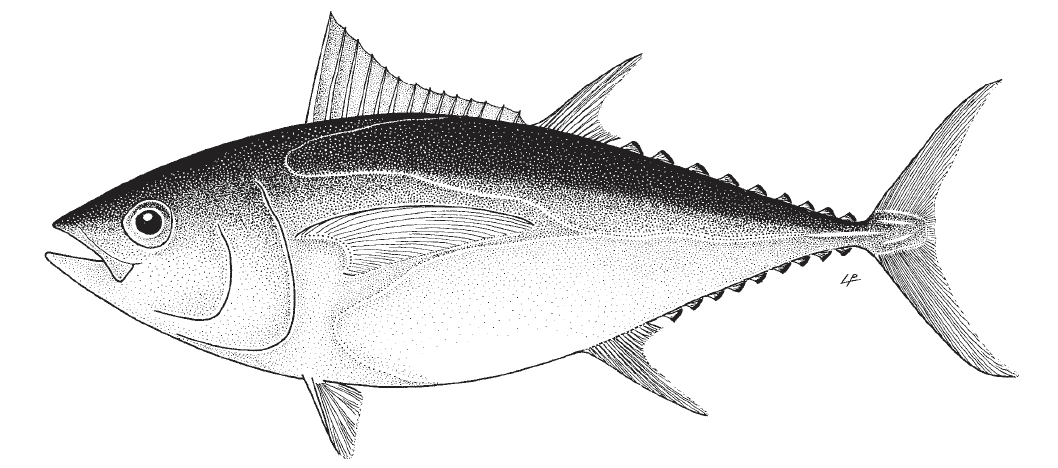
Yellowfin Tuna, Thunnus albacares. Ventral surface of liver without striations; right lobe of liver much longer than left or central lobes. Total gill rakers on first arch 26-34, usually 27 or more. Second dorsal and anal fins of larger individuals (120 cm fork length and longer) elongate, more than 20% of fork length.
Bigeye Tuna, Thunnus obesus. Ventral surface of liver covered with prominent striations; central lobe of liver equal to or longer than left and right lobes. Total gill rakers on first arch 23-31. Pectoral fins moderate to long, more than 80% of head length. Caudal fin without white posterior border. Pectoral fins short or moderate in length, reaching end of second dorsal-fin base (except in small individuals). Greatest body depth about middle of body, near middle of first dorsal fin.
Gallery