
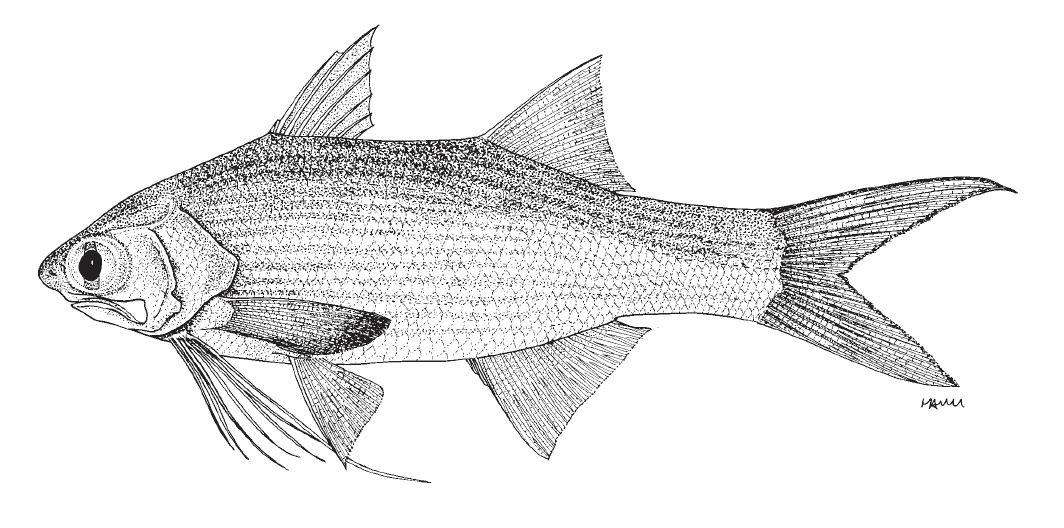
Source: FAO 2002.
| Family | Scientific Name | Author | Year | Common Name |
| Polynemidae | Polydactylus virginicus | (Linnaeus) | 1758 | Barbu |
Family Polynemidae — Eye covered by adipose, eye diameter greater than snout length. Conical snout protruding anteriorly past mouth. Mouth large, subterminal, extending posteriorly past eye. Upper lip thin; lower lip moderate. Supramaxillae absent; maxilla posteriorly broadened to varying degrees. Two widely separated dorsal fins. 7-9 separate pectoral filaments below 14-16 normal pectoral-fin rays, extending to 3/4 of pelvic fin or past origin of anal fin. Body, most of head, and much of fins covered with finely ctenoid scales. Lateral line continuous, extending to the caudal-fin margin and typically bifurcates on caudal fin.
Polydactylus virginicus
Unique Characters: Pectoral filaments 7 (rarely 8). Gill rakers 22-30. Lateral-line scales 54-63 (mean = 58); anal-fin rays 12-14 (mean = 13).
Similar Species:
Polydactylus octonemus, Atlantic Threadfin

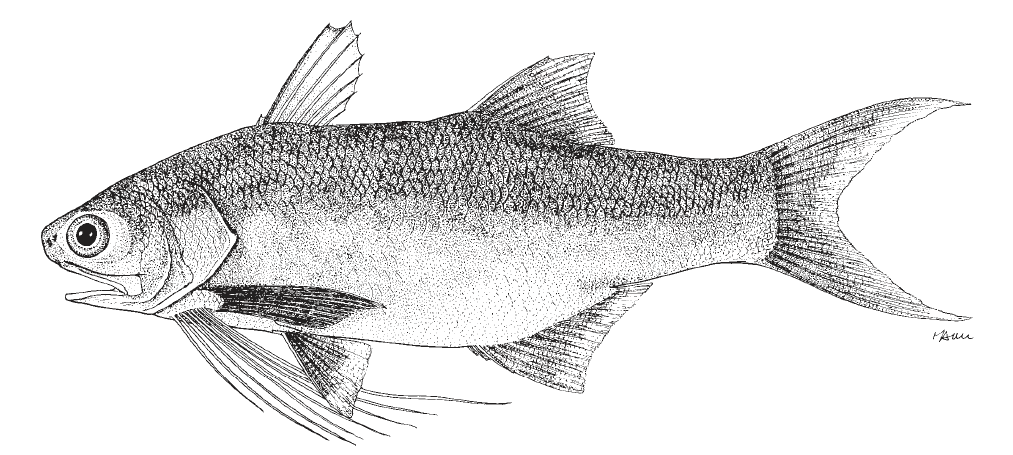
Source: FAO 2002.
Atlantic Threadfin, Polydactylus octonemus. Pectoral filaments 8 (rarely 9). Gill rakers 34-38.
Polydactylus oligodon, Littlescale Threadfin
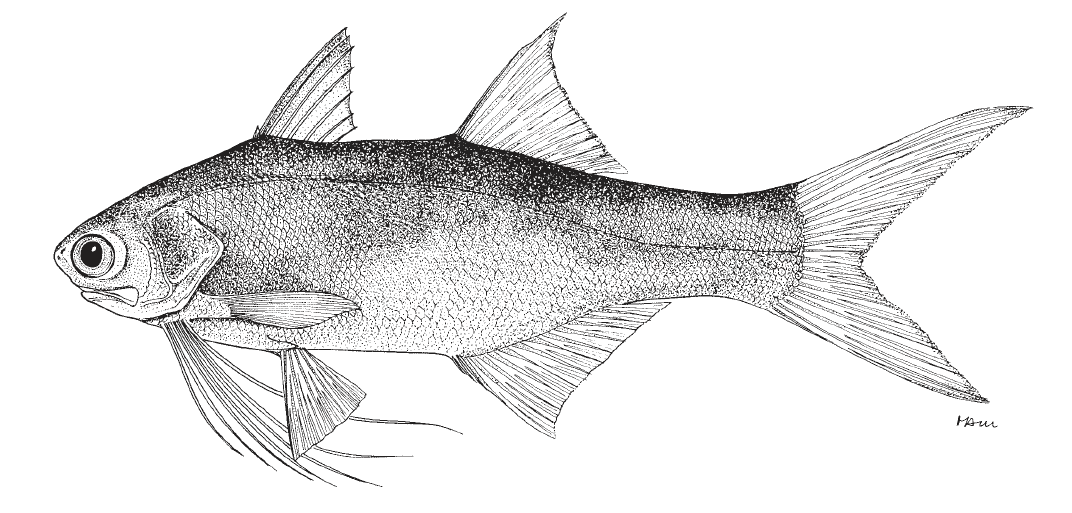
Source: FAO 2002.
Littlescale Threadfin, Polydactylus oligodon. Pectoral filaments 7 (rarely 8); gill rakers 22-30. Lateral-line scales 67-73 (mean =70); anal-fin rays 13-15 (mean =14).