
| Family | Scientific Name | Author | Year | Common Name |
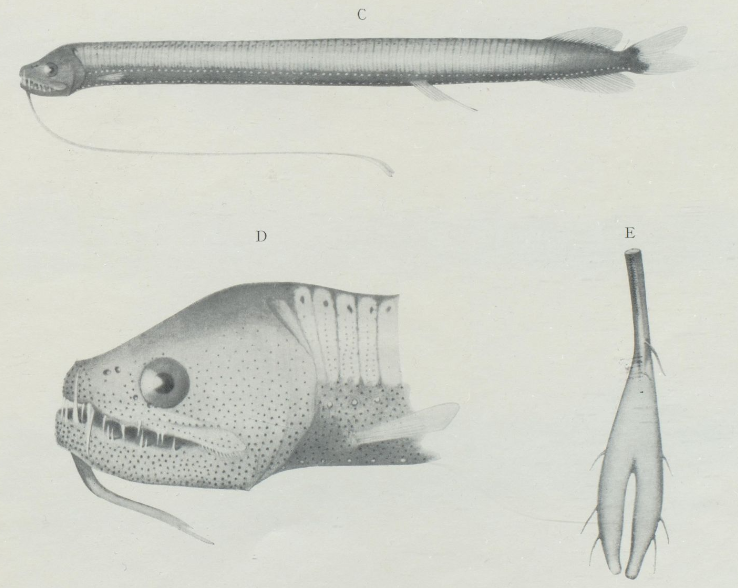
| Stomiidae | Leptostomias bilobatus | (Koefoed) | 1956 | Splitbulb Dragonfish |
Family Melanostomiidae (genera Bathophilus, Chirostomias, Echiostoma, Eustomias, Flagellostomias, Gramatostomias, Leptostomias, Melantostomias, Pachystomias, and Photonectes) – Small, oblique denticles posteriorly on maxilla. Chin barbel present; ranging widely in length, with or without branches or terminal elaborations. Dorsal fin located well posteriorly, directly above anal fin; dorsal adipose fin absent (except in Chirostomias). Suborbital photophore absent; postorbital photophore usually present, located posteroventrally to eye, sometimes reduced or absent in females (FAO 2002).
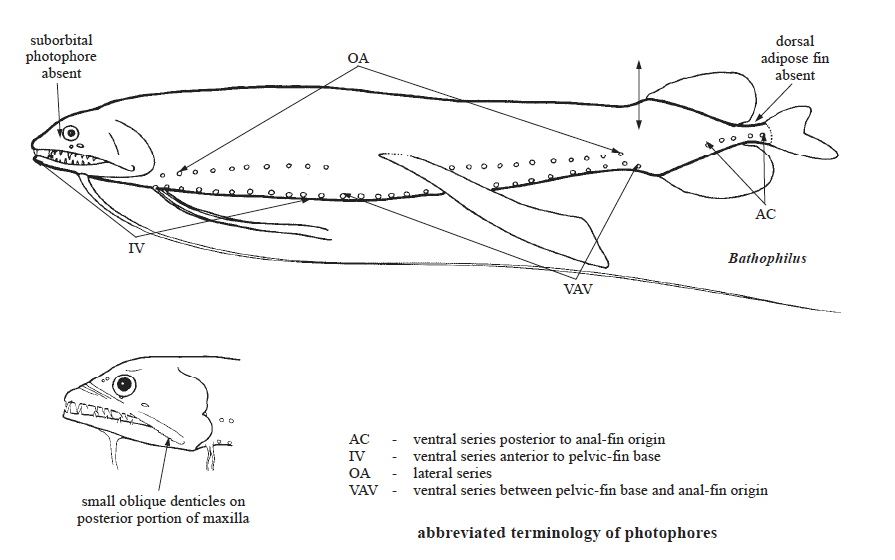
All Leptostomias Species: Body without scales or hexagonal scale pockets. Dorsal and anal fins located near caudal fin; dorsal adipose fin absent. Dorsal and anal-fin bases approximately equal; anal-fin base about equal to dorsal-fin base, its origin opposite to dorsal-fin origin. Mouth with floor, lower jaws connected by membrane. First mandibular tooth not piercing premaxillary.Pelvic-fin insertion near ventral midline. PO and SUO photophores absent, or PO photophore absent and SUO photophore minute; PTO photophore present, or present in males and absent in females. No line or loop of luminous tissue on each side of flank. Lower jaw length about equal to upper jaw, not projecting beyond upper, and not curved upwards; pectoral-fin rays 10-12, with none separated. Body long and narrow, its depth 10% standard length or less; PVphotophores 39 or more (FAO 2020).
Leptostomias bilobatus
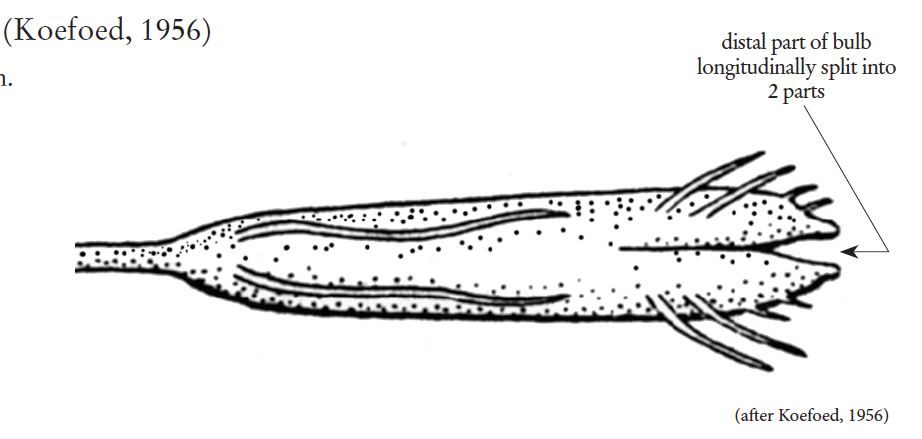
Unique Characteristics: Stem of barbel with basal filaments. Distal part of bulb longitudinally split into 2 parts (FAO 2020).
Similar Species:
Leptostomias gladiator, Seriallight Dragonfish
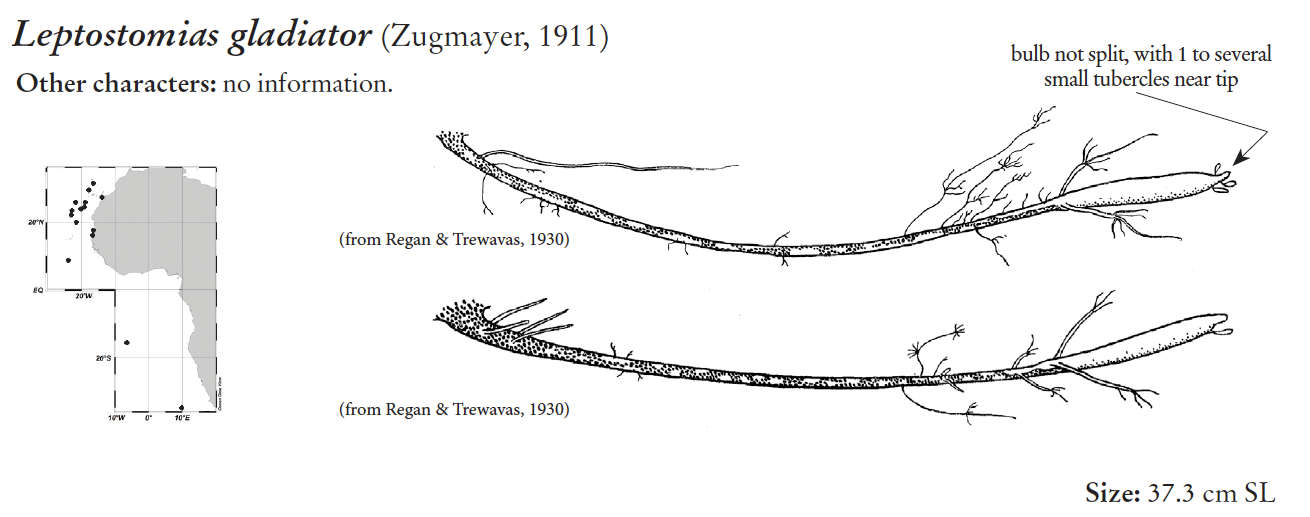
Seriallight Dragonfish, Leptostomias gladiator. Stem of barbel with basal filaments. Bulb not split; distal part of bulb with 1 to several small tubercles near tip (FAO 2020).
References:
FAO. 2002. The living marine resources of the Western Central Atlantic. Volumes 1-3. K.E. Carpenter (ed.). Food and Agriculture Organization of the United Nations, Rome, Italy. 4099 pp. http://www.fao.org/3/y4160e/y4160e00.htm.
(FAO 2020) Sutton, T.T., P.A. Hulley, R. Wienerroither, D. Zaera-Perez, and J.R. Paxton. 2020. Identification guide to the mesopelagic fishes of the central and south east Atlantic Ocean. FAO Species Identification Guide for Fishery Purposes. Rome, FAO. 327 pp. https://doi.org/10.4060/cb0365en.
Koefoed, E.1956. Isospondyli. 1. Gymnophotodermi and Lepidophotodermi from the “Michael Sars” North Atlantic deep-sea expedition 1910. Scientific Results of the Michael Sars North Atlantic Deep-Sea Expedition 1910 v. 4 (pt 2, no. 5): 1-23, Pls. 1-3.