
| Family | Scientific Name | Author | Year | Common Name |
| Stomiidae | Leptostomias gladiator | (Zugmayer) | 1911 | Seriallight Dragonfish |
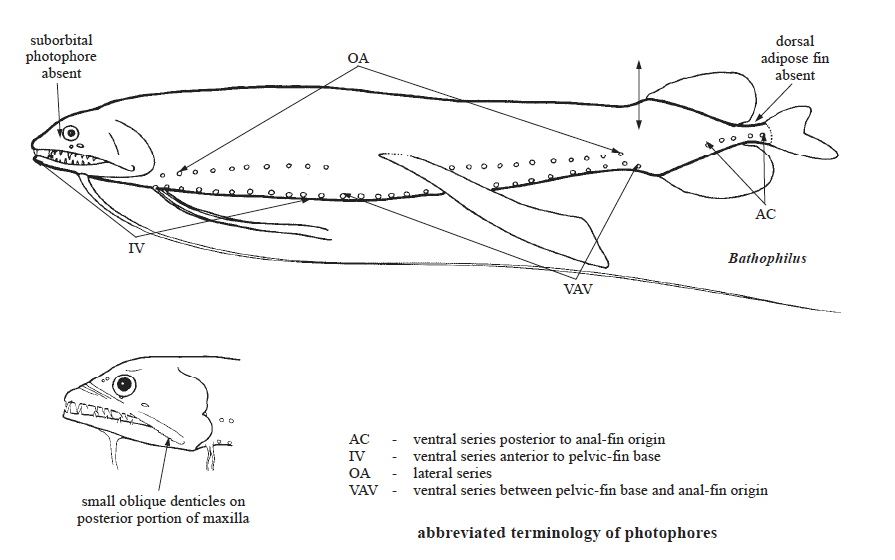
Family Melanostomiidae (genera Bathophilus, Chirostomias, Echiostoma, Eustomias, Flagellostomias, Gramatostomias, Leptostomias, Melantostomias, Pachystomias, and Photonectes) – Small, oblique denticles posteriorly on maxilla. Chin barbel present; ranging widely in length, with or without branches or terminal elaborations. Dorsal fin located well posteriorly, directly above anal fin; dorsal adipose fin absent (except in Chirostomias). Suborbital photophore absent; postorbital photophore usually present, located posteroventrally to eye, sometimes reduced or absent in females (FAO 2002).
Leptostomias gladiator
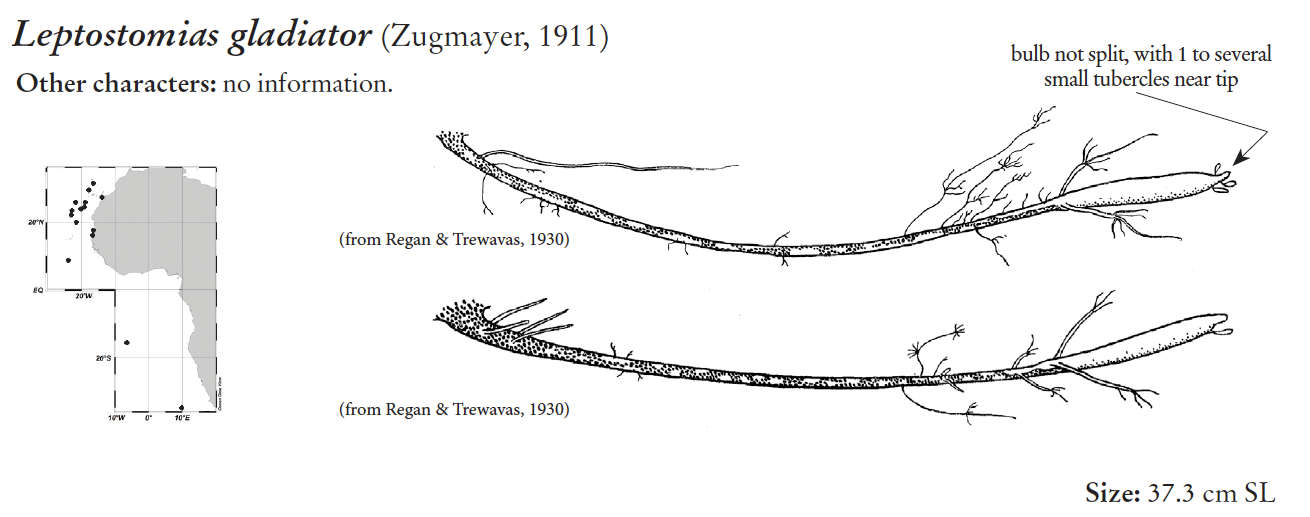
Unique Characteristics: Stem of barbel with basal filaments. Bulb not split; distal part of bulb with 1 to several small tubercles near tip (FAO 2020).
Similar Species:
Leptostomias bilobatus, Splitbulb Dragonfish
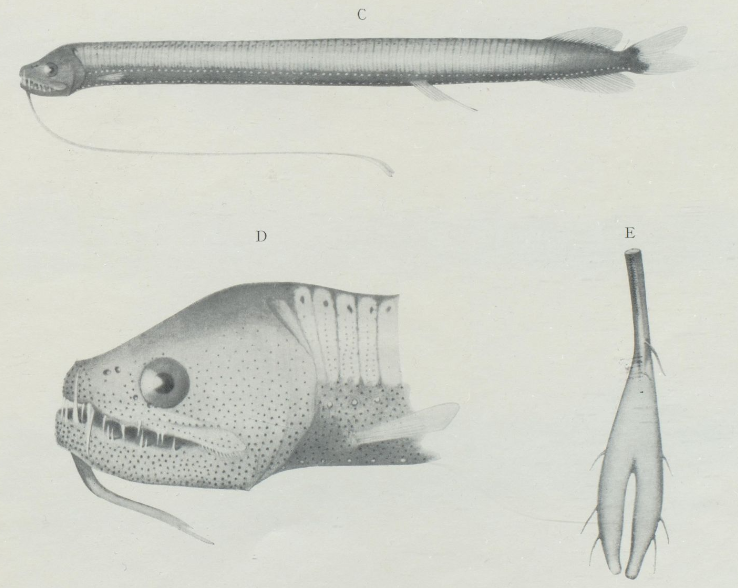
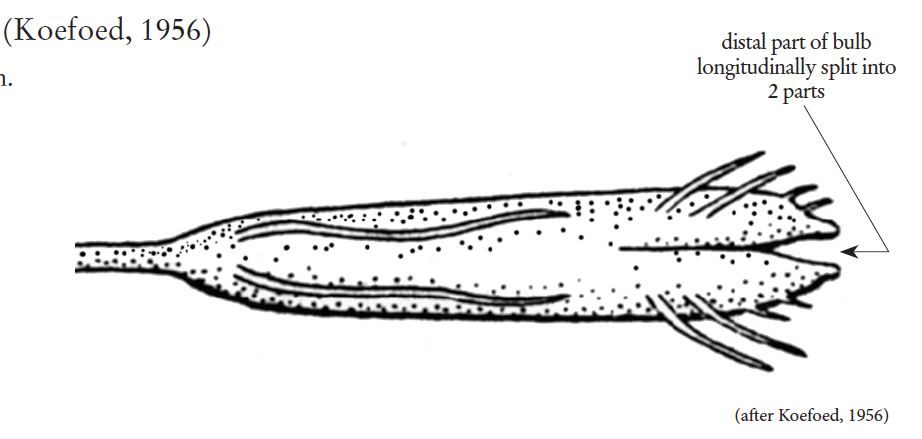
Splitbulb Dragonfish, Leptostomias bilobatus. Stem of barbel with basal filaments. Distal part of bulb longitudinally split into 2 parts (FAO 2020).
References:
FAO. 2002. The living marine resources of the Western Central Atlantic. Volumes 1-3. K.E. Carpenter (ed.). Food and Agriculture Organization of the United Nations, Rome, Italy. 4099 pp. http://www.fao.org/3/y4160e/y4160e00.htm.
(FAO 2020) Sutton, T.T., P.A. Hulley, R. Wienerroither, D. Zaera-Perez, and J.R. Paxton. 2020. Identification guide to the mesopelagic fishes of the central and south east Atlantic Ocean. FAO Species Identification Guide for Fishery Purposes. Rome, FAO. 327 pp. https://doi.org/10.4060/cb0365en.
Koefoed, E.1956. Isospondyli. 1. Gymnophotodermi and Lepidophotodermi from the “Michael Sars” North Atlantic deep-sea expedition 1910. Scientific Results of the Michael Sars North Atlantic Deep-Sea Expedition 1910 v. 4 (pt 2, no. 5): 1-23, Pls. 1-3.