
NCFishes.com Project team members Gabriela M. Hogue and Bryn H. Tracy in collaboration with Dr. Lily C. Hughes of North Carolina Museum of Natural Sciences, Raleigh, NC, Jonathan A. Raine (Bremerton, WA), and Dr. Robert E. Jenkins (deceased) of Roanoke College, Salem, Va recently described a new species of sucker – Moxostoma carolina, Carolina Redhorse (Family Catostomidae). Team members Scott A. Smith and Jesse L. Bissette also participated by taking exceptional photographs of preserved specimens of this and six other species of Moxostoma at the Museum.
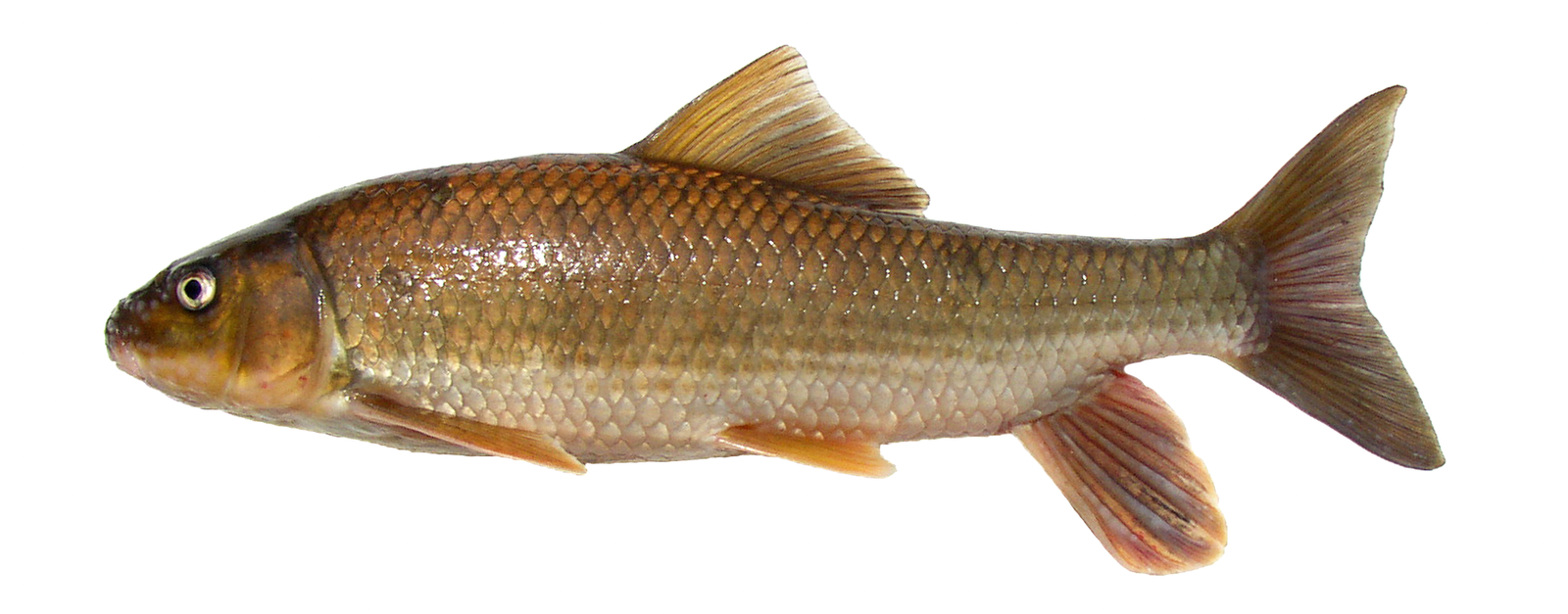
Collected from the Little River, Montgomery County, NC, May 11, 2005.
The new species is distinguished from all other species described in the genus Moxostoma by the number of caudal peduncle scales, the texture and angle of the lower lip, and by pigmentation and tuberculation patterns. Morphologically, it is similar to Golden Redhorse, Moxostoma erythrurum, although the two species are allopatric and phylogenetic analysis supports the Carolina Redhorse as a distinct evolutionary lineage. Characteristics of five of the species with which the Carolina Redhorse is sympatric, Notchlip Redhorse, M. collapsum, V-lip Redhorse, M. pappillosum, Robust Redhorse, M. robustum, Shorthead Redhorse, M. macrolepidotum, and the undescribed “Brassy” Jumprock, Moxostoma sp., and M. erythrurum are discussed and a dichotomous key to these seven Atlantic slope species is provided in the publication.
Moxostoma carolina is rare, localized and endemic to lower Piedmont streams and inshore areas of mainstem rivers and reservoirs in the Cape Fear and Yadkin-Pee Dee basins of North Carolina and South Carolina.
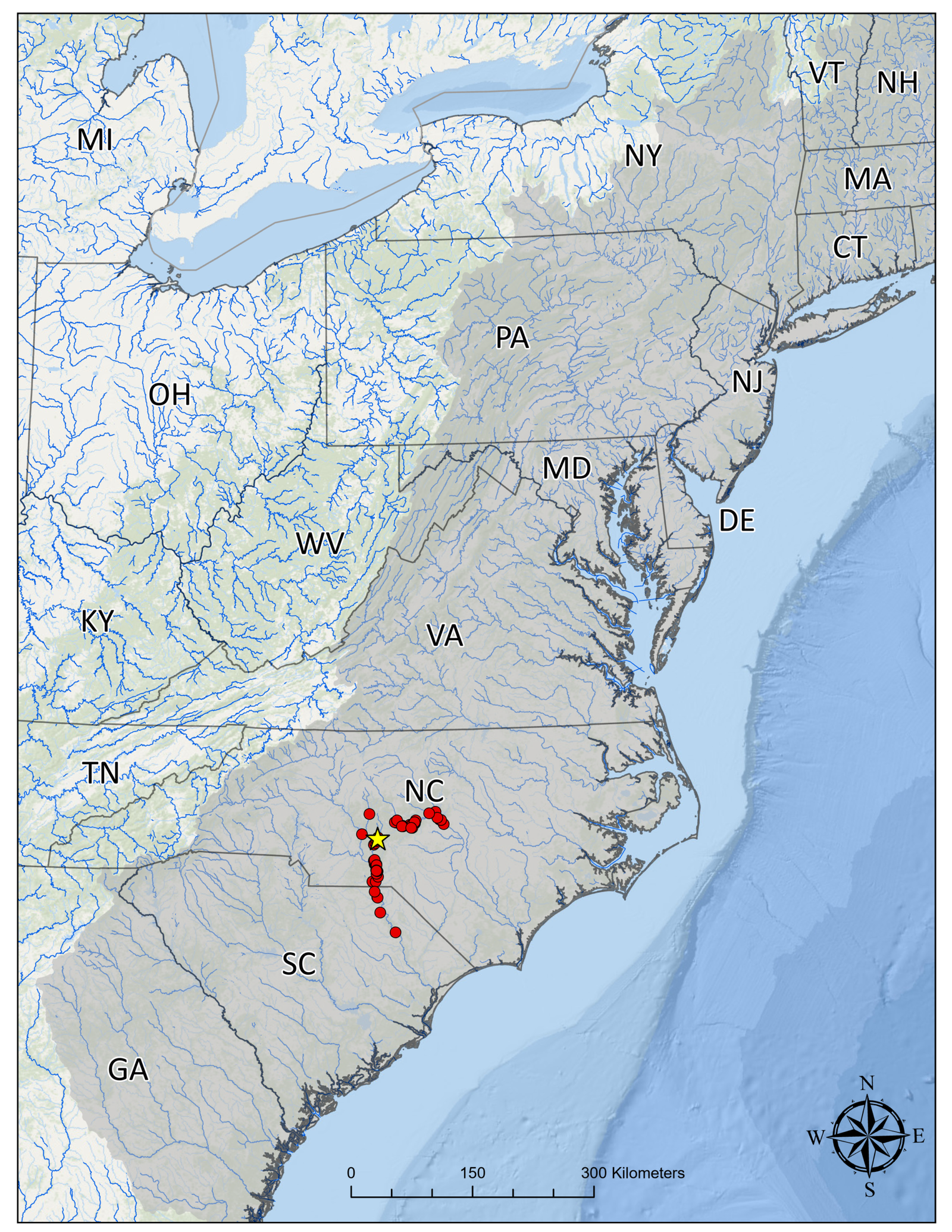
Distribution of Moxostoma carolina, Carolina Redhorse, along the Atlantic slope. Yellow star indicates type locality.
The Open Access publication may be downloaded from the journal Zootaxa here: https://doi.org/10.11646/zootaxa.5763.4.3.