
Percina evides (Jordan and Copeland 1877) was first described by D.S. Jordan in 1877 from three specimens collected by himself and H.E. Copeland from the White River near Indianapolis, IN. Jordan described the darter as: “. . . one of the most beautiful of all the darters. Its colors, though not gaudy, are very striking, and quite unlike those of any other species known to me . . .” (Jordan and Copeland 1877).

Unlike in the modern era, “back then” species were not given common names when they were first described. The first common name applied to this species, which I could find in the literature, was given in 1945 by H.W. Fowler who called two specimens from the North Toe River above Spruce Pine in Mitchell County, NC Hadropterus peltatus evides (Jordan and Copeland), the Handsome Darter (Fowler 1945). The first edition of the American Fisheries Society’s A List of Common and Scientific Names of the Better Known Fishes of the United States and Canada (AFS 1948) did not list Percina evides. Twelve years later, the AFS Committee on Names of Fishes apparently not being enamored with the name Handsome Darter, bestowed upon Percina evides the AFS-approved common name of Gilt Darter (AFS 1960), a name which the species continued to hold (Page et al. 2023) until recently. AFS (1960) did not provide a reason for giving this species the common name Gilt Darter, but I suspect it was because of the vividly brilliant golden color of the lateral and ventral surfaces and spinous dorsal fin of breeding males.

Since its original description P. evides is/was known from the Mississippi River drainage from widely separated populations in several widely separated states including North Carolina, Georgia, Tennessee, Mississippi, Alabama, Virginia, Kentucky, West Virginia, Pennsylvania, New York, Ohio, Indiana, Minnesota, Wisconsin, Illinois, Iowa, Missouri, and Arkansas (Denoncourt 1980; Page and Burr 2011).
To the best of my knowledge, the first recorded collection of Gilt Darter from North Carolina was by Jordan, O. Jenkins, and S. Meek in mid-August 1888 from the French Broad River and Spring Creek at Hot Springs (Madison County) and from the Swannanoa River at Asheville (Buncombe County) (Jordan 1889a; 1889b). These specimens are vouchered at the National Museum of Natural History and University of Michigan Museum of Zoology. Jordan (1889a) noted that in these specimens the lateral scale count ranged from 52-65, whereas specimens from the White River near Indianapolis, Indiana, the type locality, “rarely goes below 60“. Jordan (1889b) also remarked that: “These agree in essential respects with specimens from White River, Indiana, but the scales are in most specimens larger“. So even back then, ichthyologists might have had suspicions that there might be some hidden diversity within Gilt Darter.
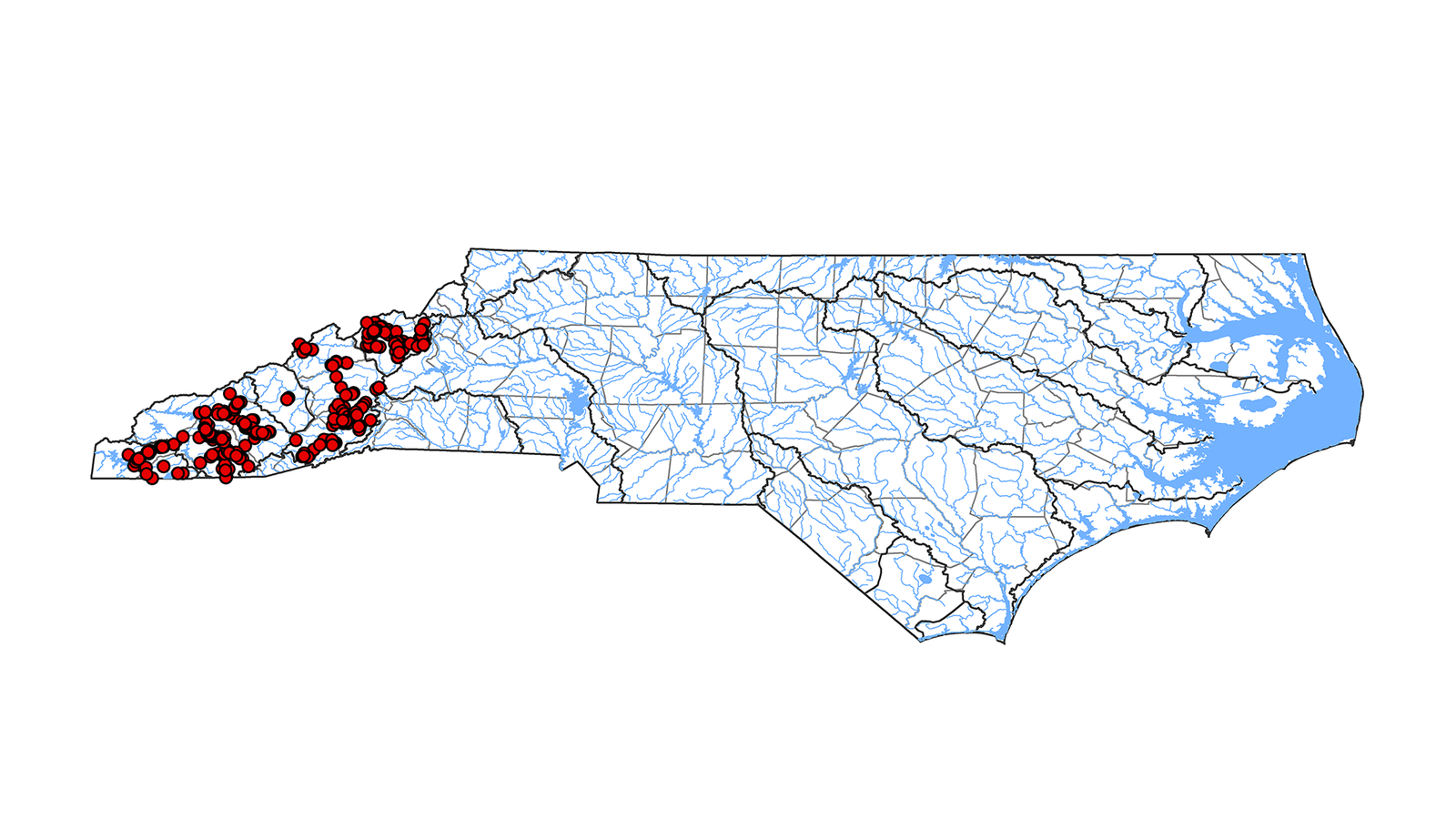
In the intervening almost 140 years since first reported from North Carolina’s mountain streams, Gilt Darter has been found commonly in our western Mississippi River drainage basins from the Hiwassee to the Nolichucky River basins; it has not been found in either the Watauga or New River basins (Tracy et al. 2020; 2024).
The suspicions of cryptic species diversity held by earlier ichthyologists were resolved in April 2026 by Wood et al. ( 2026). Once what was one species of darter was split into three additional species. According to the authors:
“The Gilt Darter, Percina evides, has a widespread distribution in rivers and streams across the Eastern and Interior Highlands region of eastern North America. Phylogenomics and disparity of meristic traits led to the delimitation of five independently evolving lineages in the Percina evides species complex, which we formally describe here. We redescribe P. evides sensu stricto as distributed in tributaries and mainstem of the Ohio River upstream of the confluence with the Tennessee River. We describe four new species: Percina versicolor sp. nov. distributed in the upper Tennessee River system; Percina campestria sp. nov. distributed in tributaries of the lower Tennessee River in Alabama, Tennessee, and Mississippi; Percina hespera sp. nov. distributed in the Missouri, Meramec, and upper Mississippi River watersheds in Missouri, Wisconsin, and Minnesota; and Percina obscura sp. nov. distributed in the White and St. Francis River systems in Arkansas and Missouri” (Wood et al. 2026).
The species found in the Blue Ridge Mountains was described and named Percina versicolor (Wood et al. 2026). Percina versicolor is restricted to western North Carolina, southwestern Virginia, and eastern Tennessee. Its scientific name Percina versicolor is from the Latin word versicolor meaning changing color or of various colors (Wood et al. 2026). Its common name is Russet Darter. I suspect the common name must refer to the reddish-brown background color of the body.
It is going to be hard to re-think Gilt Darter as Russet Darter after more than a half a century of its use. Many North Carolina ichthyologists and naturalists will likely continue to associate this species with the historical common name ‘Gilt Darter,’ a name that reflects the brilliant golden coloration of breeding males and has deep historical roots in the region’s ichthyological literature. But we welcome and heartedly applaud the unraveling of this long suspected cryptic diversity by Wood et al. (2026) and will adopt Percina versicolor, Russet Darter, into our lexicon and future publications.
References
AFS (American Fisheries Society). 1948 . A list of common and scientific names of the better known fishes of the United States and Canada. American Fisheries Society, Special Publication No. 1, Bethesda, MD. 45p.
AFS (American Fisheries Society). 1960 . A list of common and scientific names of fishes from the United States and Canada. 2nd edition. American Fisheries Society, Special Publication No. 2, Bethesda, MD. 102p.
Denoncourt, R.F. 1980. Percina evides (Jordan and Copeland), Gilt Darter. p. 724. Lee, D.S., C.R. Gilbert, C.H. Hocutt, R.E. Jenkins, D.E. McAllister, and J.R. Stauffer, Jr. (eds.) Atlas of North American freshwater fishes. North Carolina State Museum Natural History. Raleigh, NC. i-x + 854p.
Fowler, H.W. 1945. A study of the fishes of the southern Piedmont and Coastal Plain. The Academy of Natural Sciences of Philadelphia. Monographs. Number 7. 408p. + 313 figures.
Jordan, D.S. 1889a. Descriptions of fourteen species of fresh-water fishes collected by the U.S. Fish Commission in the summer of 1888. Proceedings of the United States National Museum 11:351-362.
Jordan, D.S. 1889b. Report of explorations made during the summer and autumn of 1888, in the Alleghany region of Virginia, North Carolina and Tennessee, and in western Indiana, with an account of the fishes found in each of the river basins in those regions. Bulletin of the United States Fish Commission 8:97-173.
Jordan, D.S., and H.E. Copeland. 1877. On the fishes of northern Indiana. Proceedings of the Academy of Natural Sciences of Philadelphia 29:42–82. https://www.jstor.org/stable/4060160.
Page, L.M. and B.M. Burr. 2011. Peterson field guide to freshwater fishes of North America north of Mexico. Second edition, Houghton Mifflin Company, New York, NY. 663p.
Tracy, B.H., F.C. Rohde, and G.M. Hogue. 2020. An annotated atlas of the freshwater fishes of North Carolina. Southeastern Fishes Council Proceeding No. 60. Volume 1. 198pp. 10.7290/sfcp60gca7.
Tracy, B.H., F.C. Rohde, S.A. Smith, J.L. Bissette, and G.M. Hogue. 2024. A guide to North Carolina’s freshwater fishes. University of North Carolina Press, Chapel Hill, NC. 454p. https://uncpress.org/book/9781469678115/a-guide-to-north-carolinas-freshwater-fishes/.
Wood, J.E., A. Taylor, M.F. Stokes, and T.J. Near. 2026. Four new species of darters related to Percina evides (Percidae: Etheostomatinae). Bulletin of the Peabody Museum of Natural History 67(1): 23–58, April 2026. https://doi.org/10.3374/014.067.0102.